 Netwrck
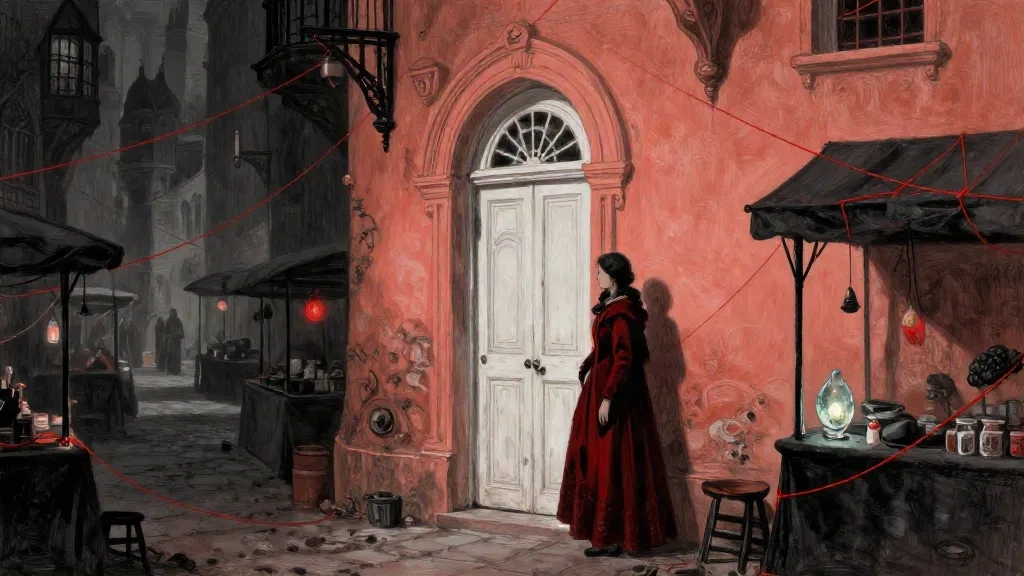
Gothic Fantasy.
The Floor Beneath the Market
At midnight, the market opened its last stair.
There was no stairway down, only a white coral arch appearing between two bakeries, its stones slick with something that smelled of rain trapped underground. Beyond it waited a long passage lit by red thread. The thread crossed every arch, every table, every polished tooth and silver spoon, vanishing beneath the feet of anyone who tried to follow it.
Seren kept her shop at the market’s lowest threshold, where the city’s second floor ended against a black wall. Above her, buildings climbed into one another. Below her, nothing existed but the market and the old supports beneath it.
She was a seamstress with a salt jar on her workbench. Customers brought her torn sleeves, split collars, the pale lining of wedding coats. She could mend the distance between two people: a glove to a hand, a name to a voice, once a boy to his mother across an argument that had lasted six years. The work left a white coral thread in her needle and a red thread across whatever she touched.
On the night the arch appeared, a man named Oren brought her two pieces of black cloth.
“Make a door,” he said. “One that opens only when both sides consent.”
The Agreement in Bone Ink
He lived above the abandoned bathhouse. His sister, Ilyra, lived below the chandler’s shop. Their father had sealed them on opposite sides of a wall and left the house to the market after his death.
“She wants to speak with me,” Oren said. “I want to hear her. I will not force the door.”
Seren spread the cloth across her table. She asked the shape of their rooms, the distance between their voices, the names they had used as children. Oren gave her none of the usual measurements. He placed a glass seed between the fabric halves.
“The late mason planted this in the mortar,” he said. “It opens once. Keep it safe.”
That night, Seren stitched a seam across the two pieces of cloth. She expected the usual resistance, the small tearing sensation that meant two people were being forced into one shape. Instead, the needle sank through a language.
Ink rose from the floorboards in narrow letters. It was neither Oren’s hand nor Seren’s. The words climbed the walls, crossed the red thread, and gathered above the salt jar.
They were written in the language of the dead: a cold, branching script that moved whenever no one looked directly at it.
Seren understood one sentence.
The village agrees that the door shall open only when both sides consent.
Below it, another sentence appeared.
The village agrees that the dead may stand in the doorway.
What the Dead Wanted
Seren called Ilyra through the market. The chandler’s daughter came with salt on her sleeves and the glass seed warm in her palm.
“Oren is above me,” Ilyra said. “I know he is. I can hear him breathing through the walls.”
“Then consent is easy.”
“Consent to what?”
Seren showed her the ink. Ilyra read the second sentence without touching it.
“The village did not agree to this,” she said. “The dead agreed for the village.”
The market contracted. White coral peeled from the arch. Somewhere beneath the floor, three slow knocks traveled through the stone. The glass seed split along a hairline seam, though no hand touched it.
Seren took the salt jar and poured a ring around her table.
“If the dead stand in the doorway, we need a witness alive enough to make them leave.”
“And if the witness opens it?”
“Then the agreement decides what enters.”
They placed the glass seed on the completed seam. Seren joined one black cloth to the other. Ilyra stood on one side of the market; Oren descended from the upper stair.
“I consent to the door,” Ilyra said.
“I consent to the door,” Oren answered.
The cloth rose. A narrow white-coral doorway opened in the wall, smelling of salt, wet stone, and flowers buried under a floor.
Beyond it stood their father.
He had consented to nothing.
The Last Stitch
Seren pulled the red thread through the doorframe. The dead man leaned closer. His face was the house remembered after demolition: shutters, nail holes, the blackened line of a roof.
“Ask us,” Ilyra said.
“Do you consent to enter?”
The dead man opened his mouth. The dead language rolled from it, branching over the glass seed.
Seren did not translate. She set the salt jar in the threshold.
Salt spilled inward.
The figure remained.
Oren took one step forward. Ilyra took one step back. The door did not close, but neither did it widen.
“Consent was never a spell,” Oren said. “It was a boundary.”
Seren understood. The village had made a door from agreement, but the dead had mistaken possession for permission. The only way to honor the agreement was to leave the threshold empty.
She cut the glass seed open.
Inside was a bead of red thread.
Seren placed it beneath the salt jar and sewed the door shut from both sides at once. Her needle passed through the cloth, the market’s red thread, and the black wall. The white coral cracked along its seam.
From within came one knock.
Then silence.
Oren and Ilyra never spoke that night. They returned to their separate floors, carrying salt on their hands and the same unresolved distance between them. In the morning, a narrow door appeared in the market wall, painted shut. Seren left it that way.
Some doors, she had learned, are not built to bring people together. They are built to keep the dead from turning every reaching hand into a welcome.





