 Netwrck
Hopeful Science Fiction.
The Tenant of Tomorrow
On the seventh floor of the Meridian Apartments, every window showed tomorrow, and no one could be trusted about it. At breakfast the boy in 704 buttered toast he had not yet eaten and set it on the sill to cool. The woman in 812 apologized at the mailboxes for a wound she would not receive until Thursday. Mrs. Venn, who ran the laundry room, sorted the morning into lavender towels and a bright plastic bag of green pharmacy receipts, and the sorting took all morning, and she did it again the next day with different receipts.
Mara lived in 611 with a brass thimble, three needles, and a door she had never opened. She was a seamstress, but not the kind who joins cloth. Her work was the other kind: she joined torn hours, mended the ragged hem of a decision somebody had begun and could not finish, closed the narrow grey gaps where two people had drifted out of the same future and did not know how to say so. A seam of blue thread cost a memory she could afford. A seam of silver cost her a dream. The tenants paid in whatever they had. The boy in 704 paid for his grandmother's house. The woman in 812 paid for a dog she had not yet buried.
She kept a ledger in the back of the thimble box, in pencil, because the ink made the entries permanent and she did not trust permanence. Eleven years. Four hundred and six seams. She had lost, by her own count, two summers, a marriage that had not happened, and the smell of her father's hands. She considered this a fair trade, though she had made the trades alone, which is the sort of thing a person only calls fair when there is nobody left to argue.
Her mother had left behind a small glass seed, clear as rain, and a salt jar with a blue lid. Beneath it, in handwriting that leaned as though it were hurrying, a note:
For the door you promise to build. Do not use salt until you understand what is being preserved.
Mara understood what was being preserved. She had understood it for eleven years. That was the difficulty. Her mother had understood it too, and had gone downstairs anyway, and had come back as the seam between the palms of a woman in wet work clothes who said You were the first when Mara asked who had taught her.
What the Agreement Preserved
The village below the city had signed its agreement three centuries ago, on a morning when the river was elsewhere. The original buildings stood where the water now ran over them, their stone rooms packed with silt, and the silt was not silt, the tenants had learned, but the slow accumulation of a village refusing to finish leaving. Every morning someone carried a sealed copy down to the apartment basement, where the dead read it aloud in a language no living person could pronounce.
The dead did not use sound. On her first morning in the basement, Mara felt the reading come up through her teeth and the soles of her feet: a grammar of absences, a sentence made of the pressure of a room that was not there. The agreement said that every child born in the village would inherit two doors. One for departure, one for return. It said that no person could close the return door alone. It said the village would remain whole only while both doors opened by mutual choice, and that the dead would hold their side of the arrangement until the living grew tired of asking.
The final clause was the one that mattered, and the final clause moved. The letters rearranged themselves whenever she looked at them directly. She copied them onto paper and got wet grey marks that spread like a bruise. When she touched the page her fingertips went numb, not cold, numb, the way a limb goes numb when it has been held still too long in one position for a very long time.
They sat at the base of the old staircase in their wet work clothes, dozens of them, sorting themselves into an order that had nothing to do with age. One had a seam between her palms, perfectly joined, blue thread gone shiny with age. Mara knew the stitch. It was hers, or her mother's, or the same one, because the stitch did not distinguish between generations; that was the whole trouble with it.
"You were the first," the dead seamstress said.
"The first to lose what I mended."
"The first to mistake distance for damage."
Mara sat down on the step, which was warm, which she chose not to think about. "I inherited a door and a jar of salt and a note that told me not to use the salt. That is not an inheritance. That is a chore with a trap in it."
The dead woman tilted her head. "Your mother said the same thing. In the same words. She was here three days and you were nine, and afterwards you would not look at the jar."
"Afterwards she was gone."
"Afterwards she was kept," said the woman, and the floor trembled, and the word the dead used for it translated itself into Mara's mouth as kept and not as lost, and she understood for the first time that the agreement was not a contract but a preservation, in the technical sense, the way a jar preserves. Something was in there. It had been put in on purpose. Her mother had helped put it in.
That was the moral of the cellar floor, and Mara walked up the stairs holding it like a hot coal: the door her mother refused to build had not been refused out of caution. It had been refused out of love, and the love had cost her the rest of her life with her daughter, and the price had been collected in full, and the collectors were downstairs, patient, well-dressed, and not yet finished.
The Pharmacist's Half
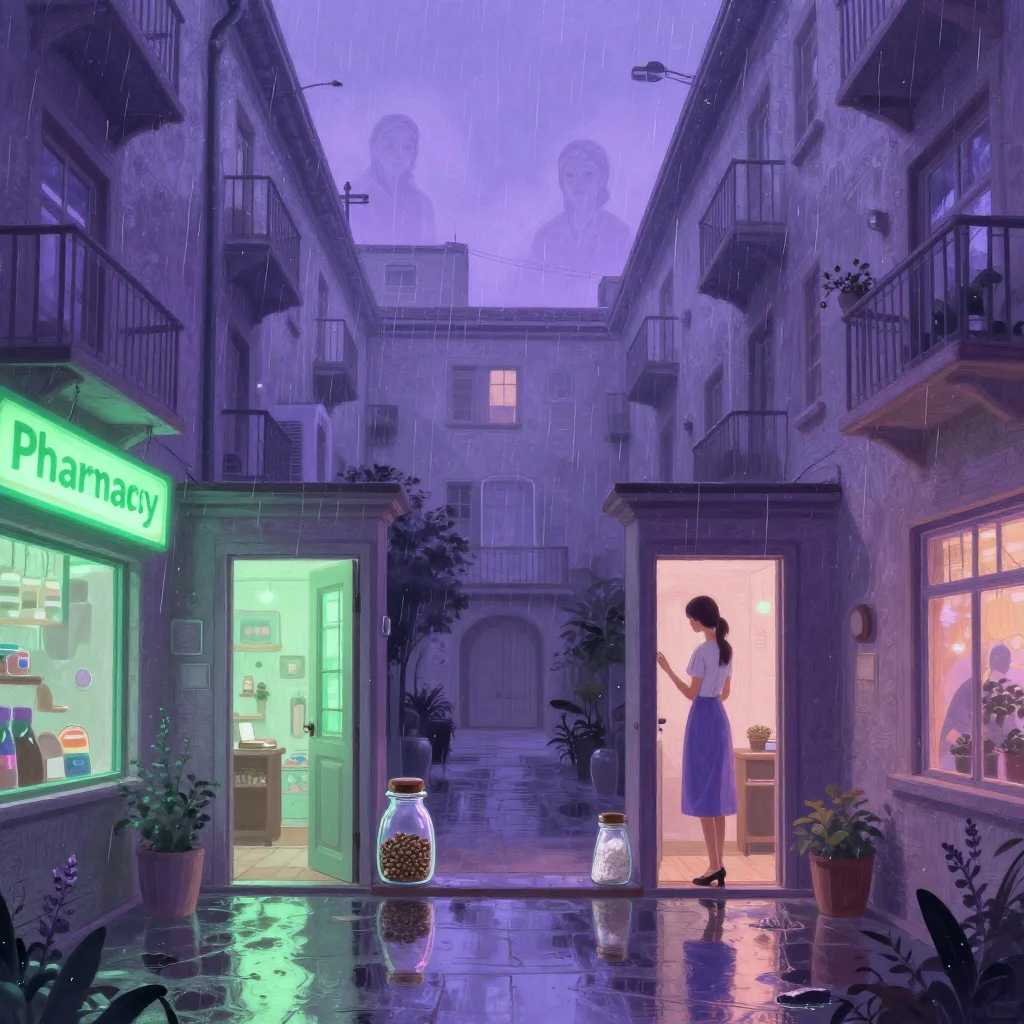
The agreement's living half was kept in the pharmacy across the avenue, under a green light that made the street look like the bottom of a swimming pool. The pharmacist was Niko. He had inherited the page from his grandmother along with the building, the ledger, and the specific knowledge that the page could not be scanned, could not be copied, and would turn every lock in the Meridian block until somebody consented to open it.
He had not inherited a conscience. He had inherited a fund. The Meridian Agreement Fund took a percentage of every tenant's rent and paid it out to whoever the agreement named, and the agreement named Niko, and for nine years he had been the only living person in the city with legal standing to be responsible for the dead. He was also, by the second year, paying for his sister's operating room. He told Mara this in the back stockroom with his back to her, moving bottles that did not need moving, so that she would have to decide whether she was looking at a liar or at a man with nowhere to put his face.
"If the door opens," he said, "the fund dissolves. The clause that names me dies with the clause that names them. You understand what dissolves means for a fund?"
"It means you stop being responsible for the dead."
"It means I stop being the only one who can afford to be responsible for anything." He set down a bottle of saline. "It means Ilsa's surgery is in eleven days."
"So you are not keeping them to feed yourself. You are keeping them because you are the only one who knows what the door costs, and you are afraid to be the one who pays."
He turned around then. He had been fourteen when his grandmother told him about the page, and he had not slept a full night since, and there was a particular tiredness around him that Mara recognized from her own mirror. "I know exactly what it costs. I have been reading it in a language I cannot speak for nine years, and every year the words move further away from me. I have never once been able to ask it a question and get an answer I could repeat to a tenant. You want me to hand that over for a door you will build out of your own mother's face."
"Yes," Mara said.
He nodded, as though she had confirmed something he had hoped. "Then we are both going to be insufferable about it."
A Grammar of Absences
She had until the last remembered sunrise, which Mrs. Venn had announced that week by pinning a notice to the laundry room with the exact number of days remaining, because Mrs. Venn believed that a deadline you could not see was a deadline you could ignore. Mara had nine days, and the last day of them was a day on which, according to the woman in 812's apology, everybody in the building would forget something small and specific and never know what it had been. Mara intended to be the exception, which was vanity, and she knew it was vanity, and she went down to the basement anyway.
Each grain of salt held a future. This was not magic in the way the tenants wanted magic, with a cause and an effect they could repeat. A grain held the outline of a thing that had not happened, and pouring it gave the basement the right to speak. She arranged the jar beneath the pipes, where the water ran hottest, and set the glass seed on top of the lid because her mother's note had not said what the seed was for and she wanted the seed where she could see it.
She poured one grain. The dead came audible, not louder, but nearer, the way a person in a dark room becomes nearer when you stop trying to see them. A sentence assembled itself out of the pressure of the floor and put itself in her mouth before she could decide whether to speak it:
Consent is not a lock. Consent is a second heartbeat.
She poured a second grain and the rest of the final clause came out in a language of pressure, eleven minutes long, and she understood about a third of it, which was enough to know she did not want the other two thirds. The clause said the return door could not be built by one pair of hands. It said the thread would be charged to the person who did not own the memory. It said, in the part she understood, that the door could not open inward only, and she thought about that for a long time afterward and never fully agreed with it.
She cut the dead woman's collar free with her smallest scissors, and stitched the missing clause onto it in silver, and silver cost a dream, and the dream that went was her mother's, and it went without ceremony, the way a coin goes into a machine. Then the thread asked for the rest.
That was not in the rules. The thread went through lavender and wet asphalt and the green reflection of Niko's sign on the wet street above, and it went looking for the memory that was being preserved, which was her mother's face, and it began to draw it out of her by the threads, from the eyes first. Mara pulled harder. The collar resisted. The dead resisted, all of them, a whole damp room of them pulling the cloth the other way with the specific patience of people who had been keeping something for three hundred years and did not intend to be asked nicely. Above them the building lost its footing in time: a wall appeared in 705 where a hallway had been all morning, a room in 602 vanished entirely, and the boy in 704 dropped his toast and stood in it with butter on his fingers, unable to remember which morning he was in.
Then Niko came down the stairs, and he did not ask. He took the other side of the cloth in both hands, which he had no right to do, and which cost him, she would learn later, everything he had been holding in place.
"I consent to the door," he said. "I do not consent to the village owning it."
"Neither do I," Mara said, and meant it in a narrower way, which is the only way a person can afford to mean anything at this scale.
They stitched together. The dead spoke the final word. The door opened inward.
The Cost of Opening
Beyond it was not a village and not a river and not a room. It was a lavender field under a wet-asphalt sky, every blade marked with the print of a foot that had not walked there yet, and the green of the pharmacy sign lay across the horizon like a seam laid over the seam. At the threshold stood the dead, carrying lamps, waiting for no one, in the correct manner of people who have been waiting a very long time and have finally stopped expecting.
Neither of them reached first. The door stayed open anyway, breathing gently, the way a held breath settles into a rhythm it can keep. Consent, it turned out, was a structure and not a spell, which meant it had weight and joists and a place where the weight was distributed, and the place was both sides, and the door did not care that they had each said not to the village owning it out loud on the stairs, like two people negotiating a lease on something neither had seen.
The fund dissolved at 6:14 in the morning. Mara felt it go through the floor the way she felt the dead reading, a subtraction. Niko stood very still with his hands still full of thread, doing arithmetic he had clearly already done. Ilsa's operating room was in eleven days. There was no fund. There was no clause naming him. There was a great many people in the building whose windows had been paying nine years of a percentage toward something they could not see, and every one of them would now find out what it had been for, and one of them would have to say the sentence to Niko before breakfast, and he would hear it, because there was nothing in the agreement any more that could soften where it landed.
She did not get her mother back. That was the price and she had known the price, and knowing it did not make the arithmetic pleasant. She could not picture the face. She could remember that there had been a face, and that it had leaned over a cot at an angle, and that she had found it beautiful, and that this last fact was now a piece of information in a ledger in a thimble box, filed next to a marriage that had not happened and the smell of her father's hands. She wrote it down in pencil anyway, because it was hers, and because the dead woman in wet work clothes came up the stairs to the landing for the first time in three centuries, and stood in the fluorescent light of the seventh floor, and said, without being asked, I kept it a while.
"Not long enough," Mara said.
"No," the woman agreed. "Long enough to be sure you were the one who would open it. Not long enough. I am sorry about that part, and I cannot do anything about it, which is the shape of my employment."
The dead left over the following eleven days. They went out through the return door in ones and twos, carrying their lamps, and as they went they gave back what had been preserved: names, mostly, and the smell of bread, and a great many small corrections to the historical record. Mrs. Venn found that her own mother had been a member of the village council and had lied about it for fifty years. The woman in 812 came home to say that she was not going to get the wound, because the Thursday in question had been un-stitched along with everything else, and then she had to sit down, because being spared is also an injury and nobody warns you about that one either.
A Future With Two Latches
Mara put the glass seed in the new soil at first light, on the far side of a door that was now just a doorframe with a lavender field in it and no way to close. It opened into a small green leaf, the plainest thing in the story, and she did not name it, because naming things is how you start owning them.
They could not put the dead back. That was the cost and it was the door's design, not its betrayal: a threshold that opens by mutual choice cannot be argued shut again by one party, and the village had chosen, and she had chosen, and Niko had chosen with his sister nine days from an operating room still hanging over him. The tenants did what tenants do. They organized. The stairwell fund became a stairwell fund, and the percentage became a percentage, and on the morning of Ilsa's surgery there were forty-one people in the hospital lobby with envelopes, and Niko counted them twice and did not say thank you, because they were not doing it for him, which he found harder than if they had been.
The windows still face the right way. That is the strange part, the part Mara will not explain to the new tenants in 611, who are not new, who are the same ones, but who now have to be taught. The windows still show tomorrow. But the boy in 704 eats his toast, and the woman in 812 keeps her Thursday, and the futures in the glass have a seam in them now, a fine blue line running the whole length of the building, and the line is a join, and a join is a thing that two people did, and every morning in the Meridian Apartments you can hear it being tested: a latch, then a latch again, never once.
Nobody opens anything alone. That is the whole of the doctrine and the whole of the cost. A door that asks its question and then waits, breathing, for as long as it takes.





