 Netwrck
Science Fiction.
The House With Two Keys
At the edge of Bellwether, where eucalyptus trees leaned over the road like tired giants, stood a museum of doors. They stood in rows beneath a vaulted roof painted the color of terracotta: red clay, red dust, red earth. Each door opened onto a different kind of courage.
Mara Venn was a village nurse. She carried a leather bag of bandages, three boiled sweets, and the small brass key every homesick house required. A house became homesick when its rooms began remembering lives that had left them. The kettle would sigh. Floorboards would whisper names. Doors would open onto bedrooms that no longer contained beds.
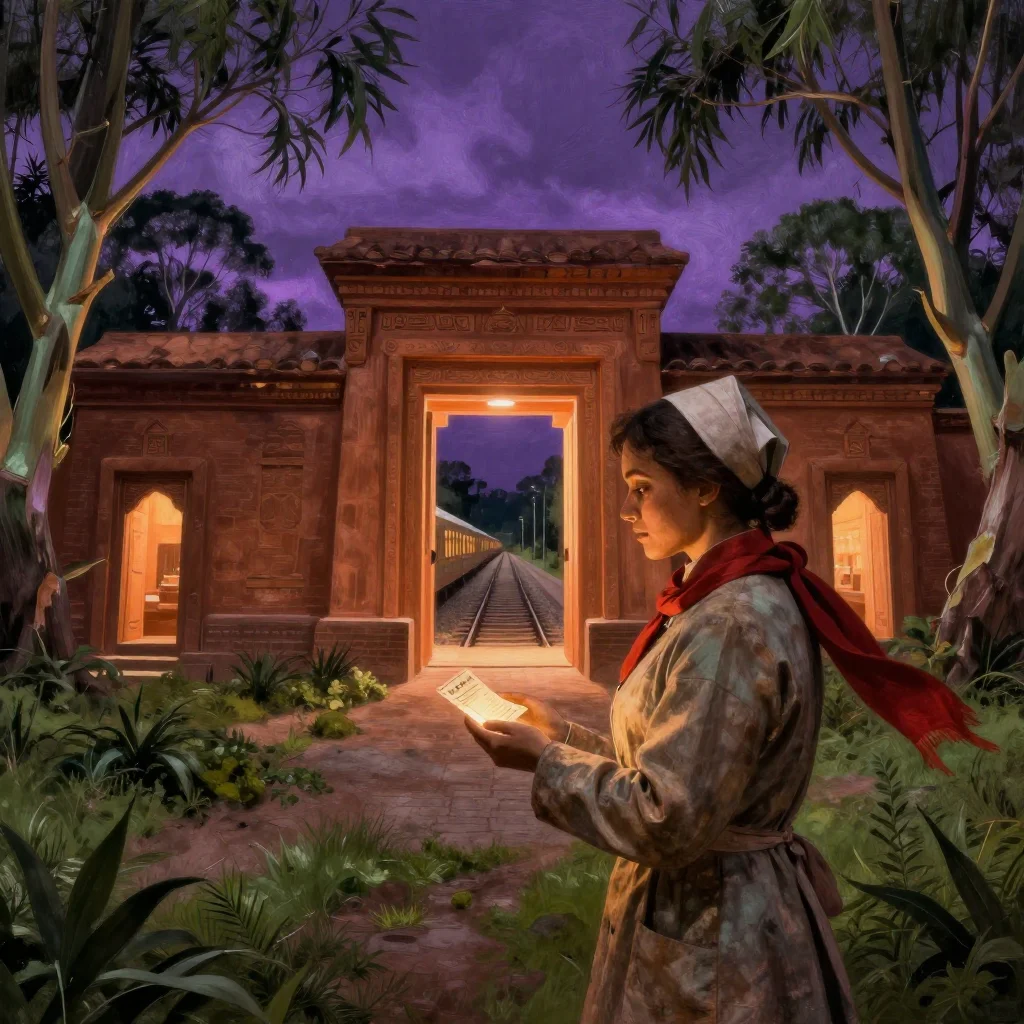
That evening, the house of her childhood stood before the museum, shivering beneath a bruised-fruit sky. Mara recognized its blue shutters and cracked porch step, though it had no business standing there. A red scarf hung from its doorknob, bright as a warning.
The Brother Who Sold the Map
Inside, her brother Tomas sat beside the cold hearth, packing a single leather case. He had returned after eleven years, which was long enough for a person to become a stranger and short enough for grief to remain unfinished.
“You are leaving again,” Mara said.
“The night train leaves at dawn.”
She held out the red scarf. “Then say what you came to say before you go.”
Tomas looked at the scarf but did not take it. “I did not come to say anything. I came to take the deed.”
“The house is not yours to sell.”
“It was never yours to forgive.”
Mara felt the old fracture open beneath her ribs. She had wanted to repair the relationship before one of its speakers left, and now the only speaker remaining was Tomas, packing his silence into a case with the efficiency of a man who had rehearsed departure.
A stationmaster entered carrying an enormous brass timetable. His hat was shaped like a railway carriage, and his mustache curled toward the floor.
“Every ending,” he announced, “is a scheduling error.”
He slapped the timetable against the wall. The house shuddered. A train whistle sounded inside the kettle.
The Door That Opened Westward
“There,” Tomas said. “You hear it? Mother is calling from the other side.”
Mara did hear it: a faint metallic rhythm, like a heartbeat traveling through rails. She crossed to the back room, where the walls were sweating eucalyptus-scented water. A door had appeared in the plaster, its paint the deep green of crushed leaves.
Beyond it lay a platform beneath the violet sky. A train waited without a locomotive, every window filled with warm amber light. The stationmaster stood aboard, checking his watch.
“All departures can be corrected,” he said. “Give me the ticket, and I will move the hour.”
Mara found the train ticket in her pocket. She had carried it since the day Tomas left, though she had told herself it belonged to a horse race. The paper had softened at the folds. On the back, in Tomas’s cramped hand, were the words: RETURN BEFORE FORGETTING.
She held it out. Tomas stared.
“You kept it?”
“I kept every impossible thing you gave me.”
Then she took the red scarf from the doorknob and tied it around his neck. “But keeping a ticket is not repair. Speak.”
The Last Carriage
The stationmaster announced that the train would leave in four minutes. Mara placed the ticket in his hand. The timetable began to shake, pages flipping backward, erasing stations, appointments, years.
“If I change the ending,” he warned, “the journey remains.”
“Then let the journey begin with the truth.”
Tomas looked at her. “I did not sell the house. I sold the idea that I could stay. Father made me leave. I hated you because you were the one he kept.”
“I knew,” Mara said.
“You never came after me.”
“You never let me.”
The stationmaster’s whistle screamed. Tomas gripped the scarf, not to silence her, but to prove it was warm. The museum doors rattled. On every threshold, courage appeared: blue courage, quiet courage, the courage to remain, the courage to leave without turning away.
At dawn, Tomas put the train ticket into Mara’s hand. “I am staying,” he said. “But I am taking the train to the eastern village. There is a house there whose west wall has forgotten how to stand.”
Mara smiled. It was not forgiveness. It was a repaired beginning, which was the only kind the future could use.





