 Netwrck
Fairy-Tale Fiction.
The Tenth Floor of Tomorrow
On the tenth floor of the Bellweather Apartments, memory was installed upside down.
Mrs. Ilyan remembered the rain that had not fallen, the argument she would have with her sister in nine years, and the precise blue of a coat she would lose in winter. She did not remember her childhood, her wedding, or the names of the dead.
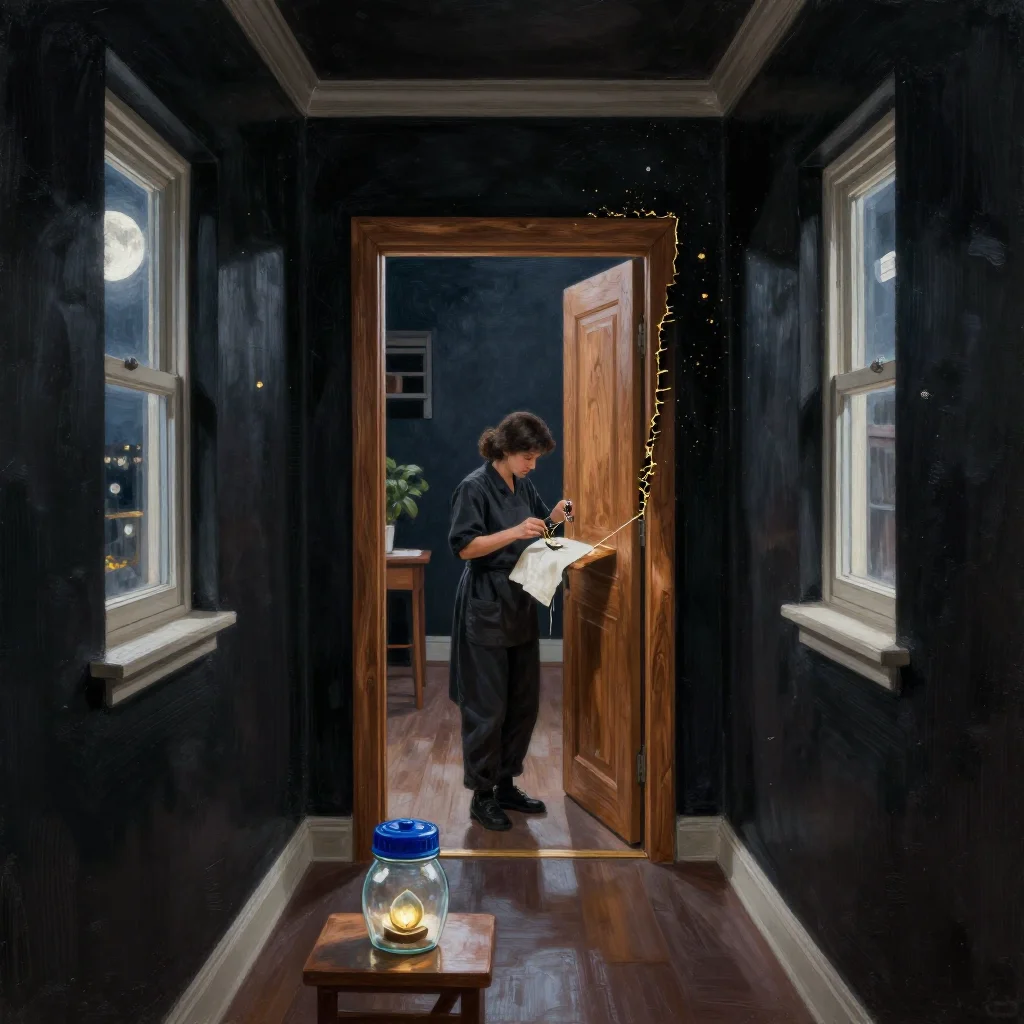
The seamstress lived in apartment 10-C. Her name was Anja Venn, and she worked by thread, needle, and a small pair of silver shears that could cut only what two people agreed to release.
Her shop occupied a room where the windows looked inward. Black lacquer covered the furniture. Gold dust rested in the seams of the floorboards. At night, cold moonlight entered through the walls as if the building had forgotten which side was outside.
On Anja's table stood a salt jar with a blue-glass lid and, beside it, a glass seed no larger than a grain of rice.
“You have a seam,” said the landlord, tapping his chest.
“You have a tomorrow you dislike.”
“Then we understand each other.”
Anja nodded. The landlord had remembered that she would refuse to sign the agreement in the basement. He had not remembered why.
The Distance Between Two Doors
Her commission came from apartments 10-A and 10-F, separated by four walls and thirteen years.
In 10-A lived Eron, who remembered every day he would spend alone. In 10-F lived Mera, who remembered the day she would leave the building and never return. Neither could remember the other. Both believed the other had already gone.
They wanted a door between their homes.
“A door is a promise with hinges,” Anja told them. “It must know who is asking and who is being asked. If one person pulls alone, the distance opens and swallows the other.”
She began with a strip of black cloth. Along its edge she stitched two gold threads, one from Eron's sleeve and one from Mera's hem. The glass seed she placed inside the seam. It glowed faintly whenever either neighbor approached the wall.
“What about the agreement?” Mera asked.
Anja pointed to a paper sealed inside the wall. “Your building already has one.”
It had appeared beneath the plaster that morning. Dense lines covered it in a language none of the living could read. The salt jar trembled when Anja held it near the paper.
What the Dead Could Sign
The janitor said the agreement was old. Older than the Bellweather Apartments, older than the city, perhaps older than the first person to build a wall between strangers.
Anja found a translation in the cemetery ledger, written by a dead clerk in letters that vanished when daylight touched them. It said:
No passage shall be opened by one will alone. The traveler must offer a future freely received, and the keeper must offer a future freely surrendered. If either offering is counterfeit, the door shall remain shut.
“That is impossible,” Eron said. “We do not know which futures we are giving.”
“Then we must make a present offer,” Anja said.
She mended the distance first, drawing the two doorframes together with white thread. The seam resisted. Each tug made both neighbors forget one another a little more. Eron could no longer recall Mera's voice. Mera forgot the sound of Eron knocking.
Anja cut the threads.
The glass seed cracked.
She poured salt around it until the floor became white as a winter road. Then she placed the seed in the center of the unfinished door and waited for the dead language to choose a living reader.
Both Sides of the Wood
At midnight, the paper began to bleed.
Letters rose from it and drifted through the rooms like black snow. They entered the ears of the living but changed them into memory.
Everyone in the building remembered everyone else.
Eron remembered that Mera had once forgiven him before either of them knew what forgiveness cost. Mera remembered that Eron had waited outside her door during the future storm, when he believed she would never speak to him again.
They came to the wall together.
Anja stitched their hands into the seam without knotting the thread. She opened the salt jar and offered each of them a pinch.
“Consent is not a lock,” she said. “It is a road kept open by two feet.”
Eron and Mera each placed salt on the glass seed. The crack healed. The black lacquer softened. Gold dust rose from the floor and settled along a line that had once been only distance.
The paper clicked.
The dead language had found its living witnesses.
The new door remained blank: no handle, no key, no visible difference between wood and wall. But when either neighbor asked permission, the other could hear the question in tomorrow's voice.
Sometimes the answer was yes. Sometimes it was no.
Only after both voices had spoken did the seam open.
Anja placed the glass seed in her pocket. It had grown into a tiny, dark star. Behind her, the old agreement folded itself shut.
By morning, everyone in the building remembered the future as a thing shared rather than stolen. In apartment 10-C, a thin line of moonlight rested on the floor.
Anja mended the distance between it and the sun, and waited for the door to be chosen.





