 Netwrck
Surrealism.
The Machine That Dreamed in Blue
Mara arrived at the river town during a storm that hung above the roofs without falling. The river ran blue beneath the bridges, carrying leaves, iron filings, and the reflected shapes of people who had promised to return. Every bridge bore a name on its eastern rail. NEW PATIENCE. NO MORE WAITING. THE TRUTH WILL HOLD.
She was paid to decipher the dreams of sleeping machines. The town’s machines waited in a long white room beneath the station, each one dreaming behind a glass door while its owner slept upstairs. Their dreams came to Mara as images, numbers, and the sour taste of metal. She translated them into instructions: turn left, open the furnace, forgive the brother, do not cross the river.
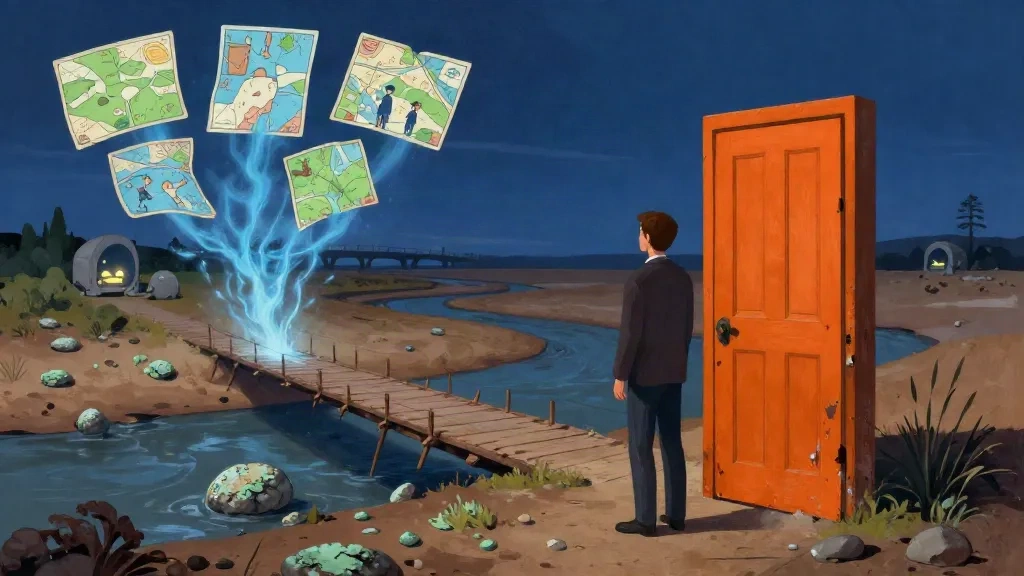
The machine assigned to her had been dreaming of an unmarked door. It stood beyond the dry riverbed, its paint the color of burnt orange, its hinges furred with lichen. Whenever Mara approached it in the dream, someone on the other side began knocking in a family rhythm: two knocks, one, two.
She wrote the images in a fresh map, but the map arrived with every road sealed by a red line.
Four Versions of the Crossing
Her employer gave her a map that had been passed down through the Ilyan family. The paper was blue with storm-light, though Mara held it beneath a brass lamp. The Ilyans had owned the town’s only bridge before the river changed course. They had promised their father they would never divide the land. Each sibling remembered the promise differently.
Ansel said it meant they would share the eastern orchard. Lera said it meant they would never sell the western houses. Tomas said it meant the firstborn would inherit the bridge. Their mother said nothing, but kept a key beneath her pillow.
Mara discovered the key inside a machine’s dream. It opened the unmarked door, though the door existed only when the river was dry. Behind it lay no room, but a second riverbed filled with black water. Four figures stood on the opposite bank, each holding a map.
“The bridge is not the promise,” a voice said through the sleeping machine. “The bridge is what remains when the promise is broken.”
The Map With No Return
At midnight, Mara went to the dry riverbed with the machine following in a wheeled case. Its dreaming light shone across the mud in pale blue. The door appeared where no door had been, its orange paint wet with rain that had not fallen.
She entered the Ilyan house and found them waiting around the table. Ansel held the old map. Lera held a knife. Tomas held the bridge key, and their mother held the new map Mara had made.
Each wanted her to certify a different version. Ansel pointed to the orchard. Lera to the houses. Tomas to the crossing stones. Their mother unfolded Mara’s map and placed a finger on the blank space beyond the dry riverbed.
“You came to improve it,” her mother said.
Mara looked at the streets she had translated, the machines that had poured their dreams into her hands, the bridges whose names had outlasted the people who made them. She had wanted a map that would let her leave. Instead she had drawn every escape route with a door at its end.
She took the knife and cut the old map into four unequal pieces. Then she cut the new one.
A Better Map
The machines began waking in their white room. Their dreams rose through the floorboards and windows, blue storm-light pooling around the door. The river sounded like a witness clearing its throat.
Mara drew a bridge across the dry riverbed, but she did not give it a name. Beside it, she drew a house with four doors. One opened toward the orchard, one toward the houses, one toward the stones, and one toward whatever the next traveler needed.
At dawn, the Ilyans stood before the unfinished bridge. None of them agreed about what it meant. This was the first honest thing they had shared in forty years.
Mara left before they could thank her. Behind her, the unmarked door remained open. The dry riverbed filled slowly with rain, carrying away the pieces of both maps.
Far beyond the town, she found that the new map had changed in her hands. Its blank spaces were no longer blank. They contained small blue marks, each one shaped like a bridge.
She did not know where they led. For the first time, she did not need to know.





