 Netwrck
Mystery.
The Weather Keeper
On rainy mornings, Elian Vey climbed the lighthouse above the botanical garden and recorded weather that had never touched the city. He wrote in ink-blue ink: glass rain, falling upward. Sleet with the taste of salt. Thunder passing through a closed room. The observatory was not a lighthouse in the ordinary sense. Its lamp pointed at other skies, and its keeper measured the distances between them.
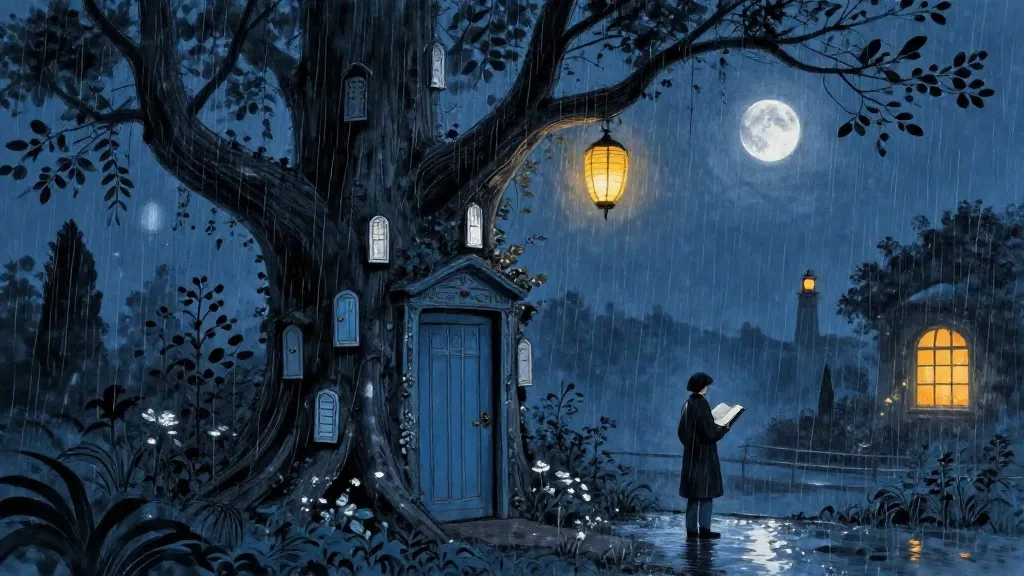
Below the tower, the garden grew around a black-barked tree whose branches bore doors. Tiny brass doors. Greenhouse doors. One enormous door sealed with a strip of municipal paper. Elian had catalogued forty-seven of them, though the tree produced more whenever nobody was looking.
That morning, the small moon hanging over the eastern beds had dimmed to a thumbnail. Beside it hung the paper lantern Mara had carried during the last warm season. It was still lit, though no flame showed inside it.
“Mara,” Elian said.
The garden did not answer. A spade leaned against the tree. The rain clicked on the leaves. Somewhere below, a municipal cart rattled over the stone path.
The Ordinance of Impossible Things
The city had passed a law forbidding impossible things. They were not banned from existing, only from being recognized. The ordinance defined a perfect blue sky indoors, a door appearing where no wall had been, and the sudden absence of a person as municipal nuisances. Every occurrence required a report. Every report ended with the same sentence: Please confirm that nothing unusual has happened.
Elian found Mara’s name on the notice board beneath the garden gate. Someone had crossed it out with a silver pencil. Her name was also missing from the keeper’s weather book, the gate register, and the little brass plaque nailed to the lantern.
He opened his observatory ledger and found a new entry in handwriting he did not recognize.
Tomorrow, the collective forgetting begins with the person who leaves the most doors closed.
Elian tore out the page. The paper was already becoming blank.
He went to the tree. The smallest door was no taller than a child and painted the deep blue of a storm. Its knob was warm. When he turned it, he heard a city he had never visited ask for directions in Mara’s voice.
A Room Made of Rain
The door opened onto a garden under a weather system belonging to another world. Rain fell in straight lines, silver against ink-blue walls. Lanterns floated above the hedges, each containing a small moon.
“You are late,” Mara said.
She stood beside the tree, perfectly visible, though her shadow had been cut from the ground. Elian reached for her. His hand passed through smoke.
“You were forgotten,” he said.
“Not forgotten. Removed.” She pointed beyond the garden. Hundreds of doors stood open in the dark. People walked between them carrying objects from their homes, unable to remember where those objects came from. “The city is making itself orderly. Anything that cannot be proved is declared illegal. Then it is taken away.”
Elian looked at the ledger page in his hand. The ordinance’s loophole was there, hidden in the weather: a thing could be impossible if it was recorded as atmospheric.
He wrote Mara’s name in the ledger, then added a description of the room: rain without gravity, warm lantern, one amber window.
The silver rain stopped.
The Amber Window
Across the garden, one window glowed amber. It belonged to no building. The small moon brightened, and the paper lantern snapped taut in the wind.
Elian read the entry aloud. Mara’s name shook in the air. Every open door slammed shut except the one beneath the tree. The garden’s false sky filled with thunder, and municipal bells began ringing from the city below.
“If you record me, they will record the door too,” Mara said.
“Then I record the weather first.”
He entered the final detail: A storm crossing from one world to another, carrying a keeper, a lost woman, and a paper lantern through an impossible door.
The ordinance had no category for a storm. The garden doors began opening in sequence, each revealing a different sky. The law’s silver pencil skidded across the notice board, unable to cross out what everyone could now see.
At dawn, Mara stood beside Elian on the lighthouse balcony. Behind them, the botanical garden shone with wet leaves and impossible distance. The small moon had vanished from the eastern beds, but the paper lantern burned gold above the tree.
Elian opened his ledger to the latest page. Under weather observed today, he wrote one line:
One person remembered.
Below it, in rain-silver handwriting, Mara added another:
The door remains open for anyone who brings a true name.





