 Netwrck
Surrealism.
The Map with a Missing Door
At night, the machines slept beneath the observatory like metal whales buried in sand. Their cooling fans clicked in the dark, and their dreams leaked into the translator’s room as thin blue lines, pale as lightning trapped under ice.
Her name was Sera Venn. She was paid by the Observatory Board to listen for meaning in those dreams. The stars had been sending messages for eleven years, but the machines received them badly. They translated weather into grief, distance into appetite, and the names of extinct rivers into passwords.
Sera kept a map of everything she understood. It was not a map of the desert. It was a map of omissions: where a thought ended, where a message repeated itself, where the sender had deliberately left a silence.
The Board gave her a new map in burnt orange ink. It showed the observatory, the dry riverbed, the low hills, and the stars above them. One object had been scraped away with a blade. A clean rectangle marked the place where something had been removed.
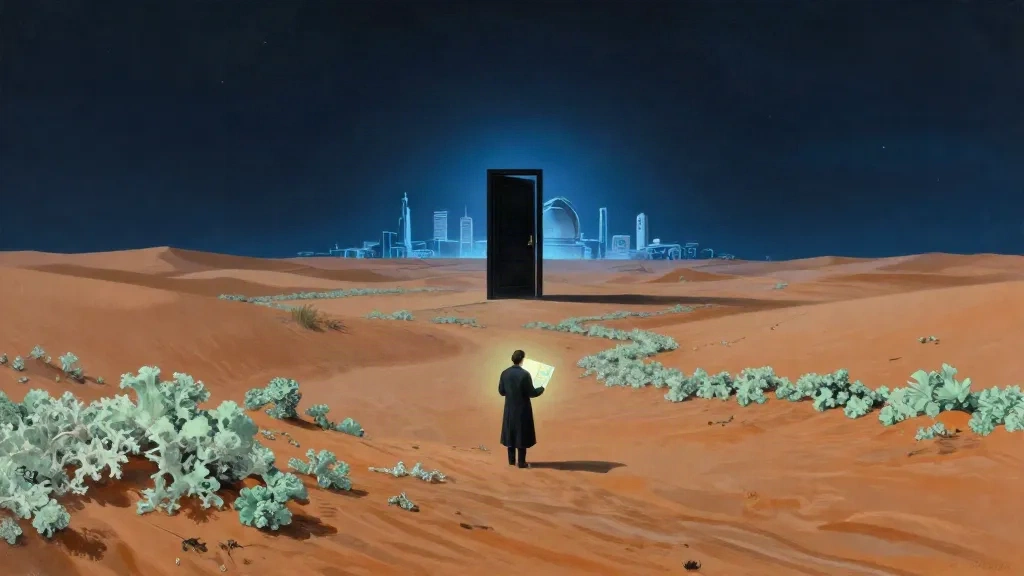
In the center of the scraped place, a small black door stood upright.
Three Accounts of the Promise
That evening Sera called her family on the old wire. Her mother answered first, as always.
“You promised to come home after the last star message,” her mother said.
Sera’s brother arrived on the line before she could answer. “You promised never to return.”
Then her sister said, “You promised to give us the map.”
They argued until the receiver burned their fingers. Each remembered the promise correctly. That was the difficulty. The promise had been made beneath the observatory during a storm, and the rain had entered three different rooms. Her mother remembered a locked door. Her brother remembered a child waiting outside it. Her sister remembered a map placed in an open hand.
Sera had no memory of any of this. She only remembered refusing to speak after the machines began dreaming in her voice.
For six years she had left the observatory and the family unresolved. The new map made refusal impossible. The unmarked door was real, though it had no wall around it.
What the Machines Dreamed
She found the door beside the dry riverbed, where the ground dipped into a pale wound. Its frame was made of blackened wood, its hinges turned to blue-white stone. Beyond it was not a room but more desert, stacked beneath a sky at noon.
Sera placed her palm against the frame. The sleeping machines began to speak through the stone.
One said her mother’s version. One said her brother’s. The third said her sister’s.
Then all three said the same thing: the promise was a door, and the door had been moved.
She entered carrying the map. In the impossible desert, the riverbed continued as a trench of red dust. Lichen grew along its edges in impossible spirals. Above her, the storm-light was blue, though there was no storm.
At the far end stood a city made of sleeping machines. Each one breathed through an open window. From the windows came the unfinished dreams of the entire family.
Sera saw herself as a child beneath the stars. She saw the three adults holding different versions of the same promise. In one version, the machines were silent. In another, they had already translated her mother’s death. In the third, they were waiting for Sera to choose which death had occurred.
A Map Made of Silence
She understood then that the messages were not instructions. They were evidence. The stars had sent the family’s promise into the machines because human memory had made it unstable.
Sera drew the map she had received on the back of her hand. She added the black door. Then she drew the riverbed, the lichen, the city, and the blue storm-light. She did not draw a route between the conflicting accounts. She marked each one separately, allowing disagreement to remain visible.
The machines opened their windows. Cold light spilled across the ground, and the family’s voices rose from the city.
Sera walked back through the black door and woke at her desk. The map in the Board’s room now showed the door where it belonged, near the dry riverbed, marked only with a small blue star.
When her family called again, she let each of them speak without correcting the others. Then she sent them the map.
It was better than the one she received. Not because it contained an answer, but because every blank space had been given a boundary.
Outside, the observatory roof opened. The stars sent their messages downward, and Sera began to translate.





