 Netwrck
Science Fiction.
What the Tide Returned
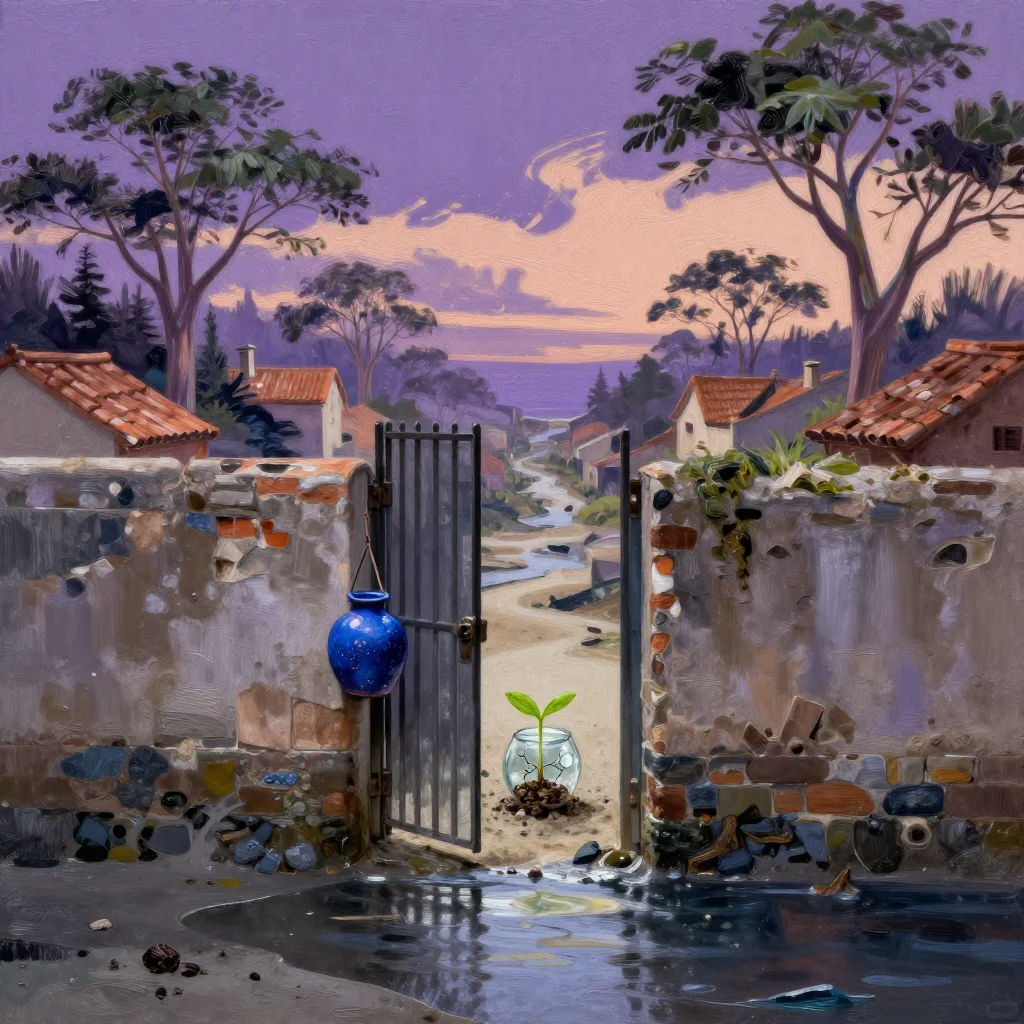
At low water, the harbor of Oru revealed its old streets beneath the silt. Terracotta roof tiles lay in rows like broken scales. Eucalyptus leaves clung to drowned doorframes, silver on their undersides. Above them, the sky bruised violet and apricot, each evening threatening to split open.
Mara kept her seamstress shop above the seawall. She mended sails, curtains, and the little wool coats children outgrew between one breath and the next. But her true work was stranger. She could mend the distance between two people: take a quarrelling mother's silence, stitch it thin, and make the son across the room remember her name.
That morning, the tide brought her a salt jar.
It was blue clay, sealed with a stopper of black wax. No shell or weed clung to it. It had not belonged to any house in living memory. Mara found the second object beneath the boatyard winch: a glass seed, clear as a lens, with a dark seedling coiled inside it.
Both objects were warm from the water.
The Agreement Below the Pier
The villagers recognized the salt jar first. Old Nera crossed herself and told Mara it had been carried by the first settlement, the people erased from every map before her grandmother was born. That night, a dead language began to appear along the seawall.
Not carved. Spoken.
Each wave left a sentence in the wet dark, and the words sounded through the stone beneath Mara's feet. She could not understand them. Nera could not either. Only the drowned could read them, said the old woman, because only the drowned had signed.
At the end of the pier stood a door in the sea wall where no door had been. It was narrow, iron, and green with rust. The tide rose to its handle and fell away. The glass seed pulsed in Mara's pocket.
“Build a door that opens only when both sides consent,” the village said through three generations of coughing children.
“A door between what?”
“The living and the dead.”
Mara looked at the salt jar. The dead were asking for a threshold. The living, she understood, were being asked to surrender the right to open it alone.
The Seam of Consent
She cut cloth from her finest linen and worked by lamplight. The first stitch joined a word in the dead language to her own breath. The second asked permission from the living side. The third waited.
The door rejected her.
On the third night, the tide returned a child's shoe, a brass thimble, and a wedding ring blackened with salt. Each object carried another clause. The dead could not enter unless the living freely opened. The living could not leave unless the dead freely released them. Consent had to be spoken aloud on both sides at the same moment.
But the dead had no mouths. The living had no patience. The sea began taking the objects back.
Mara climbed into the drowned street and listened. In the water, the lost settlement's language moved through bones, shells, and empty rooms. It said: We forgive you. We cannot forget you.
She understood then that consent was not permission. It was relationship. A door did not open because one side had won. It opened because neither side could remain whole alone.
Both Sides of the Threshold
At the next low tide, Mara hung the salt jar on the door's handle and placed the glass seed in its lock. She called the living villagers to the pier. Behind the rust, something vast shifted in the water.
“Say what you release,” Mara said.
“Our claim to the drowned,” Nera whispered.
Others followed. A child said, “My fear of the sea.” A man said, “My mother's last words.” One by one, the living surrendered what had kept the dead outside and themselves locked within.
Then the dead language rose through the door.
Mara placed both palms against the iron. On the other side, cold fingers touched the seams from within.
“Say what you release,” she called.
The answer came in a voice assembled from every drowned room: “Our right to return alone.”
The glass seed split open. A green shoot rose through the lock, and the door opened a finger's width.
Light passed through. Not sunlight. The pale, mineral glow of deep water.
Mara did not step aside. The living did not force it. The dead did not rush.
At dawn, the door remained open exactly as wide as their joined breath. The tide came in, lifted the salt jar, and set it gently on the threshold. The glass seed had become a small tree, its leaves shaped like hands.
No one called it a miracle. In Oru, a miracle was merely a repair that had learned to respect the living.





