 Netwrck
Gothic Fantasy.
The Door in the Salt
Every tide returned one forgotten object to Bellweather.
At dawn, the sea gave back a child's shoe, a wedding ring, a silver button, a key black with age. The objects appeared along the chalk-white coral cliffs, steaming beneath the returning sun, and the villagers carried them home without speaking of where they had been.
Maren Vey kept a seamstress shop on the harbor road. She mended sails, shrouds, mourning clothes, and the small tears that opened in the space between two people. Her needles were needles, but her stitches crossed more than cloth. A seam repaired with three careful passes could shorten a quarrel. Five could make a stranger remember your name.
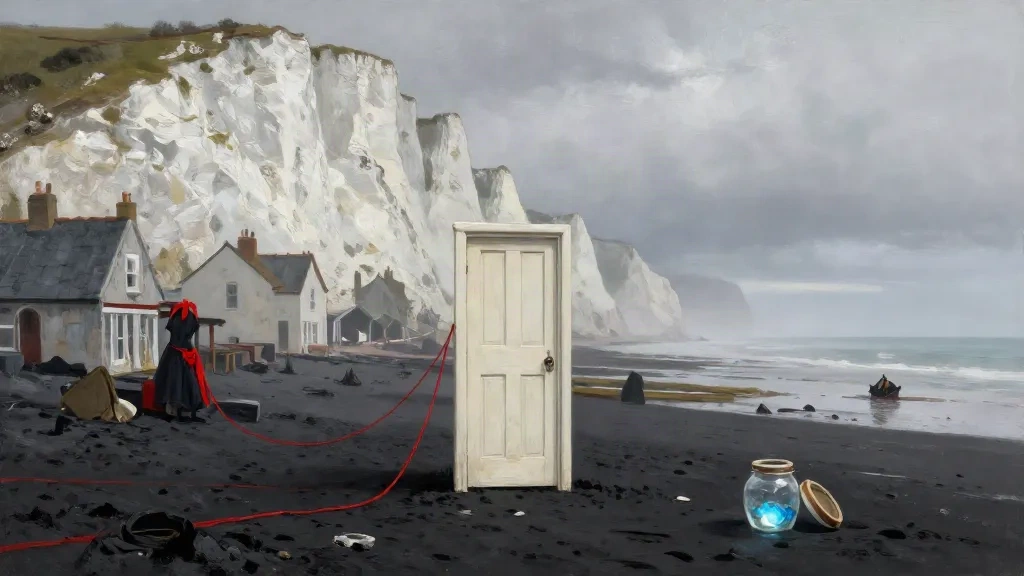
On the morning the door appeared, a salt jar stood on Maren's worktable. It had no lid, and inside it a single glass seed shone with blue fire.
The jar had belonged to her mother, who had vanished during the winter storm nine years before. Maren had never been able to throw it away.
The door was below the old church, in a passage the sea uncovered twice each month. It stood upright in the black sand, its hinges silver, its panels pale as bone. There was no handle on Maren's side. There was no handle on the other.
She knew what she wanted: to mend the door so it opened only when both sides consented.
The Agreement Below
The village met beneath the church. Mayor Orsolan placed the village agreement on the table. It was written on strips of hide in a language none of them could read, though every child had learned to recognize the letters in dreams.
“It binds us,” Orsolan said. “The living may not cross until the dead consent.”
The dead had no voice in Bellweather. They had names scratched into the cliff, bells lowered into the harbor, and rooms kept exactly as they were left. Yet the agreement ended with a sentence in red thread, stitched so tightly the letters looked like wounds.
Maren brought the glass seed. The sea had returned it that morning, along with the door.
When she held it over the agreement, the hide became warm. The dead language rose in her mind, each word arriving with the smell of salt and extinguished candles. She read:
What is brought back may be returned only by mutual wish. No door shall open for desire alone. No life shall be exchanged for memory. Let the one who sews the threshold bind both hands, and let both names answer.
“Then we need two people,” said Orsolan.
“We need two people who can speak for both sides,” Maren replied.
The village turned toward the sea.
What the Tide Owes
They brought everyone who had lost someone to the tide. Women carried the names of drowned fishermen. Children held the initials of sisters lost in fog. Old men brought locks, combs, and letters never sent.
No one could stand on both sides of the door. The living gathered on the shore. The dead answered only through the objects the sea returned.
Maren laid her red thread across the threshold. She stitched the salt jar's rim to the door's lower hinge. The glass seed she placed inside the lock, where no key could reach.
The tide rose.
Objects slid from every pocket: a mother's hair ribbon, a soldier's belt buckle, a map drawn by a dead child. They struck the door. It shuddered but did not open.
Then the glass seed cracked.
Light poured through the fracture, carrying voices. Maren heard her mother say her name. Behind the door, someone else answered: the voice of the girl who had left Bellweather nine years ago and never returned.
Maren's hands shook. She could open the door. She could demand an answer.
But the agreement required consent, and the dead had offered only a voice.
The Mended Distance
She cut the red thread. The door shuddered open a finger's width, flooding the passage with black water.
“I consent to hear you,” Maren said.
“I do not consent to open,” came the voice from inside.
For one breath, the sea went silent.
Then Maren placed her palm against the door. On the other side, unseen, another palm answered.
The stitch held.
At dawn, the door was gone. The passage filled with sand, and the village agreement lay curled in Maren's apron, its final sentence no longer written in red thread but in two pale salt marks.
The salt jar remained on her table. The glass seed remained whole.
From then on, Bellweather returned fewer things. The sea had learned what the living meant when they said no.
Maren kept sewing. When two people stood on opposite sides of a quarrel, she asked them each to hold one end of the cloth. She never pulled first.
Some doors opened. Some remained closed.
Both were honored.





