 Netwrck
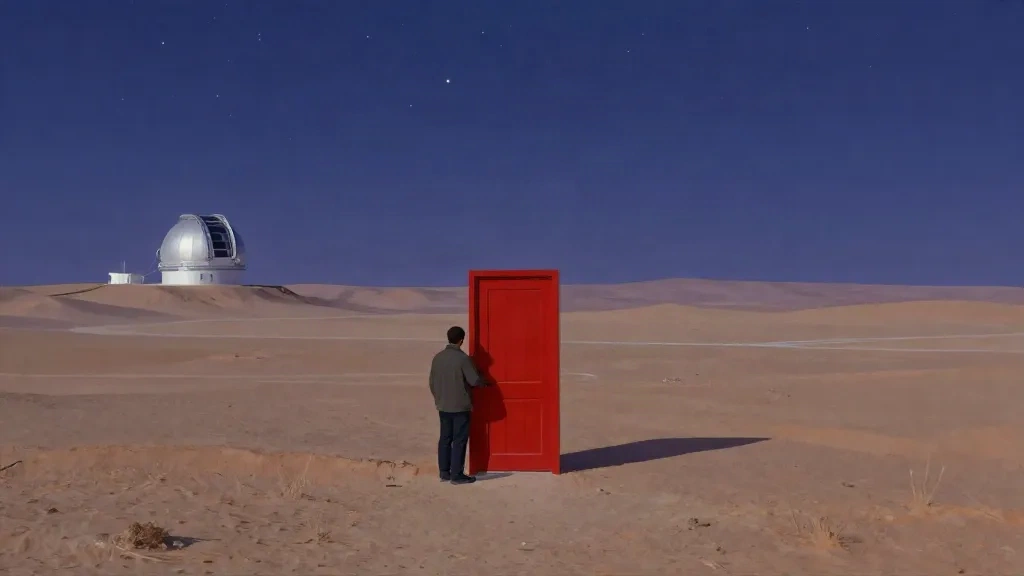
Magical Realism.
The Night Watch
At the edge of the desert, where the mountains looked like folded pieces of iron, Nara kept an observatory for stars that sent messages. From the roof she watched the dishes turn beneath the pearl sky, their silver bowls gathering light from distances no telescope could name.
Below them, the machines slept in rows beneath the floor. They were long, black machines built to listen to dust, wind, and the faint electrical singing of stone. During daylight they stood silent. At night they dreamed.
Nara was paid to translate those dreams. The Observatory Board considered understanding an economic matter, like finding ore beneath a mountain. She sat between the machines with three pencils behind her ear, a bowl of bitter tea, and a sheet of paper thick as sailcloth.
Her desire was simple, though she never said so aloud: to leave behind a better map than the one she had received.
The map in her desk drawer showed only roads, wells, weather stations, and the dry riverbed that cut southward for two hundred miles before disappearing into salt. It marked where things were, but not what they meant. Nara wanted a map that included the promises people made without realizing they had made them.
The Wrong Memory
At 2:17 each morning, the machine named Oru-9 began dreaming in a language of blue sparks.
Nara translated the pattern first as a field, then as a road, then as a family seated around an unmarked door. The machine sent back the number seven, a child's shoe, and a red line beneath a black sky.
She reported the message to the Board, but the following night Oru-9 repeated it with one change: a different person sat behind the door.
Nara had never seen the door in the observatory, though she had dreamed of it as a child. It was the same door in every dream: narrow, wooden, red, set into a wall that did not belong to any house. Her mother had promised not to open it until her father returned. Her brother had promised to open it once he came back. Her father had promised to burn it.
Each promise was different. Each had survived the years by becoming less clear.
Nara climbed down from the roof and crossed the observatory compound. The dry riverbed lay beyond the last antenna, a pale wound through the ground. She walked there with the machine's blue pattern glowing on her paper.
At its center stood the red door.
It had no walls around it, no hinges, no threshold. When Nara touched it, the wood was warm. On the other side she heard machines breathing.
What the Machines Kept
She did not open the door. Instead she asked Oru-9 to translate the sound beyond it.
The answer arrived in the form of a family. Not images, exactly, but pressures against the machine's sleeping parts: a mother's hand on a latch, a brother pushing the door inward, a father holding a match above the frame. The memories collided. None of them agreed on the promise.
Then the machine gave her the missing piece.
The family had not promised to open the door, or burn it, or wait for anyone. They had promised to return to the riverbed after the flood. The flood had come. The river had changed course. The house had burned. In the confusion, each person had preserved only the shape of the promise and lost its meaning.
Nara understood then why the stars sent messages. They were not speaking to the sky. They were speaking to whatever had forgotten how to answer.
She returned to the observatory and drew a new map. It showed the dry riverbed, the red door, the sleeping machines, and the places where memory had split from intention. She drew arrows between them, not claiming they were roads, but marking where a person might begin again.
At dawn, the machines fell silent. Oru-9 opened one metal eye.
A Better Map
It sent a final pattern: a red door opening onto the same desert, but with three figures standing on the opposite bank.
Nara waited for them to cross. They did not. One raised a hand. The others kept walking.
She folded the map and placed it where the old one had been. Then she went down to the riverbed, carrying a red pencil.
The door waited beside the salt. Behind it, the machines dreamed in their endless rooms. Above it, the stars continued their slow transmission.
Nara opened the map to the blank space and wrote one line:
A promise is not remembered. It is returned.
Then she began drawing the next route.





