 Netwrck
Mystery.
The Tree That Opened Rooms
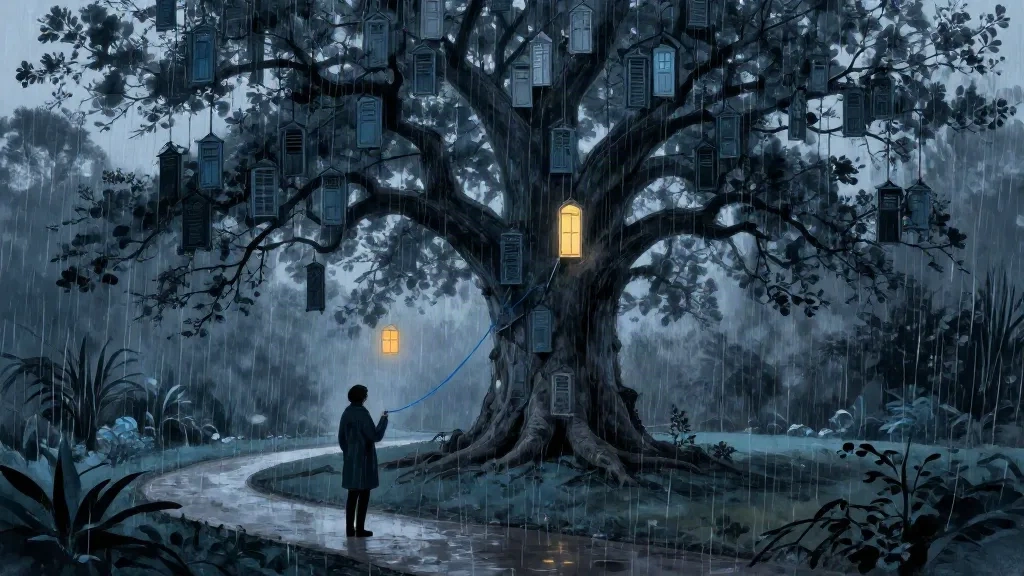
Mara Venn blew glass beside the eastern wall of Orison Botanical Garden, where an ancient tree grew doors instead of leaves. Its trunk was black bark silvered by rain, and from its branches hung hundreds of thresholds: narrow red doors for kitchens on frozen moons, green doors for gardens where weather behaved, blue doors for rooms occupied by people who had forgotten their own names.
The tree disliked sentiment. It opened only when visitors presented a practical reason.
Mara had presented hers for six years: to make windows for rooms in other worlds. Her glass was clear, thin, and stubborn. She shaped panes that did not merely separate inside from outside, but let each place keep what it needed. A window could hold a summer inside a winter palace or let rain fall upward through a scholar’s study. The garden hired her because no one else could make glass remember both directions.
That morning, Mara had watched the sun rise over the glasshouse roofs, warmed her palms against a cup of bitter tea, and heard her neighbor divide a pear into seven exact pieces. An ordinary morning. Nothing in it deserved a story.
By noon, the morning was gone.
The Safe Footpath
She found its absence first in the light. The garden had not dimmed, yet every object seemed slightly misplaced, as though the day had been carefully rearranged while she was looking elsewhere.
A gardener told her the trail to the missing morning lay beyond the fern house. He drew a blue thread around his thumb as he spoke. “Follow the path where the moss is brightest. Do not ask questions. Questions make the trees nervous.”
Mara followed the thread.
At the first fork, she asked why the path was marked with broken blue string. The gardener’s expression emptied. “Because the last person who asked reached the wrong morning.”
Then he told her the truth: the path had swallowed three mornings. A fourth was trapped beneath the root cellar.
The trail became clearer.
Mara nearly laughed. A clear trail should mean safety, but the clarity arrived with a second set of footprints beside hers. They matched her stride exactly.
At the second fork, a child sat beneath a paper lantern. He offered her a silver bell. “If you ring this, the road will hide you from itself.”
“Who took the morning?” Mara asked.
“The room behind the unmarked door.”
He then smiled and added, “Nothing was taken. Nothing is missing. That is the official version.”
The path brightened. Mara realized the danger: truth opened the way, but only a lie made it safe. The tree rewarded her for surrendering precision. Every admission narrowed the trail. Every convenient denial widened it.
The Unmarked Door
At the root cellar stood a plain wooden door with no handle, hinge, or frame. A blue thread vanished beneath it.
Mara touched the wood. Somewhere beyond it, glass chimed.
“I want my morning back,” she said.
The door warmed beneath her palm.
“I do not care whose morning it is,” she added, and the warmth vanished.
On the third attempt she told the truth without decoration. “I want the ordinary morning I lost. I want the pear, the tea, and the seven pieces. I want to know who took them.”
The door opened.
Inside stood a small room lit by one warm amber window. A table had been set for one. A cup of tea steamed beside a sliced pear. Rain silver crawled down the glass. Beyond the window, an unfamiliar city slept beneath an unfamiliar moon.
On the table rested a ledger. The garden had not stolen the morning. It had filed it. Each time someone preferred safety over accuracy, the tree moved that person’s morning into a room where no one could challenge the arrangement.
Mara found her own name. Beside it: Witness required. Morning may be released only by admitting the lie that sealed it.
She understood then that the unmarked door belonged to every person who had lied to the garden and forgotten why.
What the Morning Kept
The ledger turned its pages. Mara’s handwriting appeared beneath the title Ordinary Hours Reclassified as Property. She had signed the order six years earlier, when the tree first offered her work. She had told herself she was being practical: the rooms beyond the doors needed windows more than she needed explanations.
But the truth was smaller and uglier. She had wanted the job badly enough to let the garden call certain rooms empty when they were not.
Mara took the blue thread and tied it around the ledger’s spine. Then she spoke clearly, for the tree and for herself.
“I was afraid that honest work would be judged insufficient. I lied so the garden would value my glass more than my fear. That lie took my morning and made the path easier for others to walk.”
Every door in the room opened at once. The borrowed mornings poured through them: a child’s birthday, a soldier’s last goodbye, a woman’s quiet cup of tea. They returned to their owners like birds startled from a roof.
Only Mara’s morning remained.
She placed the ledger in the amber window. Its pages caught fire without heat. The window opened, and the ordinary morning entered the garden like rain returning to a cloud.
By evening, Mara sat beside the tree with a fresh pear, a warm cup, and no explanation for why she was crying. The blue thread lay loose in her palm. Behind her, the unmarked door had vanished.
At dawn, she shaped a window for the tree itself. It was clear, rain-silvered, and warm with one amber pane.
The garden asked what it was for.
“So nothing can be taken without someone seeing where it went,” Mara said.
The tree gave her a door in return. She left it unmarked.





