 Netwrck
Magical Realism.
The Sleeping Room
At the edge of the desert, where the mountains turned the color of old iron, the observatory kept one room below ground for machines that slept. They arrived by freight cart, wrapped in wool against the sand, with cooling pipes trailing behind them like roots.
My name is Nera Venn. I am paid to translate their dreams.
Technically, the machines did not dream. They emitted pressure waves, light, static, small arrangements of dust. But after I connected the receiver to their memory cores, the signals became scenes: a woman walking through a field of blue glass; a child counting teeth in a desert storm; an ocean folded into a drawer.
Every morning I sent my translations to the astronomers. Every afternoon I drew a map of the sky. I had been born receiving one, a thin vellum chart marked with constellations, roads, wells, and a black line ending at an unmarked door.
My father had called it the inherited map. My mother had called it the apology.
I wanted to leave behind something better. Not because the old map was ugly, but because every blank space had been made to look like an answer.
A Door Without a Number
On the forty-seventh night, the central machine began sending the same dream.
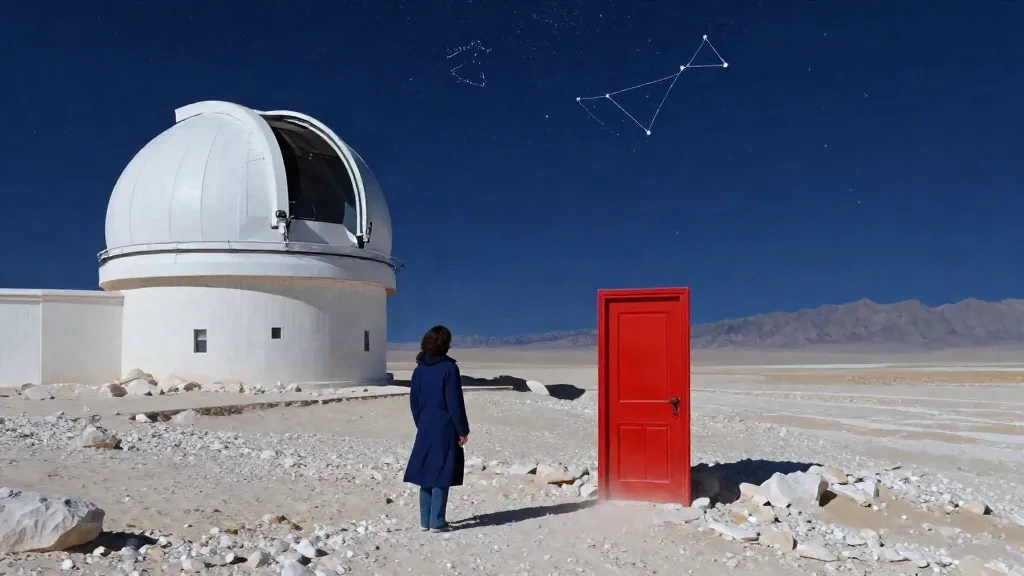
The dream was a dry riverbed. A red door stood upright in the middle of it, bright as a cut in the earth. The door had no handle, no hinges, and no number. People approached it from different directions: my father walking backward, my mother carrying a bucket of black sand, my brother holding the door open with both hands.
When I woke the machine, it emitted one more image: a constellation shaped like a sleeping animal, with the red door at its heart.
I crossed the observatory courtyard and found a door in the eastern wall. It was painted red, but the paint had cracked into fine scales. There was no handle.
My sister, Ada, saw me touching it.
“You found it,” she said.
“Found what?”
“The way out.”
She was nine years younger and had spent her childhood hearing the same family argument from behind closed doors. She believed our father had promised to open the red door. Our mother believed he had promised never to. Our brother believed the promise was that one of us would return.
“The map says nothing,” I said.
“The map was made after the promise,” Ada replied. “That is how promises become borders.”
The Versions We Carried
We walked to the dry riverbed before dawn. The path had been there for years, though rain never reached it. Stones lay in white rows along the banks, each one warm beneath my palm.
Ada took the western side. I took the east. At the center, the red door appeared in the riverbed, exactly as it had in the machine's dream.
Behind us, the observatory's receiver began to sing.
Not a melody. A sentence, slowly assembling itself from the stars overhead. The astronomers had spent generations naming what arrived from that darkness, but the sleeping machines received it first. They knew the difference between a warning and a request.
“Father said we would never open it,” Ada said.
“Mother said she would burn it.”
“Brother said he promised to shut it.”
I placed my hand on the red paint. It was warm. Under it, something knocked in the rhythm of a sleeping heart.
Then the machines answered. One after another, from the observatory below, their dreams rose through the desert air. The stars appeared not as points but as letters, too large to fit inside the sky.
They were not asking us to choose the correct memory. They were asking us to stop making the promise speak for us.
The Map Returned
The red door opened inward, though there was no room behind it. Through the opening I saw the entire desert at once, pale under a midnight-blue sky. Every abandoned settlement, every buried road, every well filled with stars. The inherited map lay on the ground at my feet, except its blank places had become true.
I took out my pencil and drew what I saw.
Ada helped me mark the riverbed. Beyond it, the path bent toward a village not on any chart. Somewhere there, people were sleeping beside machines, hearing the messages in their dreams.
The door closed when the sun reached the horizon.
I did not know whether the machines had sent us a map, or whether we had merely learned to read the one already beneath our feet. The distinction seemed less important than the promise it asked us to keep: not a promise made for one person, but a road left open for all of them.
By evening, I had pinned my new map inside the sleeping room. Beside it, the red door waited in the desert, perfectly still, while the stars continued their slow translation.





