 Netwrck
Surrealism.
The Map with a Wrong Edge
Every bridge in Veyra carried a promise carved beneath its railing: to arrive, to return, to remember, to forgive. Every river was a witness. The river did not speak, but stones remembered the names of those who had crossed, and on wet mornings the names rose in pale letters along the banks.
Translator Ilyan Voss was paid to decipher the dreams of sleeping machines. The machines occupied a long brick building behind the municipal orchard, their iron bodies arranged in rows beneath blue storm-light. By day, they repaired clocks, balanced ledgers, and dreamed of weather. By night, they produced images that had no waking cause.
Ilyan wanted one thing: to leave behind a better map than the one received.
His map was a folded sheet of waterproof cloth inherited from his mother. It showed Veyra as it had been thirty years earlier, before the river shifted, before three bridges collapsed into polite ruins, before the orchards filled with machines that dreamed of fields they had never seen. Along its margins, his mother had written one instruction:
Do not trust a road that asks nothing of you.
He wanted to correct the missing streets, the vanished footpaths, the places where promises had been broken. He wanted the new map to be useful, exact, and free of his family’s corrections.
Iron Sleep
On the third night, one machine dreamed of an unmarked door.
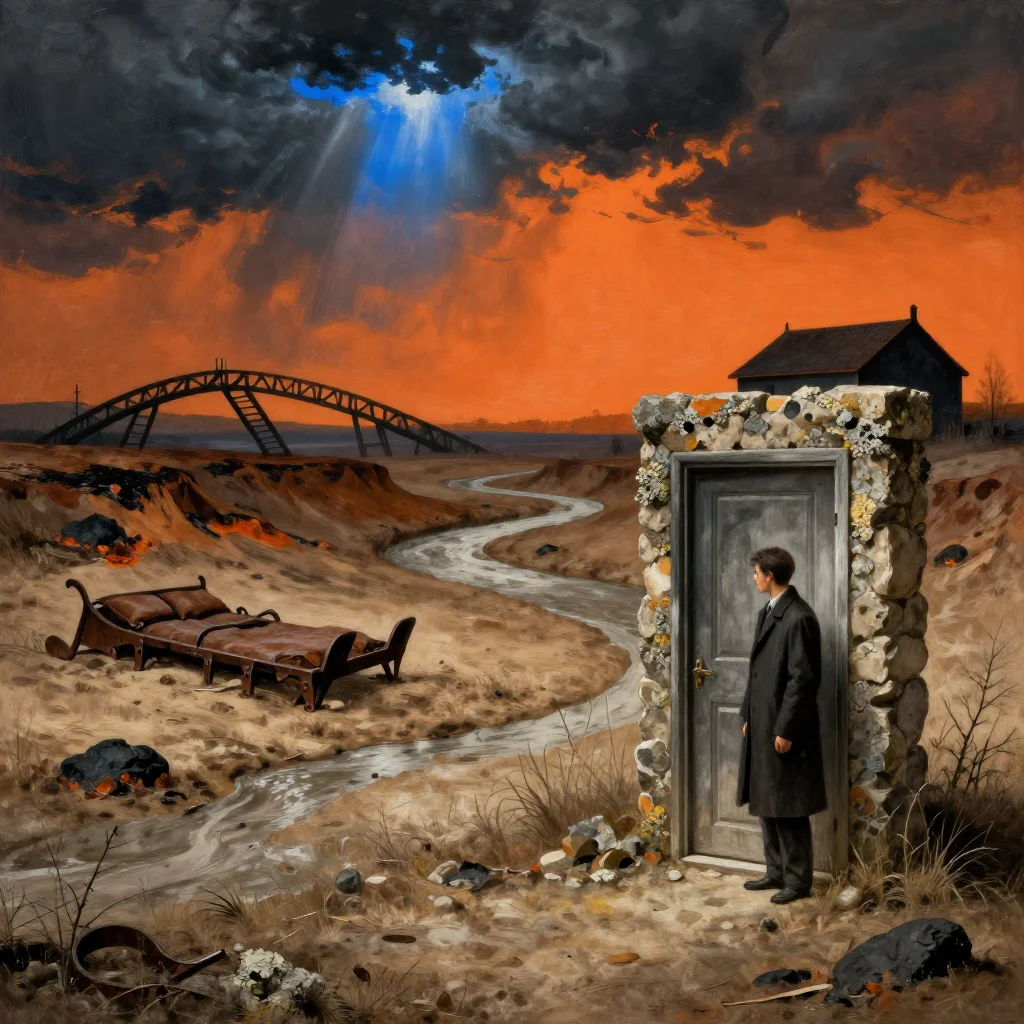
It stood in a dry riverbed beneath a burnt-orange sky. The river had withdrawn for a mile, exposing pale roots and the skeletons of small boats. The door had no hinges, handle, or number. Around it stood four people, each carrying a different piece of the same bridge.
Ilyan translated the first image into coordinates. A road behind the tannery. A culvert filled with blue water. A house where the front wall had been painted over.
He expected the machine to produce another image. Instead, it made a sound like a hinge turning in a house with no walls.
“The family,” he said.
The machine’s dream unfolded.
A brother remembered the promise as a roof. Their father had promised to build a roof over the eastern quarter when the river flooded. A sister remembered it as a bell, ringing whenever anyone in the family lied. Their mother remembered it as a boat. The boat was supposed to return with bread, medicine, and the missing brother’s body.
Each memory was accurate in its own light. Each made the others a lie.
Ilyan copied every version onto separate sheets. By dawn, his desk was covered with maps of the same nonexistent street.
The Unmarked Door
He found the door behind the painted wall, where the machine had placed it: beneath a burst of lichen, between the river’s old channel and the wall of a warehouse. The wall had been bricked over before Ilyan was born.
He could have left the map unfinished. Instead, he removed the bricks.
Behind them was a room no larger than a telephone booth. The floor was dry. A strip of storm-blue light entered through the ceiling. In the center stood a low stone table covered with brass keys, none of them marked.
On the table lay a letter from his mother.
Ilyan, it began. You will hear that your father broke his promise. Your aunt will say he refused to build the roof. Your cousin will say the river took the bridge. I will say he built it badly. None of us can agree because the promise was never completed. That is the family disease: unfinished things become different finished things.
Ilyan turned the letter over. On the back was a map made in his mother’s hand. The dry riverbed. The door. A path continuing east beneath a mountain that did not exist on any official survey.
His better map, she had written beneath it, is the one that admits what is missing.
What the River Witnessed
The family arrived before sunset.
His brother came from the roof district, carrying a ladder. His sister brought the bell. His cousin came with the salvaged ribs of the old bridge. None of them trusted the others, but all of them had received Ilyan’s summons.
“You found the door,” his brother said.
“I found the disagreement.”
The river stirred below the embankment. Though the channel was dry above it, water moved beneath the stones, rising toward the door with the patience of a witness remembering a trial.
His sister struck the bell. It made no sound.
His cousin fitted the bridge ribs together. They formed a frame around the unmarked door.
His brother climbed the ladder and placed a slate roof over the old riverbed.
“That is not a promise,” Ilyan said. “That is a shelter.”
“It is what we can build now,” his brother replied.
Ilyan stood beneath the burnt-orange sky, lichen climbing the warehouse wall, blue storm-light gathering over the hills. He understood that the family had not mistaken the promise. They had mistaken its tense.
They had spent years asking what the past had failed to build. The river, having witnessed the crossing, did not forgive the family. It continued.
Ilyan drew the new map on the back of his mother’s map. He marked the dry riverbed, the unmarked door, the roof, the silent bell, and the bridge ribs standing crookedly above the water. He left the eastern passage blank.
Blank did not mean absent. It meant the road had not yet been promised.
The Better Map
At dawn, the sleeping machines opened their iron eyes. Their dreams had changed. One dreamed of a roof filled with swallows. One dreamed of a bell moving underwater. One dreamed of a door opening onto a city where every map ended in a person.
Ilyan translated the last image first.
Beyond the door was not a place. It was a choice repeated each morning: to say only what could be proven, or to draw a line through the uncertainty and continue.
He copied the machine’s dream onto the new map. Then he placed his mother’s old map beneath it, allowing both edges to remain visible.
The maps did not agree. They no longer needed to.
Outside, the river began its slow return, dark water threading the dry stones. A bridge emerged first as a line of silver, then as a burden the town could cross.
No one could say which promise had been restored. The family met at the unmarked door each evening, bringing different tools, telling different stories. Their quarrels rose into the storm-light. The river kept them in its moving pages.
Ilyan’s map was better because it no longer pretended the past had one shape. It showed the missing roads, the family’s separate claims, and the places where someone had chosen to begin again.
On its final blank space, he wrote a small symbol: a bridge viewed from below, its reflection trembling in water that had not yet arrived.





