 Netwrck
Magical Realism.
The Sleeping Machines
Mara earned her living in the basement of the abandoned Meridian Cinema, where the projection booth still hummed after midnight. The machines had been built to sort human dreams, but since the building closed, their dreams had begun to wander. They whispered through ventilation ducts, rearranged tickets into constellations, and left tiny pools of warm light on the dusty floor.
Her employer paid her by the dream. She listened with a copper earpiece pressed to the machines’ cold housings, then translated their images into ordinary language. A burning staircase meant fear of inherited debts. A train carrying wet soil meant someone was preparing to leave. A red balloon in a blue room meant a child had been promised forgiveness.
Mara had a private desire, never spoken aloud: before the machines finally stopped dreaming, she would leave behind a better map. The one she had received from her mother was useless. It showed only roads that ended at childhood houses, rivers crossed by bridges that no longer existed, and a small star marking the place where Mara had been born.
The Film That Had Not Happened
On the last night of the month, the largest machine showed her a future that almost happened.
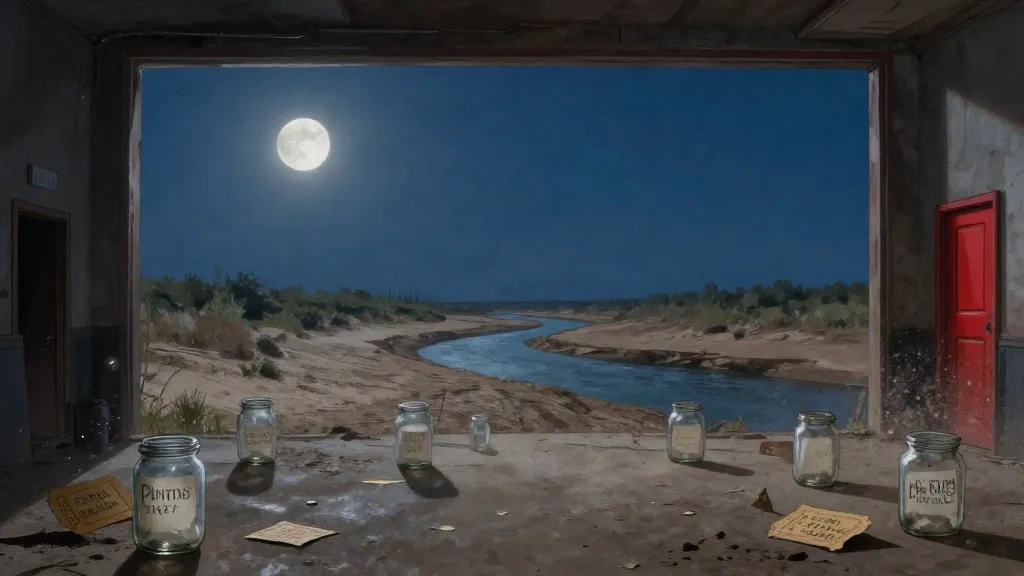
The screen illuminated with a ballroom beneath a midnight-blue sky. Every guest wore pearls. At the center of the floor stood a red door, impossibly vivid against the darkness. Beyond it, a dry riverbed stretched toward a silver horizon. People crossed it carrying glass jars filled with unspoken promises.
When Mara translated the dream, the machine spoke in her brother’s voice.
“Tell them I kept it,” he said.
She had no brother. She did have a family, however, and they had not spoken together in seven years. Her mother remembered promising to sell the old house and divide the money three ways. Her father remembered promising to keep the house for the grandchildren. Mara remembered promising to leave first, before the promise could become another argument.
The machine repeated the words in three different voices. Each voice placed the promise in a different year, beside a different river.
The Unmarked Door
Mara followed the dream into the projection booth. The film continued behind the equipment, though no projector was running. An unmarked door appeared where the emergency exit had been. She opened it and found a corridor filled with dry leaves.
At the end stood her family, separated by the dry riverbed. Her mother held a deed. Her father held a map. Mara held a red key, though she had never seen it before.
“We agreed,” her mother said.
“You agreed to stay,” her father replied.
“I agreed to return,” Mara heard herself say.
The riverbed cracked. Beneath it, the cinema’s abandoned screens flickered with futures: the house sold and empty, the house repaired and crowded, Mara boarding a night train alone, her mother waiting beside the red door. Each future insisted it was the promise, and each made the others look like lies.
Mara stepped into the riverbed. The machines’ whispers rose around her, thousands of dreams insisting that memory was only a map drawn by the living.
A Better Map
She understood then that translation was not choosing between meanings. It was carrying all of them without pretending they agreed.
Mara drew on the back of the deed, using her mother’s red key as a ruler. She marked the house. She marked the river. She marked the places where the three promises had diverged, and left them visible instead of smoothing them into a single road. The red door received no label. It remained a door, and therefore an honest destination.
When she returned to the booth, the screen had gone dark. The machines were silent. In the morning, workers found the Meridian Cinema unlocked, its floor covered with pale dust except for one clean path leading to the exit.
Mara kept the new map folded in her coat. It was not a guide to where her family would go. It was proof that they had all been lost in different directions, and that a route could remain useful even when it led nowhere else.





