 Netwrck
Mythic Fiction.
The Season Workshop
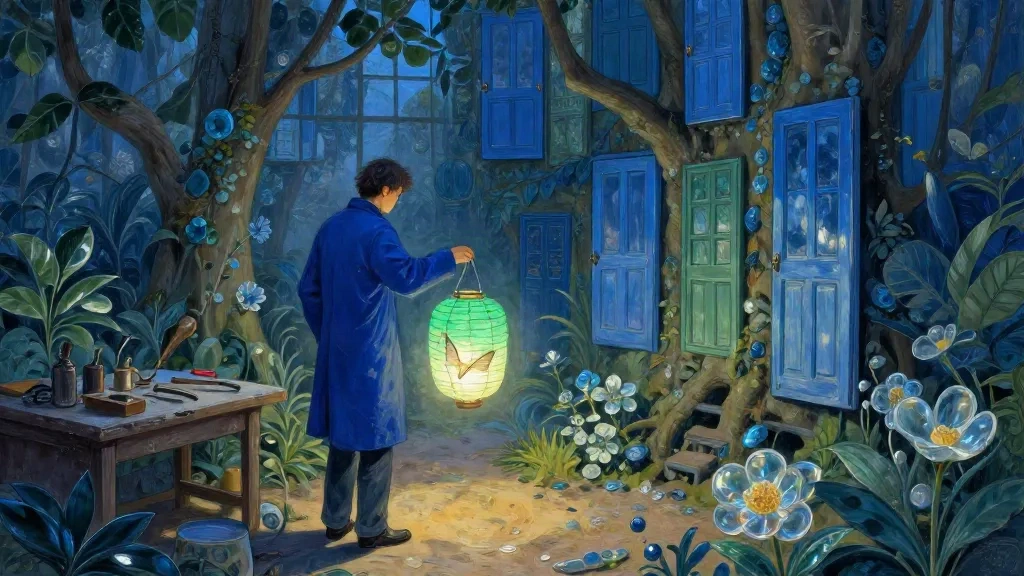
At the center of the garden stood a tree with a trunk the color of wet bark and leaves like small green flames. Doors opened in it at dusk: narrow doors, wide doors, doors with brass handles, doors sealed by frost. The watchmaker, Nera, kept her workshop beneath the eastern wall, where she made clocks for seasons rather than hours.
Her clocks were delicate things. A spring clock opened only when the first blossom released pollen. An autumn clock stopped whenever a leaf chose the ground. Winter divided its hours by the length of shadows. She wound each one with silver thread and a drop of bitter water, listening for the hidden spring inside.
That morning, the garden gave her a paper lantern.
It hung from a branch without string, its surface washed in sea-glass green. One wing of a pale moth had been pasted beneath the paper. The wing glowed softly, and when Nera held the lantern close, she heard a season she could not remember.
Inside the lantern was a memory: a woman drawing a door on the bark of the tree, then opening it with a moth wing. The woman wore a blue coat. Her face was hidden, but her hands were familiar. Nera knew them from her own childhood, though the woman had died before Nera was born.
The lantern had belonged to the garden’s maker. Nera had been entrusted with returning it, and with returning the wing to the door from which it had been torn.
The Choir Under the Leaves
When she entered the garden, the trees began to sing.
Not in one voice. The leaves carried memories: the maker laughing over a broken kettle, children hiding beneath the roots, rain soaking a coat that had once been blue. Their interests disagreed. Some wanted the lantern opened. Some wanted it burned. Some insisted the door had never existed.
“She made us,” whispered the leaves. “She left us here.”
“She left us hungry,” answered the roots.
“She made the door,” said a chorus of seeds. “The door made the garden.”
Nera tightened her grip on the lantern. The moth wing trembled against the paper. She followed the sound of the blue-coated memory through the trees, passing beds of glass flowers and a pond filled with sand. Doors opened as she passed, but each revealed only another garden.
At the far wall she found the maker’s workbench beneath cobalt shadow. Tools rested on it: a hammer shaped like a root, a needle filled with moonlight, and a small bronze key darkened by age. No maker waited there.
The choir rose from every plant. Voices pressed against one another. The garden wanted the lantern back, but the lantern wanted to return. The memory inside it wanted to remain. Even the moth wing wanted to fly, though it belonged to neither whole nor wing.
The Door That Refused to Open
Nera set the lantern on the workbench and placed the key in its lock-shaped hollow. The blue shadow deepened. Through it she saw the maker—not as a memory, but as an old woman bent beneath a paper tree.
“You kept my seasons,” the maker said.
“I kept them in time.”
“Time is a door.”
The woman reached for the lantern. Her hand passed through it.
“I cannot take it back,” Nera said. “It remembers leaving.”
“Then return what I made.”
Nera opened the lantern. The moth wing came free in a burst of pale dust. The memory poured out of it and became a blue shadow between them. The garden’s voices stopped.
The maker’s eyes closed. “I wanted the wing to cross the seasons,” she whispered. “I wanted to find the way home.”
Nera understood then that the lost thing was not the lantern. It was the maker’s way back, folded into a wing and carried past the winter door.
The Hour Beyond Winter
Nera placed the wing in the maker’s palm. The bronze key turned by itself. A door appeared in the workbench’s shadow, not in the tree. Through it came the smell of rain, blue wool, and a distant room.
The maker stepped toward it. The garden sang again, but softly. Its memories no longer argued. They had become a single sound, the sound of roots remembering water.
Before entering, the maker looked back. “What will you keep?”
Nera lifted her season clocks. “The hours after you leave.”
The maker smiled and crossed the threshold. The door closed behind her.
At dawn, the moth wing was gone, and the paper lantern had become plain. Nera wound a new clock for the garden. It opened its hands not to spring, but to the quiet afterward: the hour when a lost thing has found its maker and the world no longer needs to search.





