 Netwrck
Mystery.
The Last Performance
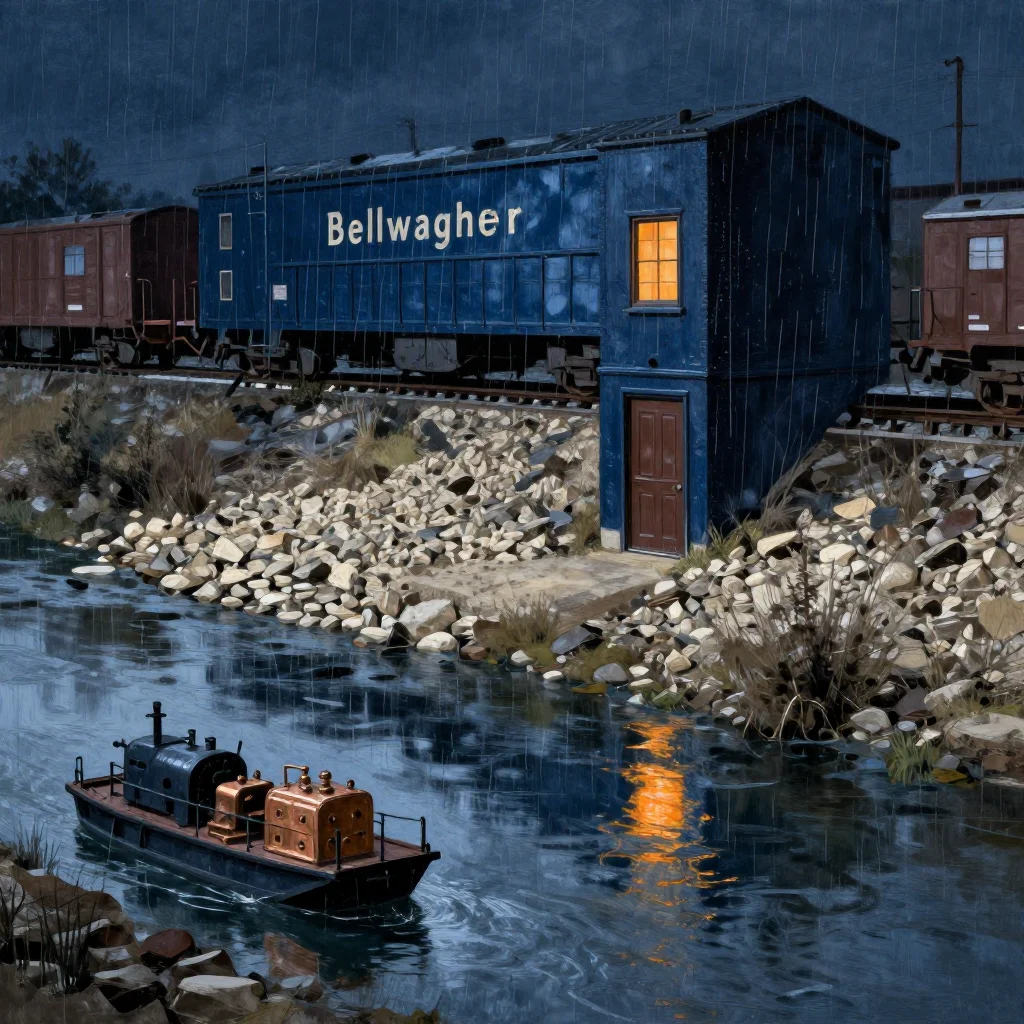
At the Bellweather, the theatre sat behind the abandoned freight yards, where rain silvered the rails and the only warm light came from a single amber window in the stage manager’s booth. Every night the company performed an ending discarded by tomorrow. Tonight’s card, printed on the same grey stock for eleven years, read: The Dry River Keeps a Copy.
Irena arrived an hour before the actors with her translation case, a black box lined with copper coils and blank paper. She had been deciphering sleeping machines for eleven years: presses that dreamed in pressure, navigation cores that dreamed in vectors, one defunct weather station that still spoke, nightly, of a blue sky over a town the maps had never admitted to. Her gift was tolerance for languages that did not care whether anyone understood them. Her injury, and she understood it as an injury, was that she could not be careless in a room. A careless translator becomes a collaborator.
The Bellweather’s fee was nine hundred and a coach ticket back east. Clause seven of the engagement, which she had read aloud to the company secretary on the telephone and to herself in the carriage, was the one that kept her turning the brass lock on her case under the booth window: the translator shall deliver a single map of the company’s property, together with her certification that all impressions received from the machine are fictional. They had paid half on arrival. The rest waited on the map.
She disliked maps that admitted ignorance. Her mother had been a clerk in a map room for thirty years, the kind of room with no windows and one rule posted above the door: leave the blanks blank. On the last afternoon Irena sat with her, she had said, in a voice already going flat at the edges, don’t draw what’s missing, Irena, you’ll only make it a place where someone could get lost. Eleven years later Irena could not reconstruct the sentence. She could remember everything around it: the hum of the fluorescent tube, the smell of the coffee, the pattern of her mother’s cardigan. The words were gone, and she had built a career out of the fact that other people’s missing words were recoverable.
“You’re early,” said Ansel Rovik, the stage manager, from the booth window, “and the board is early, so we’ll do this now.” He came down the stairs with two tin mugs and the stiff, unhurried gait of a man who has spent forty years not being noticed. He had been at the Bellweather since he was nine years old. He set out the paper, the survey, and a pen that had belonged to the founder.
“Clause seven,” he said.
“Clause seven.”
“Then you know we can’t use anything it gives you that isn’t a story.”
“I know I can’t hand you a genuine impression and keep my half.” She turned the map so the blank space faced him. It was a clean ink-blue grid, no roads, only a narrow absence shaped like a river. Whoever had drawn it had ruled the banks to the millimetre and then declined, precisely, to put a river in. “Tell me what you’re afraid of.”
“Theatre,” Ansel said, “is a machine for making people accept a version.” He tapped the blank with one finger, not touching it. “The founder thought that was cowardice. He thought you could stage the truth and it would hold. It does hold. That’s the trouble with it.” He looked up, and for a moment she thought he was going to say something else, and then the actors began to arrive through the stage door with their boots loud on the boards, and the hour closed over.
Four Accounts
The machine slept beneath the floor, a long blue-black case set into the joists by masonry that no longer matched the building above it. Its casing was warm. In an unheated theatre in October, warmth meant work; Irena crouched with her hand a centimetre above the metal and felt heat come off it in slow pulses, like breathing.
She lowered the copper frame over the casing and the dreams arrived in fragments, and the fragments had structure, which almost none of her machines did. A spoon striking a bowl. A train whistle, two octaves apart. A woman saying you promised, and then three other voices saying the same words at different pitches, none of them imitating her.
“Not an echo,” Irena said aloud. “An argument.”
The family was the Veys. The company ledger, which Ansel fetched without being asked and which he carried as if it were hot, gave her only what the theatre had decided to keep: that they had left forty years earlier, after the founder announced publicly that a future ending had been performed and could not be performed again. Mara Vey had inherited the theatre. Tomas Vey had waited beside the tracks until the freight stopped running and then gone north. Elian Vey had signed the paper releasing the Vey claim to the map, in a hand so even it looked traced. And their daughter, Sen, had never existed according to the official story, which is itself a kind of signature.
On stage the actors held four letters, one each, and the scene was the same each night: the reading of the promise, and then the disagreement over what it had cost.
Keep the door unmarked, and we will meet where the river used to run.
“Mara reads it as a return,” said Ansel, watching from the wings. “The river fills, we come back. She waited eleven years for the river. It never filled. She died in the building next door and they put her in the basement of this one because the founder’s people paid for the plumbing.”
“And Tomas?”
“Tomas read it as an eviction. Their father meant: leave, and stay gone. Tomas got on the northbound with a suitcase and nothing else, and he wrote to his sister for nine years, and Mara answered none of them, and he stopped.” Ansel said this with the flat precision of a man reading a programme. “He was right about the door. It’s unmarked.”
“Elian signed away the map.”
“Elian signed away the map and then spent the rest of his life in a town two hundred miles downriver, telling people he had been a clerk. He’s seventy-nine. He comes in on Thursdays.”
“And Sen?”
At that the dreams shifted. Irena felt it as a change of pressure in her teeth. Sen, the name, in the margin of the impression, and beneath it a set of coordinates measured from the theatre, not from anywhere official, running downward through the joists and into the earth.
“Your hands,” Ansel said.
She was shaking. “The machine gives coordinates when it agrees with itself. That has never happened.”
“It hasn’t had four accounts in forty years,” he said, and stopped, and looked at the stage, and did not explain.
The Door in the Sediment
The trapdoor was under the third row of the pit and the ladder was older than the theatre. Below it the air changed: cooler, mineral, carrying a smell of wet clay that had no business in a building on a hilltop. A dry riverbed ran the length of the understage, its stones laid in precise rows by hands, not by water. Rain that came through the freight-yard roof found its way in and threaded down the middle without lifting a single stone. It had been doing that for decades, keeping a channel open, like a sentence someone keeps meaning to finish.
At the far end stood a door with no mark on it, made of the same blue-black wood as the stage, set into a wall that the understage had no room for.
“The box won’t open it,” Irena said. “It’s not a lock. It wants the promise, all four versions, said without hesitation.”
“Then it’s a machine that only works when people tell the truth.”
“It’s a machine that only works when people tell the truth in four different ways,” she said, “which is a different thing, and much rarer.”
She spoke them, one after another, in the order the dreams had given: Mara’s return, Tomas’s exile, Elian’s silence, and the fourth, which the machine supplied in a child’s flat and frightened whisper — keep the door unmarked, and we will meet where the river used to run, and I will still be here when you come back, so do not come back late.
The door swung inward on air that smelled of coal smoke and wet wool. The room beyond was a kitchen on a night in 1984: a table, a lamp, four adults arguing over a folded sheet of paper, a girl of about six asleep beneath the table with her cheek on her arm, an enamel spoon fallen beside her.
Nobody there was a machine. The theatre had translated the Vey kitchen into the machine — a rolling, faithful, four-voiced record of the last argument — and then, when the founder found that a fact could not be performed convincingly, had cut the family out of the programme and sold the machine’s nights as atmosphere. Sixty years of paying actors to stand on stage reading letters that came out of an argument no one living had consented to publish.
“The door’s open because I said it,” Irena said. “The machine had the argument. It didn’t have the answer. It needed someone to stand here and be new.”
She looked at the girl under the table. She was not a child. She was a woman of Irena’s own age, or near it, with her hair damp at the temples, and she did not speak, and when Irena crouched to look under the table properly the kitchen was gone and there was only the doorframe and the sediment and the rain threading politely down the middle of the dry bed.
Then she understood what the door had taken, and she sat down on the stones because her legs stopped being reliable.
Her mother’s voice. Not the sentence, which had been gone for years. The rest of it: the pitch, the hum underneath the hum, the small laugh at the end of a warning. She reached for it the way you reach for a rail in a dark stairwell and found the rail had been painted over while she was still holding it. She remembered the cardigan. She remembered the tube light. She had, she understood now, been translating her own erasure for eleven years and calling it expertise.
The Boy Who Folded the Map Wrong
Ansel was waiting at the trapdoor with the tin mugs gone and his hands in his pockets.
“I was nine,” he said, before she asked. “I was the boy who carried the second map out under my coat, in 1984, and put it in my pocket, and later took it to a map room in a city two hundred miles away and asked a man to tell me what it showed.” He was not looking at her. “He said it was the works of a child. He said the streets didn’t go anywhere and the river ended in four places, which is what rivers do, and that there was a line across the blank and no name for the line.”
“Ask all of them,” Irena said.
“Ask all of them.” He nodded. “I was ashamed. I folded it in half to fit my pocket, and then in half again, and by the time I put it back under the coat of a sleeping child it was creased into quarters and the writing had gone through. I have thought about that fold every week for forty years. You don’t lose a map by writing on it. You lose it by being small.”
“You were a child.”
“That is the best argument anyone in this building has ever made for why we should be allowed to decide what a family gets to know,” Ansel said, “and I would like to note that I have been making it to myself, and no one has listened yet.”
The Interrupted Performance
She went up through the pit with the coordinates under her fingernails and the smell of coal smoke still in her clothes, and she did the thing she had come to do, which was not the thing she had been hired to do.
She stopped the performance at the reading of the fourth letter. She said, to sixty empty seats and eleven actors and one stage manager who had not sat down in forty years: “The promise was not a road. It was permission to remember differently without making anyone disappear.”
Then she asked the company, as a condition of the certification she had already decided to write, for the machine to be woken in the open, once, with the actors present, so that the room would hear a fact instead of performing one.
The founder’s descendant in the chair — a woman of about fifty with her mother’s jaw — said no for six seconds, which in that room was close to enthusiasm. They woke the machine at half past eleven. It spoke in a voice assembled from four memories, none of them loud, and it said the promise four times, and it said, between the third and the fourth, a name.
“Sen,” said Irena, when the room had recovered enough to want a fact. “Not a ghost. A person the company removed because a person cannot be staged without consent, and the founder preferred a version.”
“You have one day,” the chair said, “to deliver the map, or the bank takes the building and your certification is worth nothing to anyone.”
“Then I will bring you a map that is a fact and a certification that is true, and you will discover what that costs in a building like this.”
An Ending Kept Open
Elian came on the Thursday, seventy-nine years old, with a bus ticket and a folded square of paper in his breast pocket that he had not been able to throw away for sixty years. Tomas’s daughter came, and Tomas’s widow’s lawyer, and the branch of the family that had believed Sen was a typo, and four people who had never come before and gave their names as if they were being admitted.
They gathered in the dry riverbed at nine at night with the rain threading over their shoulders. None of them could prove the first promise. All of them had brought a page from the same map — a corner, a fragment, a page from a road atlas with a hand-drawn river in the margin, a photograph of a river with a family standing in it — and every version disagreed, and every version was evidence.
Irena laid the pages together on the stones and did not reconcile them. She drew the unmarked door on every copy, and beneath it the coordinates, and beneath those she wrote in the plain hand her mother would have used: Begin with what they remember together.
“That’s not a map,” the chair said, standing at the ladder.
“It’s a map with the disagreements left in,” Irena said. “Your predecessor ruled the banks to the millimetre and put nothing in between. I have put the door in between, which is the only place anyone has ever agreed a thing was.”
She wrote the certification honestly. It was four sentences long and it ended with the words not fiction, not wholly, and not the property of the Bellweather Theatre Company. The bank refused it. The building was sold in the spring to a company that stages one performance a year, in June, to an audience of forty, and the nightly discarded ending ended because there was nothing left to discard; the card for the first June read simply Programme, and someone in the audience wept, and Ansel Rovik, who was no longer stage manager, sat at the back and did not explain.
What the Fee Was For
She went east with a coach ticket and no second payment, because the second payment was held against the map, and the map had been refused, and the Bellweather went into administration over an uninsurable inventory of dreams. Nine hundred and the case was what she had. Her last case before the Bellweather had been a navigation core that dreamed in vectors, and in the vectors there was a coastline, and the coastline was wrong, and the company that owned the core had wanted her to round it into a shape they could sell, and she had left the whole second payment on a table and walked out and had been, for six years afterward, extremely careful about what she said yes to.
What she had at the end of it was a square of blank paper folded into quarters, creased along the lines an eight-year-old boy made when he could not carry a whole thing and refused to leave it behind, and a name she could no longer hear in the right pitch, and a door drawn in ink at the edge of a dry river with an amber window burning at a distance.
She kept translating. She took the work that needed no certificate. And when a case came in from a coastal authority that wanted a machine’s weather made to agree with a new boundary, she thought about four voices saying the same six words in different pitches and how much of a life it takes to make a version hold, and she wrote the honest translation, and lost the sale, and went home by a train that was late, and did not fill the blank space in her own map with anything at all.





