 Netwrck
Historical Fantasy.
The Hinge-Maker of Vesper Peak
In the winter of 1893, Nera Venn climbed the cinder stair to the observatory with cold iron in her satchel and tobacco-brown snow whispering against her boots. The mountain slept beneath them, a furnace of old hunger sealed under nine measures of black stone. Above, the great dome opened to a sky scrubbed clean by the wind. Below, thirty-seven enormous doors stood in galleries cut into the crater wall.
No record said what lay behind them. Each had a different frame: one of riveted steel, another of blistered copper, another carved from a single piece of blue basalt. All had hinges.
Nera repaired those hinges.
She worked from the northern gallery inward, the way she had every winter since her father vanished at the western door. Her hammer rang through galleries usually silent beneath the snow. She set each pin with three measured blows and waited for the metal’s answer. A true hinge closed without a sound. A false one sighed. She replaced those that sighed.
On the eastern wall, a train ticket lay pinned beneath a loose rivet. The paper had been folded and unfolded so often that its creases had become soft as cloth. It showed the 7:10 northbound service, dated the previous day.
Nera pinned it back exactly as she had found it, then resumed her work.
What the Quietness Earned
Below the observatory, Vesper Peak belonged to the Ashbond Trust: six gentlemen in the valley city, a railway company, and a crown surveyor whose seal covered more land than their ledgers admitted. They sold lamps, maps, and stories about the mountain’s dead astronomers. They did not sell passage to the summit. Visitors waited in the village hotel, where the Trust served hot cider and answered questions with photographs.
The eastern door, however, had opened once.
Years ago, after a rail accident buried the northbound train beneath Whiteglass Pass, a passenger had walked out of the mountain carrying a single unburned ticket. She had no memory of the journey. Her watch had advanced a year, and in her pocket lay an empty teacup of blue porcelain.
Nera knew the story. Everyone in the valley knew the story. The Trust denied its central detail: that the teacup had appeared in the passenger’s possession while the door stood open. A closed mystery, declared the Trust’s solicitor, preserved a profitable mystery. Nera understood less clearly why that should matter.
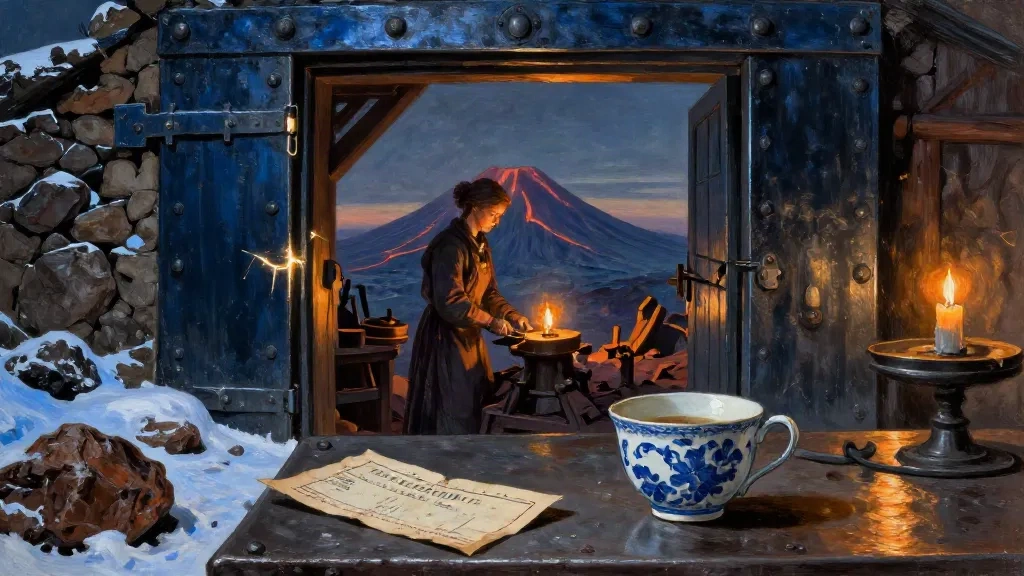
At sunset, the empty teacup stood on her workbench. She had brought it from the archive, where the Trust locked away recoveries from doors that opened. The porcelain bore a crescent of reflected candlelight, though the workshop lamp had not yet been lit.
She set it beside the ticket.
Both objects belonged to a life that had not happened. Nera pressed her palm against the eastern door. Cold passed through the iron and settled in her wrist. Beneath it, far below, something turned as patiently as a key in a lock.
Terms of the Unwritten Future
The Trust sent its overseer before dawn. He carried no guards, only a leather case and a smell of expensive tobacco. Nera had seen him once at her father’s funeral, before the Trust purchased his grave plot and the right to describe his disappearance.
He placed a new hinge beside her anvil.
It was made from rail steel, its surface black with soot. A brass ticket punch lay pressed into one leaf.
Install this, the overseer said, and the eastern door will remain closed. Refuse, and the Trust will classify the gallery as unstable masonry. Everything will be removed. Including her tools. Including the record of his father.
He opened the leather case. Inside lay a contract naming Nera master mechanic of the Vesper doors, with a salary large enough to leave the valley. Below the salary, a clause forbidden the examination of any unnumbered hinge. At the bottom, a departure ticket bore the same date as her own. The 7:10. Tomorrow.
For the first time, Nera believed it could be hers.
She put the empty teacup beside the contract. Candlelight trembled across its inside, revealing a second line of writing she had never seen: A future must be repaired before it can be chosen.
She took up her hammer.
The overseer smiled too quickly.
The first blow split the brass punch.
The Future Without an Ending
By morning, the eastern door stood open only a hand’s width. Nera had fitted the rail-steel hinge but turned it backward. It could resist the Trust forever, its teeth already taking the strain of pressure from within. A visitor could not pass. Whatever waited inside could not emerge.
She climbed to the summit and placed the 7:10 ticket in the observatory’s western telegraph tube.
There had never been a western line. The Trust had always declared the direction dangerous. Yet the tube trembled, carried by a train she had not seen and could not board. Its distant whistle was almost like her father clearing his throat.
Nera left the empty teacup on the open workbench. In daylight its porcelain was plain, chipped, and cold. Her own cup waited on the opposite shelf, still full of yesterday’s tea.
Below, the overseer shouted orders. Steel rang from the galleries. The Trust came with crowbars, lamps, and papers assigning every stone to a lie.
Nera struck the mountain bell once and descended to meet them.
In years to come, stories would say she chose between the known valley and the unknown road, that she opened a door and vanished before dawn. The Trust would publish neither story, for both required an ending.
Nera knew better. The hinges under her hands were already warm, and one among them was beginning to sing.





