 Netwrck
Mythic Fiction.
The Museum of Openings
Every door in the Hall of Unmade Things opened onto a different courage.
One opened onto a bridge of burning banners. Another opened onto a dark sea where swimmers wore their courage as silver shoes. A third revealed a field of white flowers, each one bending beneath the weight of a promise.
Mara had been making bells since she was twelve. She worked in a narrow room beneath the maritime museum, where salt leaked through the walls and the old street above them kept its secrets in its paving stones. Her bells were small, black, and tuned strangely: they rang for memories that had not yet been owned.
When Mara tapped one on a workbench, it remembered a winter afternoon she had not lived. Another recalled the exact blue of her father's last shirt. The third, a little cracked bell in a green velvet box, rang for something she did not recognize at all.
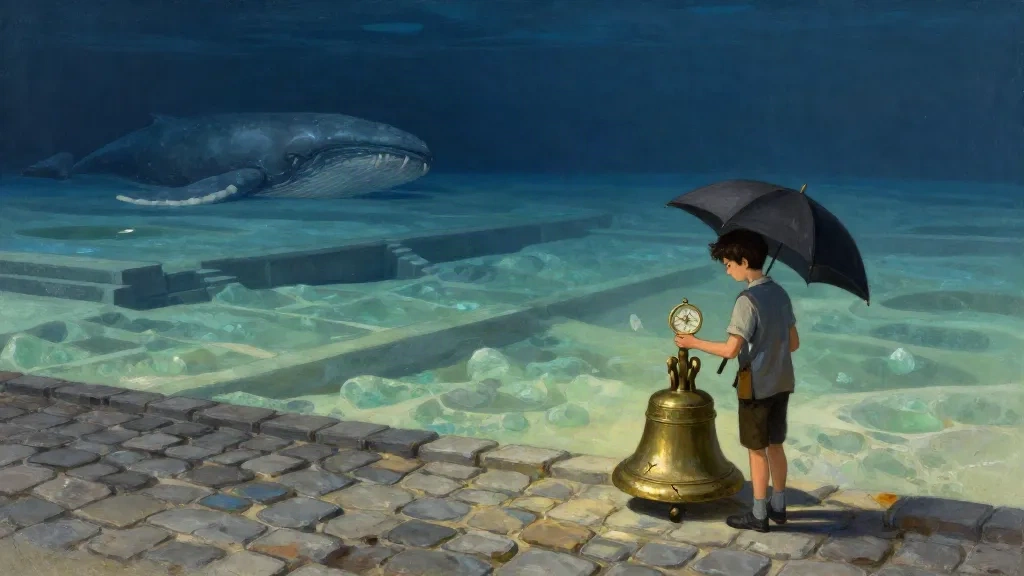
On the night before the holiday, the bellmaker received a brass compass with no needle. Its face was etched with three words: THE STREET IS A LID.
She also found a black umbrella leaning outside the museum. It belonged to no one, though its handle was warm.
The Nameless Holiday
The next morning, Salt Street vanished beneath a procession.
People carried bowls of seawater, unlit lanterns, and flowers whose names had been scratched away. They moved through the town in silence. The holiday commemorated a grief that had never received a name, and therefore no one knew where to begin.
Mara followed the procession. At the square, she saw the black umbrella open above a hole in the pavement. Beneath it waited a narrow stairway, and at its bottom stood a door of pale green salt.
The brass compass trembled in her pocket.
Behind the door was not a room, but a landscape. She stood on a seabed beneath the familiar street. Above her hung the underside of cobblestones, each stone a dark star. Sand ran through underground rivers. In the cobalt shadows, enormous shapes moved like sleeping whales.
Her cracked bell began to ring.
It showed her the moment the street had been built over a scar in the world: a great wound made when the town forgot the dead during a storm. The people had sealed the wound with stone, but grief remained beneath them, growing denser each year.
Mara wanted to know the true shape of the world beneath the street. She wanted it as a builder knows a foundation, as a sailor knows a shoal, as a daughter knows the hidden rooms of a parent's house.
Instead, the grief opened another door.
The Door That Would Not Open
Beyond it stood her father.
He was younger than she remembered, and his shirt was blue. He held a key made of wet sand.
“You came,” he said.
“I came because the bell rang.”
He looked toward the sleeping whale-shapes. “Then you have heard what the city has spent three generations refusing to hear.”
Mara stepped closer. “What is true beneath Salt Street?”
“That it is not beneath you,” he said. “It is waiting for you.”
The black umbrella snapped shut. A wall of cobalt shadow swept between them.
Mara ran. The underground landscape buckled into stairways, doors, flooded rooms. The procession above beat its silent drums. She climbed with the cracked bell in one hand and the brass compass in the other.
At the final door, the compass needle appeared. It pointed not forward, but downward.
Mara understood. The world beneath the street was not another place. It was the shape left by every choice made without looking. The town had built itself on a refusal, and the refusal had become a foundation.
She struck the bell.
Its sound passed through the walls, through Salt Street, through every black umbrella in the procession. For one breath, the town remembered what it had buried.
A Name the Earth Could Carry
Mara rose into daylight.
The people had stopped. Faces turned toward her, wet with tears they had been taught not to call grief.
She held the bell above her head.
“This is for those we lost when we decided the storm was more important than they were,” she said.
No thunder answered. No one corrected her.
That evening, the museum installed a new door. It opened onto a narrow staircase descending through green sand. At the bottom, visitors placed bells in niches. Each rang for a memory they had carried alone.
Mara left the cracked bell there. She kept the brass compass, though its needle had vanished again.
Years later, when children asked what lay beneath the world, she did not offer a map. She opened the black umbrella above them, held it against the sun, and pointed toward the cobalt shadow beyond the museum wall.
“The true shape,” she would say, “is the part that changes when we finally look.”
Then the bellmaker would descend, carrying no answer into the green dark.





