 Netwrck
Hopeful Science Fiction.
Stall 936
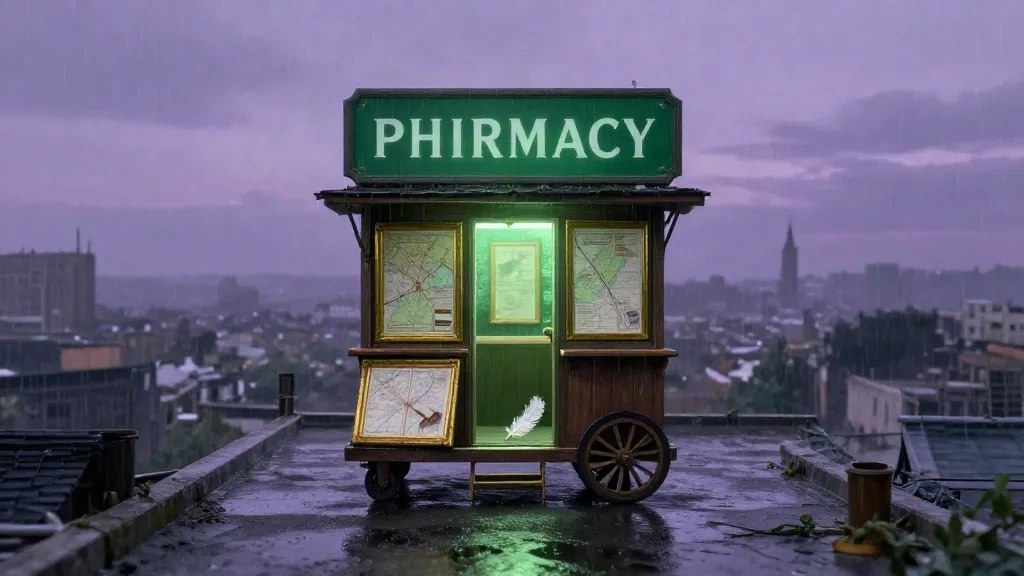
The market floated where the elevated road had ended, its stalls lashed together from rain-dark wood and brass street signs. Below, the city was a field of wet asphalt roofs, each one reflecting a lavender sky. Between the stalls drifted the scents of cardamom, hot dust, and green pharmacy light.
At stall 936, retired cartographer Nera Venn arranged three obsolete maps beneath a cracked glass bell. She had spent sixty years drawing coastlines that moved, borders that dissolved, and rivers that abandoned their valleys. Now her hands were steady enough only for small work.
Her customers brought memories without owners. A railway conductor could no longer recall the final whistle of his route. A child possessed the smell of a kitchen demolished before she was born. A woman carried the precise weight of a key that had opened a door in a house erased from every register.
Nera listened. Then she drew.
Her special maps belonged to places that no longer existed. A black line became a wall. Two careful strokes made a lintel. With enough silence, she could add a door where no door remained, and the memory would slip through into a room where it might rest.
The Price of Belief
The market’s cheapest memories were lies softened by convenience: a summer that had been winter, a stranger made kind, a last goodbye invented to prevent an early departure. Vendors called them comfort goods. Their owners, if they ever returned, would recognize the forgery and leave it behind.
The expensive things were always true.
On a black counter beside stall 936, a woman named Oren sold exact memories. Her prices were written in copper buttons. Buyers could not bargain. They received what had happened, untouched by mercy.
“Truth is heavy,” Oren said. “That is why it rests badly.”
He placed a white feather on the counter. It had belonged to a hospital bird, released above a city that no longer stood. The feather remembered wings beating against windows. Every impact was true. None of the windows opened.
From a tin cup nearby, a small moth wing emerged. It belonged to a lantern burned over a vanished railway platform. The wing remembered the glass breaking, the flame falling, and every person who had looked upward instead of running.
Nera had no money. She had only her pencils, three maps, and a promise made long ago to her sister: that she would build somewhere no lost thing had to keep searching.
What the Maps Refused
Nera placed the moth wing on the first map. It fluttered without air, tracing the outline of a platform that had sunk beneath a reservoir. She drew a door beside the tracks. The map refused the ink.
She tried the second. The white feather covered the place where an entrance hall had stood. Again, the line loosened and vanished.
“Places need a witness,” Oren said. “Yours are gone.”
“Then the memories are witnesses.”
She bought the truth of the feather with her oldest map. Paid for the truth of the moth wing with the other two. What remained in her hands was a narrow blank sheet bought with her final commission: the map of a house demolished that morning.
Loss opened the street. A vanished hospital lifted its roof. The drowned station returned its rain-dark tiles. For one suspended moment, the market looked down upon a city made entirely of places that had been loved and abandoned.
Nera drew the door.
It was not a door into any remembered room. It was a door between them. The moth wing passed first, its scales bright as pharmacy signs. The white feather followed, carrying the frantic shadow of wings against unbreakable glass.
A Place to Rest
Behind the door was a plain chamber with lavender walls and a floor of wet asphalt polished smooth. Shelves held abandoned names, unspoken apologies, and endings witnessed by no one. Nothing glowed. Nothing demanded belief. Every true thing could enter without being made into a spectacle.
Customers followed. Nera gave each lost memory a shelf, a lamp, a chair facing the door. The market quieted around her work. Even the lies stopped fluttering when they saw the truth resting safely.
At sunrise, Oren left his white feather on the threshold. Nera pinned the moth wing above it. One signalled endurance; the other, release. Between them, the door remained visible.
Her final map showed no vanished place. It showed the floating stall, the green pharmacy signs, and a narrow chamber built where memory had learned it was allowed to stop searching.
Nera drew no exit. For once, nothing was lost on the way home.





