 Netwrck
Mythic Fiction.
The Bell That Knew Her
On the morning the Museum of Doors gave away its smallest bell, Mara Vale was already late for the Unnamed Day.
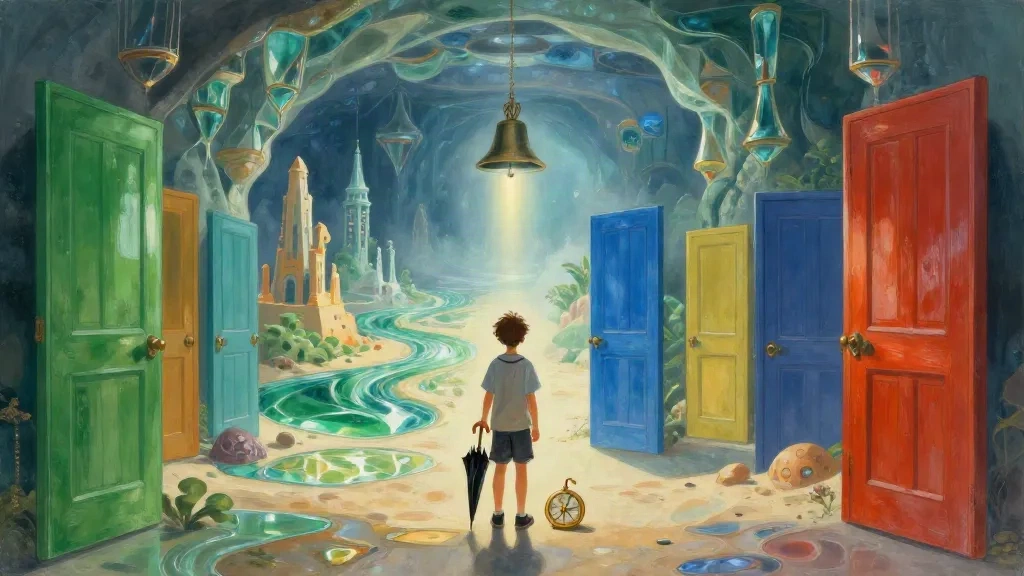
The museum occupied the space between a tailor’s shop and a disused cinema, though no one could agree which street that was. Its façade held twelve doors in a row, each painted a different shade of weather: blue-black, oyster, rust, the green of shallow sea glass. Above the entrance, a brass sign read: Every opening requires a courage.
Mara carried the bell in both hands. It had no clapper, yet it hummed against her palms, a sound like a swallowed bell buoy. Mara was fifteen, a bellmaker’s apprentice, and she had learned that her bells did not ring for memories she possessed. They rang for memories she had yet to claim.
When the museum’s curator gave her the smallest bell, he said, “It has found its road.”
“Where?” Mara asked.
He pointed toward the narrow gap between two buildings, where the air smelled of wet stone and oranges. “Beneath Marrow Street.”
She knew that street. Everyone in the town knew it. On Unnamed Day, the market stalls closed before noon, the children tied gray ribbons to their wrists, and the old people left bowls of water outside their doors. Nobody knew what the day commemorated. Nobody asked.
A Door That Faced the Tide
A black umbrella stood outside the museum, its handle carved from driftwood. It was leaning against the wall as though waiting for someone taller to arrive.
Mara opened it beneath a sky without weather. Rain fell upward from the pavement into a cobalt sky. A brass compass rested on her palm, needle turning toward a door marked with a blank plaque.
The door opened onto a beach beneath the town. Sea-glass green water threaded through black sand. At low tide, thousands of doors lay half buried in the sand, their thresholds leading to forests, battlefields, kitchens, high roofs, and other rooms Mara did not want to enter.
A woman in mourning clothes stood beside the nearest door. Her face was hidden beneath a veil, and in her hands she held a child’s shoe, empty and shining.
“You are late,” the woman said.
“Late for what?”
“The remembering.”
The small bell began to ring. Mara felt the vibration in her teeth. For an instant, she remembered a kitchen she had never visited, a woman singing three notes, and a window opening onto a garden where snow melted too early. The memory vanished before she could name it, leaving only the taste of salt.
The brass compass spun toward the blank door.
“What is Unnamed Day for?” Mara asked.
The woman looked down at the shoe. “For everyone we carried when there was no road left to walk.”
The Courage Under the Stone
Mara stepped through the door.
She found herself beneath Marrow Street, among roots and wet brick. Above her, the town’s houses hung like shadows in cobalt water. The unnamed holiday moved through the walls as a procession of muffled bells. No one led it. No one followed it.
Each door in the museum began to open at once.
One opened onto courage to forgive. Another, courage to leave. Another, courage to speak in front of a crowd. Then a door opened onto courage to remember an empty place at a table and still place a bowl there.
Mara’s bell rang without a clapper.
The memories came. Not hers. A boy beneath a window, holding his breath. A woman setting down a letter she had carried for forty years. A dog waiting beside a door that would never open again. A city exhaling after the announcement of a death. The grief had no name because no one had survived to give it one.
Her compass pointed downward.
There, set into the oldest stone, was the final door. It was small, brass, and warm.
The woman with the empty shoe came to stand beside her. “The courage behind this door is not remembering what was lost,” she said. “It is making room for what was never allowed to be found.”
The Street That Opened
Mara placed the bell against the brass door. Its sound rose through the earth, through the foundations, through every house above.
She thought of her mother, who had left town when Mara was four. She thought of the bellmaker’s workshop, where her hands had learned the shapes of metals. She thought of the future she wanted: a map of the world beneath the world, every hidden road marked in honest ink.
Then she opened the door.
Beyond it lay a valley of blue grass, crossed by rivers of green glass. In the distance, towers stood upside down beneath the sky. The world beneath Marrow Street was not beneath it. It was inside it, waiting for a courage no one had asked it to possess.
Mara stepped through with the woman and the bell.
Above them, the unnamed holiday ended. In the town, people lifted their gray ribbons. They did not know what they remembered, but they knew they had remembered it together.
That evening, Mara hung the smallest bell above the museum’s entrance. Whenever the wind moved through the narrow street, it rang for memories not yet owned—and for the unnamed ones that had finally found a road home.





