 Netwrck
Romance.
The Market of True Prices
On the morning the orchard road vanished, Mara Venn spread her oldest map across the bridge table. Rain silvered the ink. Beyond the parapet, the river carried the morning away as if it had been spilled from a blue pitcher.
Mara had drawn coastlines for forty years, roads for employers who believed geography was a promise made without witnesses. Now, retired, she made maps no one could visit.
She inked their doorways. Not all doorways. Only on maps of mills drowned by reservoirs, villages struck from registries, estates swallowed by forests: places gone so completely that even memory had lost their addresses. Each door contained a room for the lost to rest.
Across the river, Marigold Market had appeared in every almanac for two hundred years. Its sign read: Nothing Here Is Valued for Use.
Mara crossed the Bridge of Kept Oaths and entered.
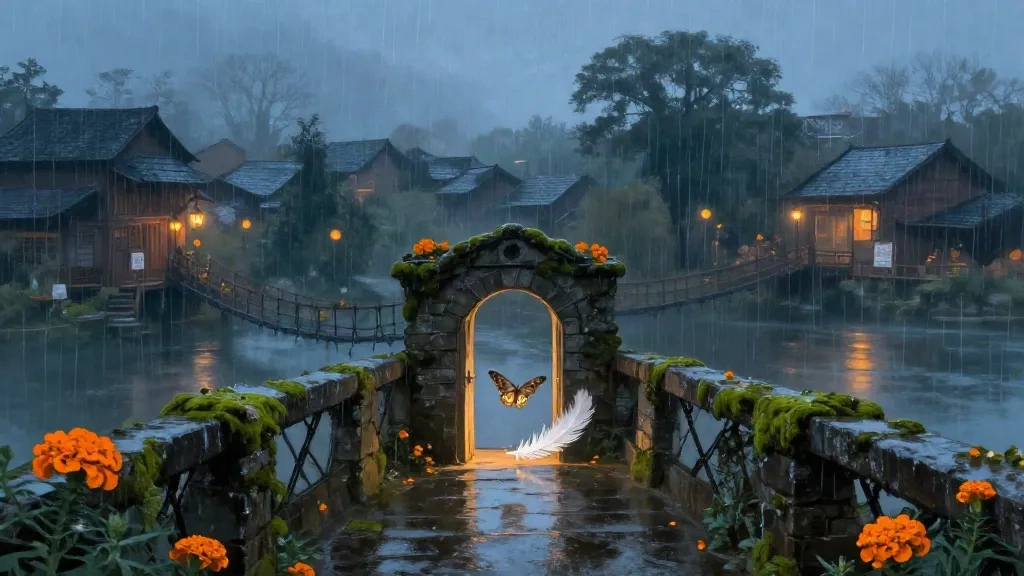
Stalls displayed a silver button that could reveal a judge's first bribe, a child's red shoe remembered by no one but its owner, and a white feather whose shaft trembled whenever someone spoke a deliberate lie.
Most stalls charged modestly. A wooden horse stood one copper coin. A jar of laughter three. The truth behind a murder sold for a month’s wages. Such things were expensive because they were always true.
The Price of Vanishing
The feather lay beside a glass case marked WITHOUT WINGS. Inside rested a moth wing, broad as a hand, green and gold, veined like a river delta.
“It flew through twelve forgotten counties,” the seller said. “The night they were removed, it carried a message from a bridge-builder named Oran Vale.”
Mara’s hand stopped above her purse.
Oran had repaired the old footbridge when she was seventeen. He knew the sound of her name before she crossed it. Forty-three years later, the town claimed he had drowned during a spring flood.
No body had been found. No bridge had closed.
“Why hasn't he rested?” Mara asked.
“Because the river witnessed his last promise,” the seller said. “He swore to return before the marigolds faded. The river keeps such oaths.”
The white feather rose inside its case. A lie, Mara thought. Then the moth wing struck the glass with a sound like thunder in summer.
Oran was alive.
He had retired to Bellweather, a settlement abandoned before either of them was born. He went there deliberately, the seller explained, to make himself difficult to remember. Rage had carried him from the market. Fury had been free.
Mara bought the feather for a year’s savings. The seller placed the moth wing beside it: a gift, he said, for paying honestly.
Maps of the Unlived
At dusk they met where the old bridge joined the northern road. Rain had stopped. Marigolds burned orange along the embankment.
Oran looked older. His left hand was scarred, his coat belonged to another century, and he carried the feather in his fist as though uncertain whether to burn it.
“I didn't leave because I stopped loving you,” he said.
“You left because the town took every promise seriously,” Mara replied. “It remembered us. You couldn't bear being witnessed.”
He glanced toward the river. “And you?”
“I became someone who maps what is gone.”
“Not everyone.”
“Not everyone,” she agreed.
For years he had watched her from the ridge beyond town. She had seen him at market fairs, always departing before she could reach him. Now he crossed to her side.
“I need a map,” he said. “Not of Bellweather. Of a place where forgotten things can rest.”
“Why should you rest with them?”
“Because leaving is not always the same as being free.” He touched the feather. “I am tired of paying for roads I was too afraid to take.”
The Door in the Water
Mara took out her smallest map. Before midnight, she drew a shoreline that had never existed, shaped like two hands almost touching. At its center she made a narrow rectangle.
Her pen broke.
“A door needs a name,” Oran said.
“Not a place.”
“Then whose?”
The river began to glow. In its reflection, hundreds of lost things moved along the bottom: gates, name tags, unborn seasons, unopened letters.
Mara understood. The map could shelter what no longer had a home, but its first door must belong to someone willing to remain.
She wrote in marigold ink: Orrin Vale Memorial Rest.
“My name,” Oran said.
“Your name.”
“And after?”
“Mara Venn. I will finish every map I began.”
He took her hand. The white feather lifted and became a narrow gleam on the water. The moth wing trembled with the colors of moss, wet stone, and marigold.
Across from them, a door rose in the river, neither solid nor reflection.
This time Mara did not map the way back. She mapped a room inside the door, with two chairs, and beside it a long table where lost things could finally be named.
Oran crossed the threshold first, still holding her hand.
Behind him, the market bell rang. In every bridge across town, the timber gave one solemn knock.
Every promise had a witness.
Now, so did they.





