 Netwrck
Romance.
The Door in the Mud
Mara Vale kept the old maps in a room above the ferry office, beneath a window that wept whenever the river changed its mind. She was fifty-eight, retired from the Cartographic Corps, and famous only in Bellwether for drawing doors.
Not on living places. Her pencils refused those walls. Doors appeared only on maps of settlements swallowed by flood, quarry, fire, or the slow swallowing of time. She inked them carefully: hinges, latch, threshold. Each led somewhere that no longer existed, until one morning when someone knocked from the other side.
Her concrete desire had been simple before the knocking began: a place where lost things could rest. Not rescued, not displayed, not explained. Rested.
Now there was a knocking sound in the wall behind her maps.
Mara pressed her palm to the plaster. Three taps. Pause. Two taps.
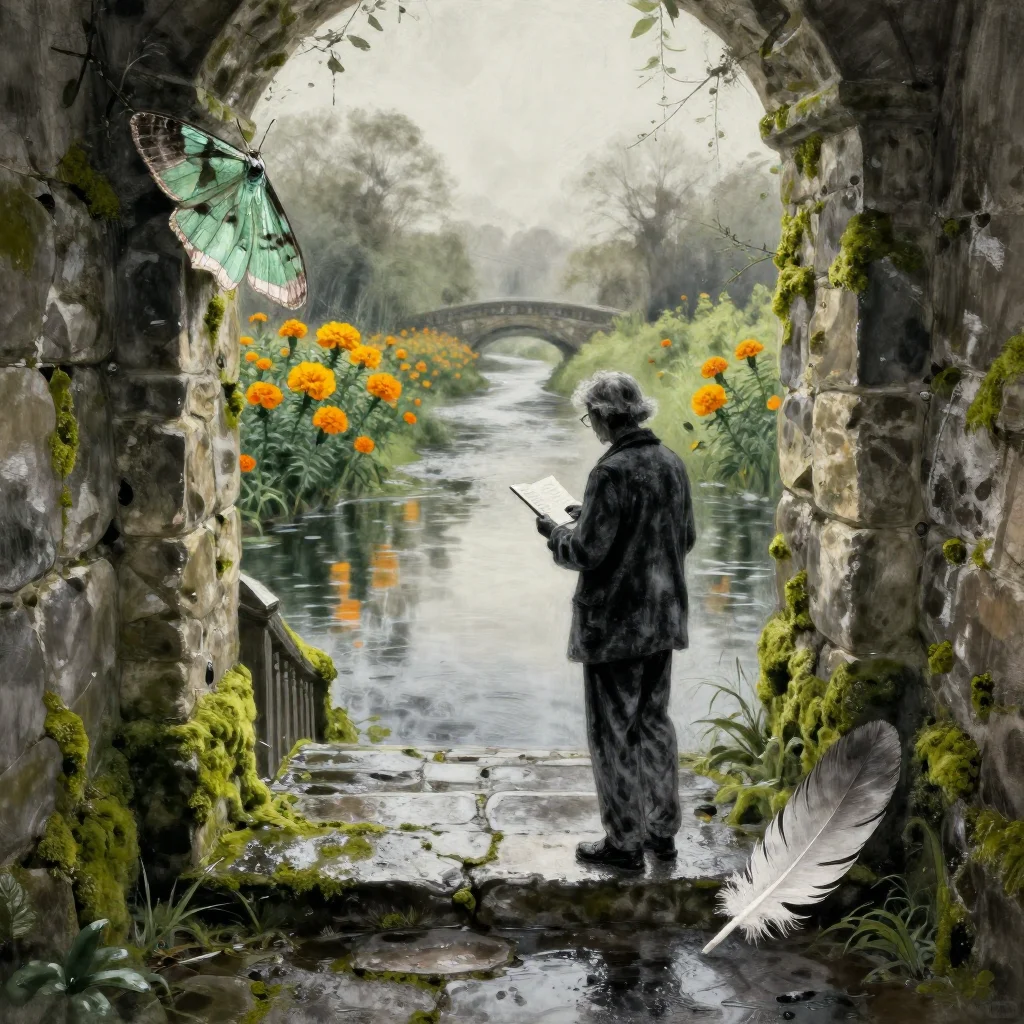
On the table lay the white feather she had found that morning beside the east bridge, impossibly dry in the rain. Beside it rested a moth wing, broad and silver-green, torn from something that had died before Mara was born. Together they looked less like objects than evidence.
The Market of Expensive Things
At noon Mara crossed the covered market, where every bridge displayed a name and every river served as a witness.
The market sold small certainties: a compass that always pointed toward the person who had wronged you, a bell that rang only when someone was about to confess. Expensive things were always true. That was the rule posted beneath the awning, though the rule had been painted over a dozen times.
Mara bought the feather’s shadow from a stall of bottled weather. She bought the moth wing’s name from a woman who refused payment until Mara drew her a door on a map of a vanished village.
“Hallow Fen,” Mara said, when the pencil finished.
The woman’s face softened. “You were there.”
“I was nine.”
“Then the river has waited twenty years for your return.”
Mara folded the map. The knocking had started again, now beneath the floorboards of her room, beneath the market, beneath the waterline.
At the far stall, a man in a charcoal coat was selling a bridge. It had no river beneath it, only wet stone and a flash of marigold light. He offered it to Mara at a price she could not pay.
“You want a place for lost things,” he said. “This road will take them there.”
“What do you want?”
“Someone to draw me a door out.”
What the River Kept
His name was Ilyan Rook. He had been the last person to cross Hallow Fen before the flood. Everyone remembered him differently: child, soldier, bride, thief. Only the river agreed on one detail. He had left something behind.
They followed the bridge beneath the market. It was not drawn, Mara realized. It was being remembered into existence, stone by stone, by everyone who needed somewhere to go.
Ilyan held the white feather. Mara carried the moth wing. At the river’s edge, the water lifted to reveal a drowned staircase. Beneath the surface lay a door, black with age.
Mara drew it on the blank margin of Hallow Fen’s map. The line burned through the paper. Somewhere inside, something sighed with relief.
“You built a room for the lost,” Ilyan said.
“A threshold.”
“What if one of them refuses to leave?”
Then she looked at him.
He had not come for the bridge. He had come to be found. And Mara understood that a promise could be a shelter, a prison, or a door opened from the wrong side.
The Marigold Door
She drew herself inside. Not into Hallow Fen. Into a place assembled from lost thresholds: a nursery without a child, a kitchen where the kettle remembered boiling, a hospital garden where no patient had survived the winter. Moss green covered the walls. Wet stone breathed beneath her feet.
Ilyan followed.
“Is this where they rest?”
“Only if we make room.”
Outside, the market bells began ringing. The expensive things were telling the truth, and Bellwether was running out of places to hide them.
Mara placed the moth wing beside the door. Ilyan laid the white feather across its threshold. Between them, the room learned how to become a home.
At dawn, the river carried no names. It carried only a pale shape beneath the current, turning slowly toward open water.
Mara watched it go.
Then Ilyan took her hand, not to lead her anywhere, but to prove the door could bear them both.





