 Netwrck
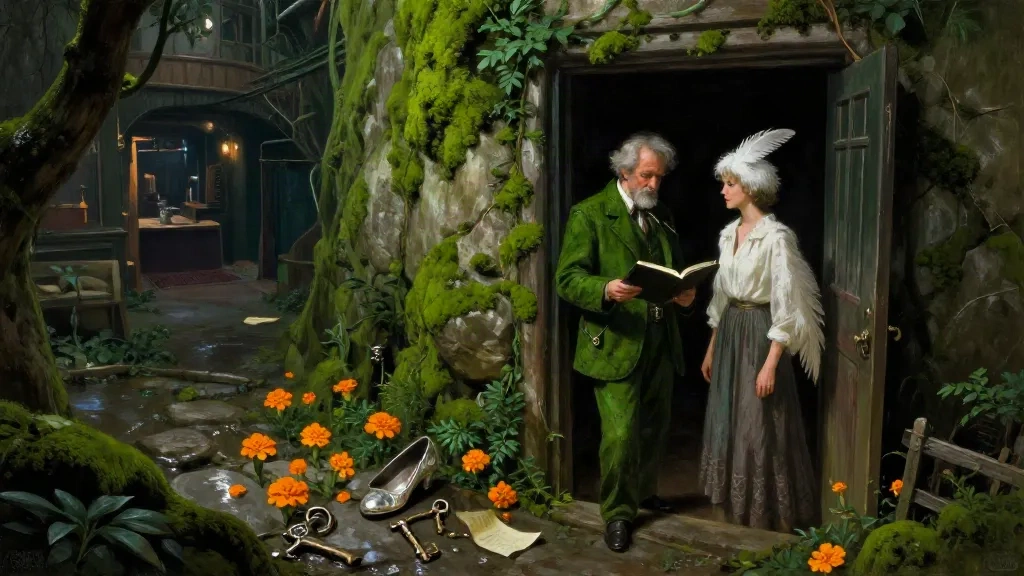
Romance.
The Wings of Discarded Endings
At midnight, the theatre opened onto last night.
Ival found the door behind a painted flat where a garden had once been. It was a narrow green door, damp at the hinges, with a brass knob shaped like a sleeping bird. The theatre smelled of wet stone, sawdust, and rain trapped beneath the stage. Above him, the actors performed tomorrow's discarded endings: a woman returning a letter after ten years, a king dying before the crown, a child growing old in the instant before leaving home.
He had spent sixty-one years drawing coastlines that no longer existed. Rivers erased by new dams. Villages folded into quarries. His maps were kept in the theatre basement, beneath a moth wing and a white feather, because the wing could find vanished places and the feather could make the found ones harmless.
Ival wanted one door that led nowhere. A place where lost things could rest without being named, collected, or returned to the people who had failed them.
The Market of Honest Things
Behind the stage lay the market, open only between performances. Stalls crowded the corridor with objects polished by impossible light: a child's silver shoe, a wedding veil, a compass pointing toward a lover who had died before the wedding.
The market's rule was cruel and simple. The expensive things were always true.
At the first stall, a woman offered Ival a red thread wrapped around a black stone. It cost a memory. The thread was genuine grief, she said, pulled from a man who had forgotten his son's name. At the next, a boy sold a key that opened the future. It was a beautiful key, bright as winter, and it was true that whoever carried it would become homesick for a place they had never seen.
Ival kept his money. He wanted a place, not another piece of the past.
On the final stall sat a woman with a white feather in her hair. Her face was young beneath paint and powder, but her hands were old, cracked at the knuckles. She wore a moss-green coat and watched him with the attention of someone who had already lost something twice.
“You draw doors,” she said.
“Only to places that no longer exist.”
“Then draw one to a place that has never existed.”
Her name was Veya. She played the woman who forgot the moon in the theatre's second act. By morning, her role had been removed from the script. The market had taken the memory of her performance and sold it to a grieving astronomer.
“If I make a refuge,” Ival said, “will you enter it?”
“If it is real.”
The Price of a Door
They chose an unbuilt room in the theatre's southern wall. It was there in the first plan, then absent from every plan after the fire. Ival spread a blank map across the stage and drew with charcoal instead of ink.
The market gathered at the door.
Truths pressed against it: the sound of a mother calling from a house demolished before Ival was born; the smell of his first wife's hair; the exact expression of Veya's face when she understood she had been forgotten. Each offered a memory in exchange for passage. Each was true, and each was too heavy to carry into a place of rest.
“They will fill it,” Veya whispered. “A refuge made from truths is only a prison with better lighting.”
So Ival used the moth wing.
He released the small, dusty fragment into the charcoal lines. The wing's powder entered the paper and revealed a place without edges: a low room filled with moss, standing stones softened by rain, and a marigold flame burning beneath a ceiling of open sky. The room accepted the things that entered it, but it did not accept their claims. A lost key lay there without demanding its lock. A childhood glove rested without asking for a hand. A letter curled in the dark, its tears dried to salt.
The market recoiled. Truth had been the only currency it understood. Here, truth was simply a thing among many things.
At dawn, the theatre doors opened. The actors stumbled out carrying discarded endings in their coats. Ival and Veya stood inside the impossible room while the market vanished, taking its stalls, its prices, and its bright lies.
An Ending With No Audience
They furnished the refuge slowly. A bench from the old railway platform. Three cups from a demolished café. The white feather, now fixed above the entrance, casting a pale light across the moss.
Veya learned to draw maps. Her lines were inaccurate, but she found doors where no cartographer had thought to look. Ival drew hers for her: a route through wet stone, a shelter under a marigold sky, a home that moved whenever they changed their minds.
On the final night, the theatre performed an ending with no audience. No one returned a letter. No king died. The child left home, and the house remained standing.
When the curtain rose, Ival looked at Veya and understood that the truest thing in the room was not a lost object, but the choice to remain.
She took his hand.
Outside, the lost places were still gone. Inside, they had learned how to rest.





