 Netwrck
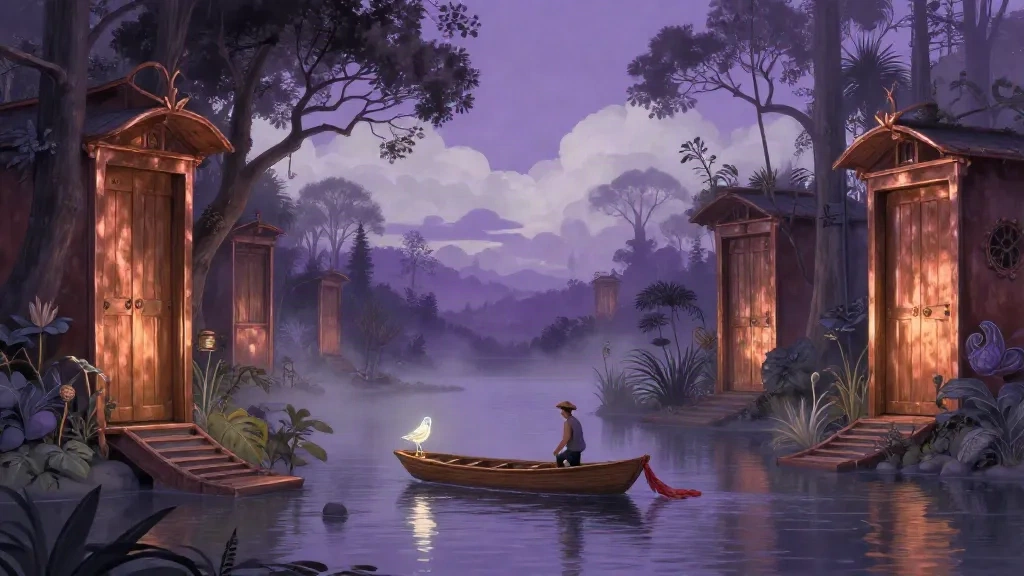
Fantasy.
The Lake at the Wrong Hour
Orren had learned the lake by its absences. At high water, it was only a blue depression between the garden’s black beds, reflecting cloud-white sky. At low tide, when the bronze weeds bent outward and the drowned stairs revealed their green mouths, it arrived without a splash.
He rowed then, in a narrow boat with a patched stern. The botanical garden rose around him: glasshouses of violet dusk, copper roofs furred with salt, trees whose branches held doors instead of leaves. Every door waited above the waterline.
On his prow sat a glass bird, its wings clear as rainwater. Around his throat hung a red scarf, faded from crimson to rust. He had found the bird in the garden’s eastern hedge, tangled in a thorn that had opened like a keyhole. The scarf had belonged to his sister, though he remembered no sister.
Orren’s destination was the First Witness, the person said to remember the world before its first mistake. The stories disagreed about that person. Some named a queen in a white tower. Some named a child buried beneath the oldest tree. All agreed the lake would not become passable until the ferryman found them.
The Map’s Honest Face
The map came from the garden’s door-maker, who had been dead for a century. Its paper was sewn from the bark of the tree that grew doors. Orren carried it in a tin case, unfolded only when he reached the lake.
The first drawing showed a straight channel toward the northern shore. He rowed there, but the channel closed beneath the boat, reeds rising in a silver fence. The map had changed.
He tried marking the shore with charcoal. The coastline in the tin altered overnight. He told the truth to the stones, asking them to point toward the First Witness. The map ink ran into new shapes.
“Honesty makes it shy,” the door-maker had warned, though Orren had thought the joke cruel. The map could be deceived by lies, perhaps, but not by the truth. A lie gave it a road to become. A truth forced it to forget the road it had already made.
So he began carrying a second map in his head, composed of weather, birdcalls, and the remembered tilt of stars. This private map led him not northward but beneath the garden, where a trail of copper lamps shone underwater.
The Door in the Root Cellar
The lamps ended at a door standing upright in the lakebed. It was made of black wood, with a brass handle shaped like a sleeping heron.
Orren brought the glass bird to it. The bird chirped once, a note thin as cut glass. The door opened onto a cellar filled with roots, hanging lanterns, and shelves of drowned seeds. A woman sat beneath the lowest shelf, combing wet moss from her hair.
“You are late,” she said.
“I am looking for the First Witness.”
“Everyone is looking for the First Witness.” She set down the comb. “The first witness is not a person. It is the moment before the world decided to be called by its present name.”
She pointed to a seed in her palm, dark and smooth as a closed eye. The map in Orren’s case began to rust, its paper curling toward the seed.
“My sister wore this scarf,” he said.
The woman looked at the red cloth. Her face changed, not into recognition but into grief.
“She is the one you remember,” she said. “And the one who made the first mistake.”
Outside, the tide began returning. The lake rose against the cellar door.
The Name Before the Name
Orren understood then. The First Witness was not waiting at the end of a journey. It was waiting inside the mistake: the instant his sister had tied the scarf around his neck and sent him away, or the instant he had forgotten her, or both.
He placed the seed in the map’s fold. The paper tore soundlessly. Every route he had abandoned appeared at once, then disappeared. The door-maker’s map was becoming what it had always been: a shell around an unnamed beginning.
“If I remember her,” Orren said, “will the world return?”
“No,” the woman answered. “It will become capable of changing.”
The glass bird flew from the prow and struck the cellar window. Its wings broke, scattering bright shards across the drowned garden. In that flash, Orren saw the original lake beneath the lake, another lake beyond it, and a red scarf tied around the neck of a child who had never been born.
He understood the wish in his chest. Not to restore the lost world. To find someone who had kept its first shape, even if keeping it had ruined everything else.
He reached for the scarf. The woman caught his hand.
“You will forget me,” she said.
“I already have.”
“Then I will remember for both of us.”
At high tide, the door closed. The lake vanished. The garden’s trees shook their doors open, and every one revealed the same violet dusk, the same copper rain, the same cloud-white sky.
Orren kept the glass bird’s empty hollow. He kept the scarf, though it was only a red strip now. And each low tide, he crossed toward the woman beneath the root cellar, carrying the memory he had not been given.
Some maps change because the world moves beneath them. His changed because the road had finally learned to follow him.





