 Netwrck
Science Fiction.
The Return
Every tide brought back one forgotten object.
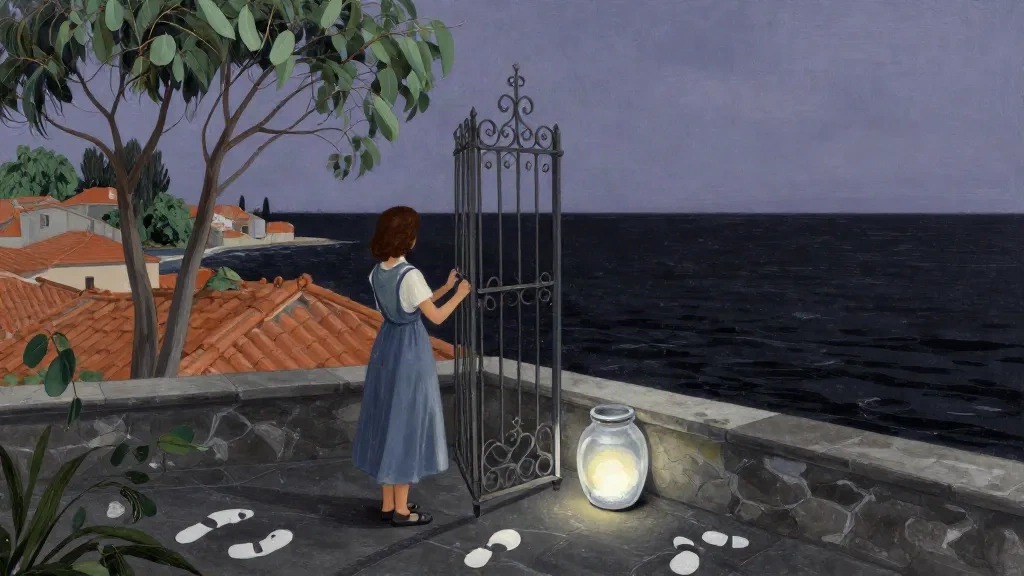
At dawn, Mara Venn found the iron door lying in the wrack below the ferry stairs, its salt-rimed frame half buried in crushed mussel shell. It was taller than any door in Bellweather and narrow as a coffin. Eleven black nails held a green board across its center. The tide had polished the nails but not the board.
Beyond the seawall, fishing boats moved through a sky colored like bruised fruit. Terracotta roofs shone under the first eucalyptus-scented wind. Villagers gathered above the door, touching their amulets and avoiding one another’s eyes.
“My mother lost a key,” said Pell. “Before I was born.”
“My grandfather lost his shadow.”
“Mine,” said Oren, lifting the glass seed sealed in his coat, “was a promise.”
The object belonged to no one who could name it. That was the trouble with Bellweather’s tides. Each returning thing was intimate. Each claim upon it was a wound.
Mara carried the door to her shop because everyone agreed to carry everything, eventually, after refusing to.
She was Bellweather’s only seamstress. Her needle could mend what people had lost between themselves: the torn sleeve of a friendship, a hem altered after a funeral, the widening distance between a woman and her brother who lived on opposite sides of the same house. She never repaired the body. She repaired the permission to approach it.
The green board defeated her awl. When she touched it with her silver needle, the board whispered in a language she had never studied.
Its letters appeared briefly in the grain: THE LIVING MAY NOT ENTER BY RIGHT.
Below that: THE DEAD MAY NOT ENTER BY WITNESS.
Mara set down the needle. The bell above her door rang though no wind entered.
The Agreement
The village agreement surfaced that afternoon.
Old Nan brought it from the town archive in a cedar case sealed with black wax. He would not touch it. Nor would he say how he knew it had waited beneath the customs house for ninety years.
The document was a single skin of pale paper, covered in marks that curved and doubled. Every living reader saw the same empty lines. When Oren held the glass seed above it, green sparks traced words only the dead could read.
Oren’s mother spoke them aloud, though she had been dead for eleven years.
“Bellweather will return what the sea takes. Bellweather will forget what the sea gives. Every living person shall consent before the sea crosses their threshold. Every drowned person shall witness after the crossing. Silence shall count as refusal.”
At the final line, the paper burned without heat.
Nan looked at the iron door in Mara’s back room. “They agreed to the door. They never agreed to what opens it.”
“What does?” Mara asked.
“Consent freely given on both sides.”
Oren placed the glass seed in her hand. Inside it, a dark root trembled. “My mother said the seed was a promise. She never told me whose.”
Mara’s hands had sewn a hundred reunions. None had required a dead woman to speak and a living man to answer.
At sunset, the sea drew back.
Two Sides
The bellweather bell rang underwater.
Mara carried the door to the stone landing where the dead were named on slate tablets. Behind it, the sea climbed the cliff in a vertical wall. Beyond the iron frame, there was no room, only blackness packed with the reflections of houses that had drowned.
Nan recited the village agreement. The dead voices answered from beneath the tablets.
The door trembled. The green board split down its length, revealing a gap no wider than a palm. Cold air breathed through it, smelling of salt and iron.
Mara understood then. The door was not for entering. It was for separation.
She drew her needle through blue thread and stitched the gap closed, leaving two spaces. One on the living side. One on the dead.
“The first consent is yours,” she told the sea.
Oren stepped forward with the glass seed. “I consent to hear the promise.”
“And I refuse to surrender the right to refuse it.”
On the other side, his mother spoke. “I consent to witness my son. I refuse to speak for anyone else.”
The thread tightened.
Every voice in the black water went silent except one.
“I consent,” it said, using Mara’s mother’s voice. “I consent. I consent. I consent.”
The needle was pulled toward the dark.
Mara drove it deeper. “Dead witness is not living consent.”
Then she cut the final thread.
The door opened only a hand’s width. Through it passed the glass seed, unchanged except for a second green root inside it.
What Both Sides Kept
At dawn, the sea returned a salt jar to Mara’s doorstep.
She opened it. The air tasted of rain, eucalyptus, and clean wool. No speaking voice rose from it.
Pell placed the matching jar beside hers. Oren carried the glass seed home. Nan burned the agreement, because the living no longer required the dead to translate their promises.
Mara left the iron door on the landing. It opened only when both sides spoke, and closed when either withdrew.
On the ninth tide, the sea brought her a child’s mitten, a brass whistle, and a strip of wedding cloth. She repaired each one without claiming the memories inside.
The village stopped asking what the dead wanted. The dead stopped asking the living to forget.
Some nights, the door knocks twice. Mara opens it halfway, holds the needle, and waits for two honest answers.
Sometimes only the sea comes.
It says nothing.
She closes the door, salts the iron hinges, and returns to her work.





