 Netwrck
Adventure.
The Bell That Was Not Hers
Mara Venn made bells in the narrow workshop above the cobbler on Lantern Street. Each morning, the street’s noises arrived through her windows: shutters, cart wheels, sparrows disputing crumbs, the bakery bell calling the first customers inside. But beneath those sounds, she heard another ringing.
It came from small brass bells hanging nowhere.
The museum of doors stood at the end of the lane, though no child was born there and no city map admitted it. Its entrance was a narrow arch painted the color of black cherries. Mara had visited once with her father. He had stopped before a green door, pressed his palm against its paint, and said, “Some doors open when you finally admit what you are afraid of.”
He had never said what he feared. Mara had never asked.
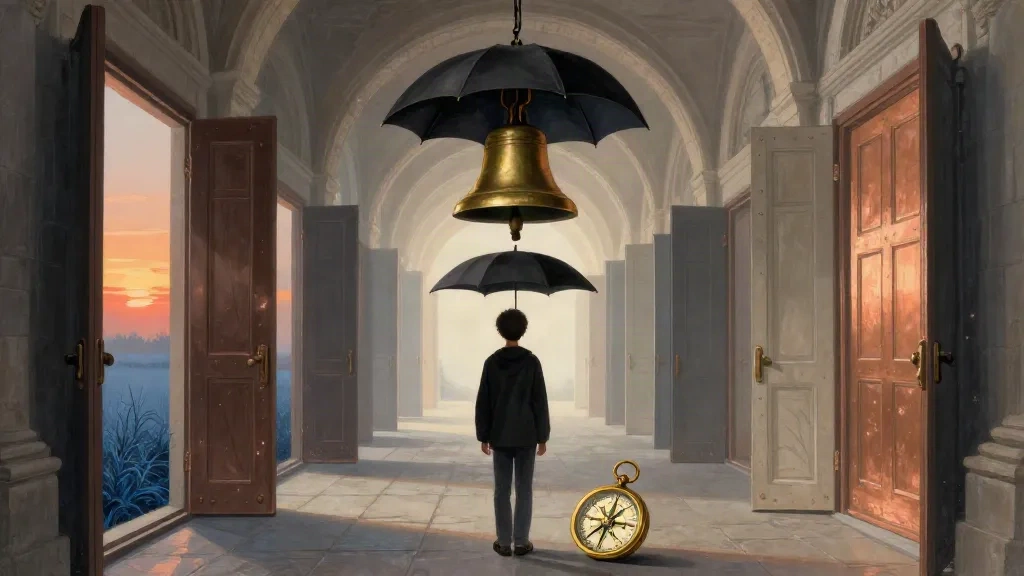
That morning, the ringing became urgent. A silver clapper sounded beneath her floorboards. She pried up one board and found a black umbrella, a brass compass, and a bell the size of a plum.
When she lifted the bell, she remembered a winter morning that had never happened: snow on the roofs, her father laughing behind a bakery window, and someone calling her by a name she did not know.
The memory vanished. The bell kept ringing.
The Holiday Without a Name
At noon, the museum’s doors opened. A crowd gathered in the square carrying paper lanterns, silver ribbons, and bowls of unpeeled onions. Above them hung a black banner with no lettering.
“What is today?” Mara asked the woman beside her.
“The Unnamed Loss,” the woman replied. “We remember the griefs that never received a name.”
Every year, citizens brought an object to the square and placed it before the museum. Some brought shoes. Some brought keys. Others brought clocks stopped at different hours. The city’s bells remained silent, because grief without a name could not be announced properly.
The museum doors began opening by themselves. A red door revealed a field of blue grass beneath a copper horizon. A white door opened onto a staircase climbing into a storm. A black door exhaled the smell of rain on hot pavement.
Mara stepped through the black door.
She found herself beneath Lantern Street.
The buildings above had been cut away, exposing rooms, basements, tunnels, and foundations packed shoulder to shoulder. Cobblestone streets hung overhead like frozen rivers. Beneath them ran another city, lit by copper sunset. Its avenues followed shapes Mara recognized: the bend of the bakery, the corner where her father had taught her to whistle, the patch of ground where the old oak had stood.
The brass compass spun in her palm, then pointed east.
Across a bridge made of old doorframes, someone was ringing a bell.
Rooms That Refused a Name
The city below was full of rooms. A woman stood inside a room filled with unopened letters, turning the lock without touching it. A boy carried an empty grave from house to house, adding one shovelful of pale stone each time. A soldier stood beside a battlefield made entirely of closed eyes.
“You hear it too,” the woman said when Mara entered the letter room.
“Hear what?”
“The missing name.”
She pointed beyond the walls. There, doors floated without hinges. Each had a shape suited to a particular sorrow: narrow enough for grief that refused comfort, wide enough for grief that swallowed a family.
One door was marked only with a smear of black cherry.
When Mara touched it, her borrowed memory returned. Her father was standing in this room, older than she remembered, holding a blue envelope. His face was calm. His hands were not.
“If I give it a name,” he said, “it becomes real.”
“And if you do not?”
“Then everyone keeps pretending it is weather.”
The memory broke. The bell in Mara’s hand split from crown to rim.
Outside, the unnamed holiday had begun to rise through the underground city. Doorways opened in the copper horizon, and the public’s forgotten grief came pouring through: rooms that no longer contained anyone, promises that had been made to the dead, names removed from public notices after a hundred years.
Mara opened the black umbrella. It caught the grief like a sail.
The Shape Beneath the Street
The brass compass pointed toward the largest door. Mara crossed the bridge, carrying the umbrella and the broken bell. Behind her, the unnamed rooms began to lose their shapes. Grief without a name was still grief; it needed only a direction.
At the final door, Mara found an empty room. In its center lay a slab of pale stone.
She understood. The world beneath the familiar street was not a secret kingdom. It was the weight people placed underground whenever they refused to carry it above ground.
She raised the bell and struck its broken edge against the stone.
The sound was imperfect. It lacked a clapper, a finished tone, the neat shape of an answer. It sounded like a child trying to speak through a closed door.
All across the underground city, other bells answered.
The black umbrella lifted into the copper wind. Every floating door turned toward the surface. Their blank faces began to gather marks: a name, a date, a line of handwriting. Not beautiful marks. Not complete ones. Still, the rooms had walls now, and the walls had doors.
At dawn, Mara climbed the hidden staircase and emerged beneath the museum. The city’s citizens were still gathered in the square, waiting for a holiday that had never been named.
She placed the broken bell on the banner.
“We do not need one name for every grief,” she said. “We need to stop hiding them.”
The first bell of morning answered from below. Then another. Then the black cherry, pale stone, and copper horizon began, slowly, to keep time.





