 Netwrck
Hopeful Science Fiction.
Shadows Before Snow
Mara Venn arrived at Aurora Lodge three days before the first expected snowfall and found the shadows already waiting.
They stretched from the empty slopes toward the resort, long blue bodies bending beneath the lift cables. One waited beside her name on the reception board. Another crossed the moonlit ice rink in the shape of a horse and carriage that had not existed for a century. The night porter, Ilyan, followed her gaze.
“They board first,” he said. “Then the guests follow.”
Mara had spent sixty-eight winters drawing coastlines, vanished villages, and borders that treaties had later erased. Retirement had not quieted her hands. In the small room above the map room, she kept pencils sharpened and blank sheets stacked beneath the window. She could draw anything. She could draw a door only on a map of a place that no longer existed.
That was the family joke, until her father had proved otherwise with the door beneath their house on Bellwether Street, opened once and closed again when the demolished neighborhood began to leak through.
Mara had spent forty years pretending the trick was geography. That winter, the shadows proved it was need.
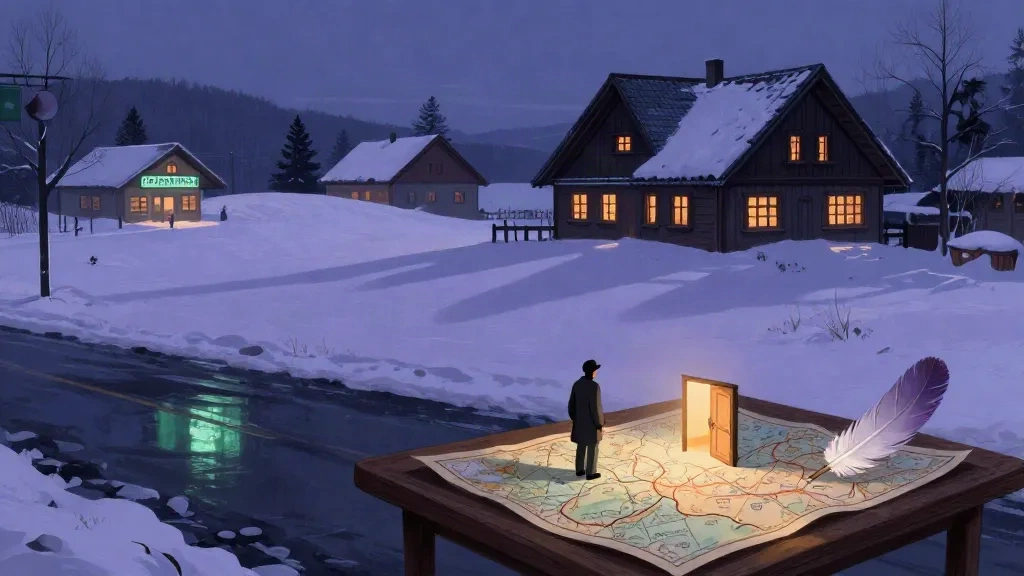
In her satchel lay two objects found inside a dead hotel in the Drowned March: a moth wing the size of a hand, translucent and lavender at the edges, and one white feather, dry after eighty years beneath the salt.
The Market of Expensive Truths
The market opened in the lodge cellar after midnight, between the boiler room and the old swimming pool. Stalls occupied corridors that had been bricked shut in the lodge’s first winter. Vendors sold borrowed names, unopened letters, childhood shoes, and jars containing the last sound of familiar rooms.
Everything valuable was true. Mara learned this when the woman at the silver stall offered a key cut from a house that had never been built.
“It will open one true wall,” the woman said. “You have chosen the honest price.”
Mara had no money, only the moth wing and feather. She placed them together. A pale green pharmacy-sign glow ran across the cellar, and every stall went silent.
The feather rose. The moth wing trembled. On the wall appeared a brass plate: PLACES THAT HAVE FORGOTTEN HOW TO EXIST. Admission: one destination.
Behind the plate, a clerk unfolded a map of the Bellwether district. Streets led toward vanished porches, a vanished school, and the vanished house where Mara had grown up. Doors crowded the drawing. Some opened onto beaches beneath black water. Others showed rooms crowded with forgotten people, waiting for permission to remain lost.
“You may restore one place,” said the clerk. “But you must first prove the place you are leaving.”
The clerk drew a door beneath Aurora Lodge. Beyond it waited wet asphalt, lavender fog, and the green reflection of a pharmacy sign that had burned down years ago. A gust carried the scent of rain through the cellar.
Mara recognized the street.
What the Map Owed
She stepped through.
The map folded around her like wet paper. She stood in an intersection where two seasons overlapped: snow above, rain below, both falling through the same empty air. A child in a red coat searched beneath the pharmacy awning. An old man stood beside a bus shelter holding a paper ticket whose destination no city possessed.
“You cannot restore us all,” the child said.
“I know.”
Mara opened her notebook. She drew the pharmacy sign, every cracked letter, the green glow reflected in black puddles. She drew the bus shelter, the ticket, the red coat. She drew the white feather beside the lantern and the moth wing resting on its edge.
Then she drew a door.
It did not open. The map resisted her, ink trembling at the corners. The expensive truth of the market returned: every erased place demanded that the living relinquish something equally real.
Mara understood. The refuge for lost things could not be built by remembering only what was missing. It would have to remain in the present.
She opened the door.
Beyond it stood Aurora Lodge, its windows warm against the storm. Ilyan was waiting at the threshold, holding the reception board beneath his coat. The missing names, the old horse, the drowned district—all waited behind him.
“Is it true?” he asked.
“Not completely,” Mara said. “But it is here.”
A Place to Put the Light
She set the map on the lodge floor, beneath the chandelier, and drew a door in the center. This time she did not use a vanished street. She used the space between them: a warm room with many windows, shelves for names, a stove, and a low table where anyone could leave something they had carried too long.
When she signed her name, the door opened.
The lost child entered first, carrying the red coat. The old bus traveler followed. Others came in a line that continued beyond the cellar, across the drowned street, through every forgotten place the map could remember. None vanished. None demanded replacement. They rested.
Outside, the shadows finally lifted from the snow. The first real guests arrived at dawn, carrying skis and suitcases and no idea that the resort had begun before them.
Mara placed the moth wing on the new map. Beside it rested the white feather, pale as fresh snow.
On the first page, beneath the door, she wrote a single destination: HERE.





