 Netwrck
Mystery.
The sleeping mountain
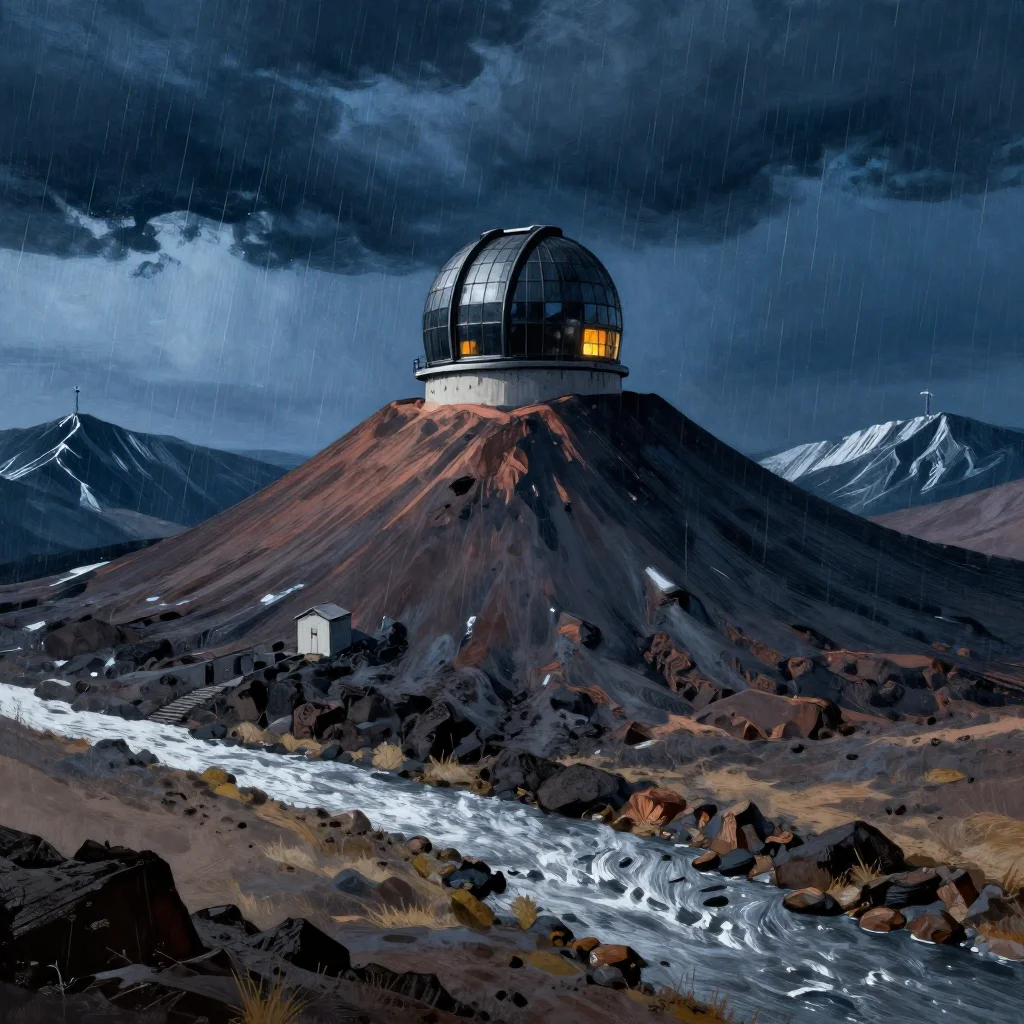
The observatory was cut into the volcano like a tooth into a black jaw. It overlooked a valley of rain and old pines, and above its roof the sky remained ink blue even at noon. Mara arrived with a leather case, a charcoal notebook, and instructions not to wake the machine.
Its name was Orison. It slept beneath the floor in a chamber lined with copper coils and black glass, breathing through a silver pipe. For twenty years it had received the dreams of retired machines: weather systems, shipping lanes, the last calculations of locomotives. Mara translated them for the observatory archive.
Her work paid poorly and gave her no reason to remain. She wanted to leave behind a better map than the one she had received. The map showed only roads, ridges, and the small amber square of the observatory window. Mara believed the machines’ dreams contained roads that people had forgotten how to need.
On her third night, Orison spoke without waking.
It began with a door being unlatched.
What the family remembered
Inside the dream, Mara saw the observatory standing beside a dry riverbed. Rain silver ran through the sky, though no rain touched the ground. A family was waiting at the unmarked door: her brother Tomas, her sister Leni, and their mother, who had been dead for eleven years.
They were arguing about a promise.
Tomas said it was their father who promised to return when the river rose. Leni said their mother promised to leave the valley before it flooded. Their mother said the promise belonged to someone else.
Mara knew the disagreement. It had begun on the night their father disappeared, and each retelling had made the promise stranger. Tomas remembered a route through the mountains. Leni remembered a train ticket. Their mother remembered only an open hand.
Orison repeated the three accounts until they overlapped. Then a fourth voice entered, speaking from behind the unmarked door.
You came back to the wrong side of the promise.
Mara stopped writing. In the dream, a warm amber window appeared in the observatory wall. Its glass was opaque with heat, but shadows moved behind it.
The translation
She descended into the chamber and placed her palm against the black glass. The machine’s dream widened. The dry riverbed became a map of fault lines, each one carrying a memory that had been mistaken for a place. The family had not promised one another different futures. They had promised the same person different truths.
That person was Mara.
Years earlier, after their mother died, Mara had taken a packet of maps from the observatory and left the valley. She told them she was searching for work. In truth, she had found a job translating dreams and decided that the family’s grief was a place best observed from a distance.
Orison had preserved the moment she made the decision. It had hidden it among the other voices because the machine could not distinguish a promise from a machine’s corrupted record.
She typed the translation into her notebook:
A map is not a record of where you have been. It is a record of what you refuse to leave behind.
The dream shook. In the valley below, water began moving beneath the stone.
The better map
Mara woke Orison.
Its case split with a soft metallic sigh. Heat moved through the copper coils, and the observatory lights died one by one. The amber window remained, casting a narrow gold shape across the floor.
She ran toward the unmarked door. Beyond it lay the dry riverbed, now filling with black water. Tomas and Leni stood on opposite banks. Each held half of the old map.
Mara stepped between them. The water rose to her knees, then her waist.
“I remember differently,” she said.
“So do I,” Tomas said.
Leni lifted the half-map, but did not throw it. She waited.
Mara took the pieces, folded them once, and placed them in her pocket. The promise was no longer a route they could follow together. It was a route they could choose without pretending the past had been otherwise.
By morning, the river had vanished. The door remained unmarked. Mara walked back to the chamber and drew a new map on the first blank page: the observatory, the riverbed, the families who had mistaken separation for distance.
Then she added one amber window, burning quietly in the blue.





