 Netwrck
Adventure.
The Cartographer of Vanished Places
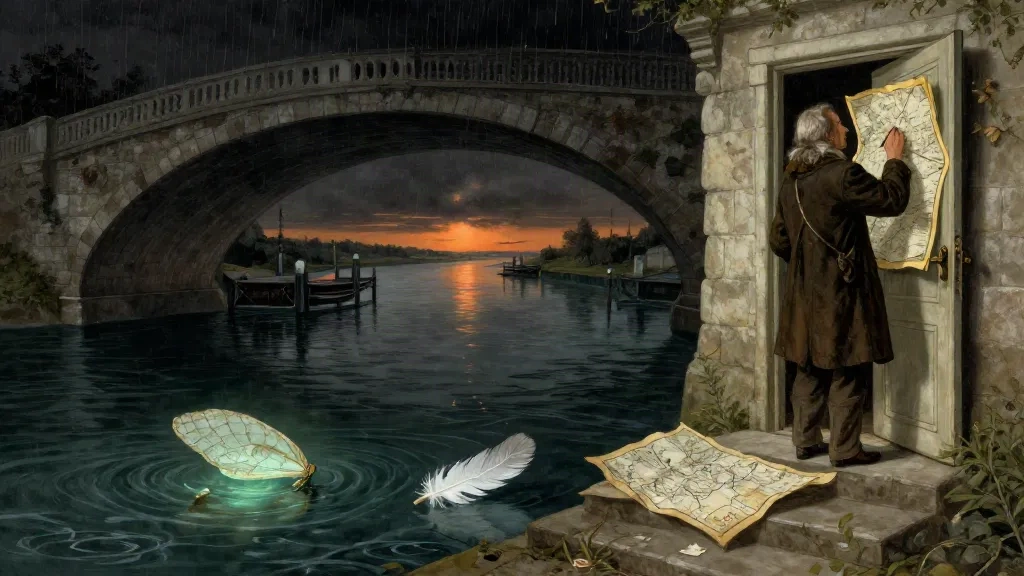
At sixty-one, Elian Voss drew only doors. Not entrances to houses or warehouses, but doors in places that had ceased to be: drowned villages, vanished orchards, borders removed from every atlas. Her hands remembered the pressure of coastlines no living surveyor could confirm.
She kept her instruments in a black-cherry cabinet beneath the north window of her rented room. There were no compasses, only blunt pencils, a brass ruler, and a moth wing sealed beneath glass. The wing had belonged to the pale moth that emerged for one night each winter from the old survey office. Its scales were the color of dust on abandoned stairs.
Every morning, Elian copied streets erased by floods. Her destination was always the same: a place where lost things could rest until no one remembered what they were.
Below her window, the River Sable ran between the town’s bridges. Each bridge bore a civic promise carved into pale stone. THIS CROSSING KEEPS WHAT IT CARRIES. NO DEBT CROSSES HERE. RETURN WHAT WAS BORROWED.
The river witnessed every promise. Children swore vows on its railing, merchants blessed their ledgers above it, and magistrates read judgments aloud so the current could carry the truth onward.
The Market That Would Not Lie
On the final morning of autumn, Elian followed a white feather down to Copper Quay. It lay on the steps of a market sheltered beneath a warehouse roof, where the horizon beyond the stalls shone copper beneath a rainless sky.
At one booth, a clockmaker sold watches that never stopped. At another, an old woman offered a compass pointing toward whatever its holder missed most. The expensive goods were always true.
That was the market’s law. A tin cup would be filled to its rim. A map would name the exact place to which its owner felt exiled. A mirror would show the buyer at the age they deserved to be.
Elian found a brass door handle on a velvet tray. Its price was one true memory.
“That is not an exchange,” she said. “It is theft.”
“The market does not deal in theft,” the vendor replied. “Only in choices.”
When Elian touched the handle, the market vanished. She stood ankle-deep in black water beneath the floorboards. Around her floated the lost things of the town: a child’s red shoe, a wedding veil folded into the shape of a bird, a soldier’s blank name tag. They drifted toward an open door sinking into the riverbed.
The moth wing beneath the glass in her cabinet began to tremble.
The Door in the Riverbed
Elian opened the passage with a map drawn on the back of an old pay stub. A door appeared only after she had established what no longer existed. The river had erased three drowned lanes, a vanished guildhall, and one entire hill.
She drew the door at the boundary where all three losses overlapped. A white feather drifted from the darkness and settled on her wrist. It was larger than a swan’s, luminous as winter.
Beneath her, the river rose.
A brass hand closed around the doorframe. The market’s vendor stood in the current, unclothed and unaged. Between them floated a wooden cradle.
“You are the woman I buried,” he said.
Elian recognized her own name written inside the cradle’s lid. She had spent forty years erasing places because maps were honest, and honest maps could not be made to forgive anything. Her lost daughter, she now remembered, had drowned in a road that no longer existed.
“You want peace,” the vendor said. “Take the cradle. I will return your daughter, and you will surrender the memory of why she died.”
Elian reached for it.
The white feather blackened. In the market above, the most expensive wares had begun screaming: true names, true directions, true reflections. The river was acquiring more witnesses than it could bear.
She understood the trap. She could recover her daughter, but only by making the river another place where the truth was traded away.
A Map Without a Promise
Elian drew the cradle on her map instead of taking it. Then she drew the current carrying it downstream, past the bridge marked NO DEBT CROSSES HERE.
“You cannot map what you refuse to claim,” the vendor said.
“A cartographer does not own a place,” Elian answered. “She records it.”
She struck a line through the cradle. The blank name tag turned white. The red shoe drifted homeward. The veil unfolded, and beneath it appeared a small hand no larger than a moth’s wing.
Elian did not close the door.
She opened it wider. Every lost thing rose from the river, carrying the pale-stone weight of forgotten lives. The market emptied. Across the copper horizon, the town’s bridges shone one after another, each promise briefly visible in the water.
By dawn, the drowned door had vanished. Elian’s cabinet stood open, its glass broken, the moth wing gone. On the floor lay a single white feather, dry as summer.
Years later, travellers spoke of a hidden place below the northern bridge where broken toys, discarded names, and surrendered years lay gently on black-cherry shelves. The river never rose above its stone threshold.
No keeper claimed the place. Elian did too. She had learned that rest was not possession, and that the most faithful map must leave room for what the mapmaker can no longer bear.





