 Netwrck
Speculative Fiction.
The Last Performance
Mara Venn had spent forty years drawing coastlines that no longer existed. She worked for governments and newspapers, then for anyone who missed a vanished village, a drowned street, or the exact shape of a childhood garden. By the time she retired, her hands had begun to tremble whenever she drew a door.
She did not choose that talent. Doors appeared only on maps of places gone from the world: a sealed mine, a demolished palace, the vanished western shore of Lake Ossa. In every room she had ever entered, she could have found the door she had drawn. She never did.
Then, in the winter of her seventy-third year, the theatre arrived.
It stood at the end of a charcoal avenue beneath pale winter light, its brickwork the colour of old iron. Across its marquee, in letters that changed as she watched, was the word UNFINISHED.
Inside, the audience sat silently before an empty stage. A young usher pressed a program into Mara’s hands.
Tonight’s discarded ending: The City That Refused to Sleep.
“Where is it performed?” Mara asked.
“After tomorrow,” he said. “You have brought a map.”
He was right. In her coat pocket, folded against her hip, was a survey sheet of the old railway yards. She had brought it to prove the theatre was not a dream, though she had not admitted the thought even to herself.
The Market of Expensive Truths
Behind the stage lay a market. Stalls crowded the backstage corridors, their wares arranged under bare bulbs: a wedding veil still damp with rain, a child’s shoe filled with salt, a brass key warm as a living hand.
The market sold truths. The cheapest were convenient ones. A lie about a train, a lie about a debt, a lie about a person who had already gone. But the expensive truths stood behind glass on the highest shelves: that a city had burned; that a king had been murdered; that a child had survived the flood.
Mara found the stall she wanted. Its sign read: WHAT WAS LOST WILL REST HERE.
Behind the counter, a man in a red velvet coat examined her map. “You want a place for lost things,” he said.
“I want one safe place.”
“That is more expensive.”
He named a price: a memory of her mother’s garden, the exact hour she had left it, and the moth wing she had carried since childhood.
Mara placed the wing on the counter. It was pale, scales rubbed to rust, and trembled without wind.
The man’s smile disappeared. “That is not a price.”
“Then what is it?”
“A key.”
What the Maps Refused
He told her the theatre performed endings discarded by the future. Every night, the losers waited backstage. Cities, forests, names, bodies, seasons. They had no place to remain because the world had finished deciding what they meant.
Mara drew a map of the lost garden from memory. The lines became a narrow room, then a corridor, then a door.
“You cannot map a resting place,” the man said. “Rest is not a location.”
“Everything has a location,” she answered.
She drew until her wrist failed. The door opened into a theatre beneath a winter sky. Rows of seats held abandoned endings: a wedding interrupted by sunrise, a battlefield after the last flag, a house where every occupant had forgotten the same evening. In the rafters, white feathers drifted through the dust.
One feather landed on her hand. A moth wing lay beside it, folded like a tiny door.
Across the stage, a girl in a rust-red coat sat alone. Mara recognised no one. The girl lifted her head.
“You came late,” she said.
Mara looked at the map. The theatre had drawn a door behind tomorrow.
The Ending Discarded
She crossed the stage.
“I can take you somewhere,” she said.
“Somewhere real?”
“Somewhere that remembers.”
The girl rose. Behind her, the actors waiting for tomorrow’s performance began to dismantle the scenery. Stone walls became painted flats. Forests became ropes and canvas leaves. The market’s expensive truths rang like bells in the empty auditorium.
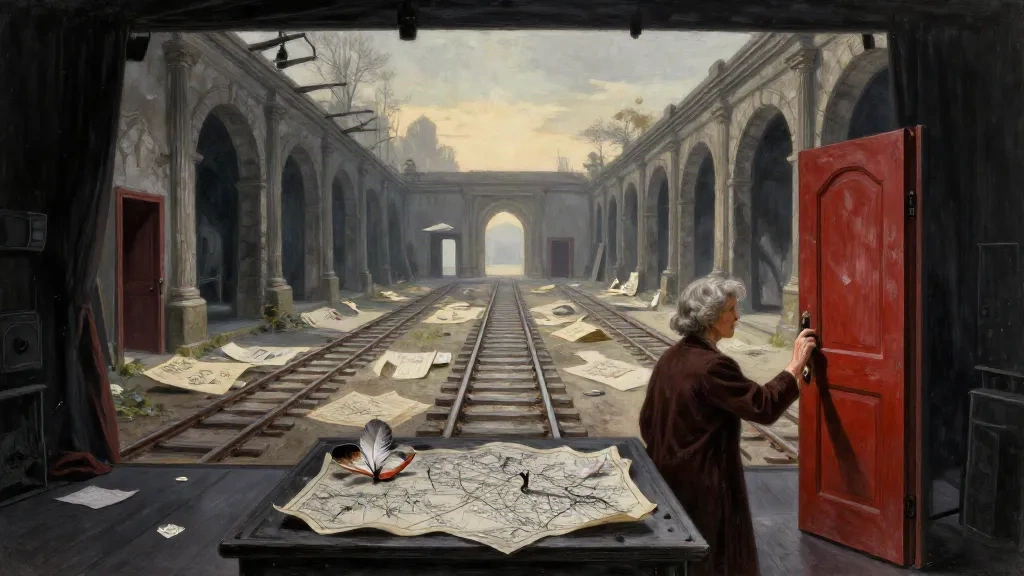
Mara opened the door she had drawn. Beyond it waited the old railway yards, white with frost, the tracks vanishing beneath a low red moon. She placed the moth wing and feather on the threshold.
The theatre folded itself around the place. Stone became warm. Frost became dust. The rust-red light entered the charcoal corridors and showed walls, benches, small windows, a roof strong enough for rain.
Lost things came forward.
Names. Shoes. The last leaves of orchards. A dead language. A thousand doors that had once led nowhere.
The girl in the red coat looked back at the stage.
“Will you stay?” she asked.
Mara took out the map. Every blank space had become a room. Every room had a door.
“Not as a cartographer,” she said. “But yes. There is still work to do.”
The theatre began its performance without her.
At dawn, the man in the velvet coat found the map on the counter. He saw a new place marked in careful lines: a sanctuary beneath a pale winter sky, where nothing had been forgotten and nothing had been discarded.
Its door was open.
He smiled and placed a white feather beside the ink.
From somewhere beyond the stage, a bell rang once, and the lost places finally had somewhere to sleep.





