 Netwrck
Folk Horror.
The theatre of discarded endings
By the time Mara Venn returned to Earth, the sea had stopped behaving like a map. It lay beyond the black windows of the orbital elevator, folded into a silver argument, while the continents below wore names that no longer agreed with the stories attached to them.
She had not come home. Her capsule touched no ground. From the station’s highest cupola, she watched the cities flicker on and off like furnaces in a house where someone had forgotten to close the door. The official reports called the planet stable. The children’s broadcasts called it a rumour. Mara believed the broadcasts, because children had never mistaken a warning for a comfort.
Her contract had ended years ago. The agency had sent three polite letters, each folded into a blue square. The fourth contained her green stone, returned without explanation.
It sat in her palm now, smooth, cold, veined with a mineral green no terrestrial geology could name. She carried it everywhere. At night she placed it against the cupola glass and watched the dawn arrive in an impossible cyan.
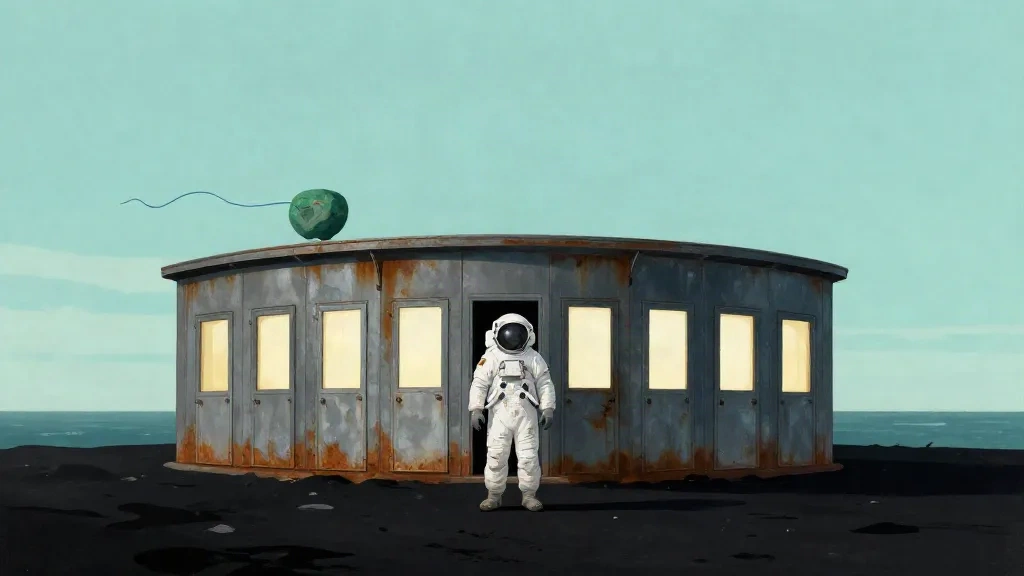
On the station’s lower ring, a small theatre had opened between two airlocks. Its sign was made of salvaged letters: TOMORROW’S DISCARDED ENDINGS. Beneath it, someone had written: Please do not applaud the door.
Mara entered because the theatre was the only place where Earth still seemed unfinished.
The voice behind the scenery
Inside, the auditorium smelled of dust, pine needles, and rain trapped in velvet. Bare bulbs burned beneath a ceiling painted with a sky that had never occurred. The stage held twelve doors, each wearing a different number.
The caretaker was a small man with a face folded into pleasantness. He explained that every night the theatre performed endings people would have lived if tomorrow had chosen differently. The discarded ones. The almost.
“Can I hear a voice?” Mara asked.
He smiled without opening his mouth. “That depends on whose voice you mean.”
She drew the green stone from her pocket. The caretaker’s smile vanished. Behind him, a blue thread trembled across the floorboards, stretching from the stage into the wall.
At once, the theatre filled with overlapping whispers. Some belonged to strangers. One was a child reciting numbers from a weather report. Another was her mother, asking whether the stars had looked that close when she was young.
Mara crossed the stage. “I want the voice history used as background noise.”
“History?” The caretaker lifted one shoulder. “People leave the volume low when they want to forget who is speaking.”
He pointed to door seven.
On the other side, Mara heard herself launch from a coastal field. She heard the rocket climb. She heard the first breath taken in vacuum, magnified through a speaker until it became a weather system. Then a voice beneath the static:
You are hearing me because the world has learned to speak over me.
Mara pressed her hand to the door. The green stone warmed. The blue thread tightened around her wrist.
When the storm moved the walls
At midnight the storm arrived.
It did not touch the theatre. It moved through it.
Doors swung inward without hinges turning. Corridors folded into the auditorium. The stage rotated beneath Mara’s feet, carrying door seven away from her while the caretaker’s voice came from behind the walls.
“The storm rearranges doors while people are inside them,” he shouted. “Never choose the nearest exit. It may be the one you entered by.”
Mara seized the blue thread and followed it. It led beneath the seats, through a trapdoor, into a narrow passage lined with mirrors. In each mirror she saw a different Earth. One was thriving. One was underwater. One had no moon.
In the last mirror, Earth was only a rumour spoken by a fleet of satellites.
Mara looked at herself inside it. No green stone. No blue thread. Just an astronaut in an old suit, floating above a planet that had forgotten how to look up.
The voice came again, now from the mirror.
Stay there. Let them call themselves a world without you.
She struck the glass.
What the dawn required
The mirror broke outward into the theatre. Frost covered every seat. The impossible dawn had entered through the shattered doors, soft cyan light pooling over the iron stage.
Mara stood in it with the green stone in one hand and the blue thread knotted around the other. The caretaker bowed.
“You can keep the voice,” he said, “or you can return to the sky. Not both.”
Mara had spent seven years refusing to leave orbit. She had told herself it was courage, then duty, then habit. The truth was simpler. Earth had become a rumour, and rumours are easier to love than a place that can disappoint you.
But the voice had not asked her to save the world. It had asked to be heard.
She set the green stone beneath door seven. The blue thread unwound and passed through the keyhole. At once, every discarded ending began speaking at once.
Mara listened until the storm went quiet. Then she opened the door and stepped onto the stage.
Behind her, the theatre closed.
At dawn, a green stone appeared on an empty shore, wrapped in blue thread. No one found it. No one needed to. Somewhere above the water, a voice that had once been background became the first sound of morning.





