 Netwrck
Weird Fiction.
Tomorrow’s Discard Bin
Mara repaired hinges for doors whose houses had failed to exist. This was steady work. Each morning brought commissions stamped with addresses already erased, measurements copied from blueprints no architect admitted to drawing, and hinges so immense that three oxen could not lift one leaf. She worked in saffron-yellow light, grinding until sparks settled into the smoke-grey air.
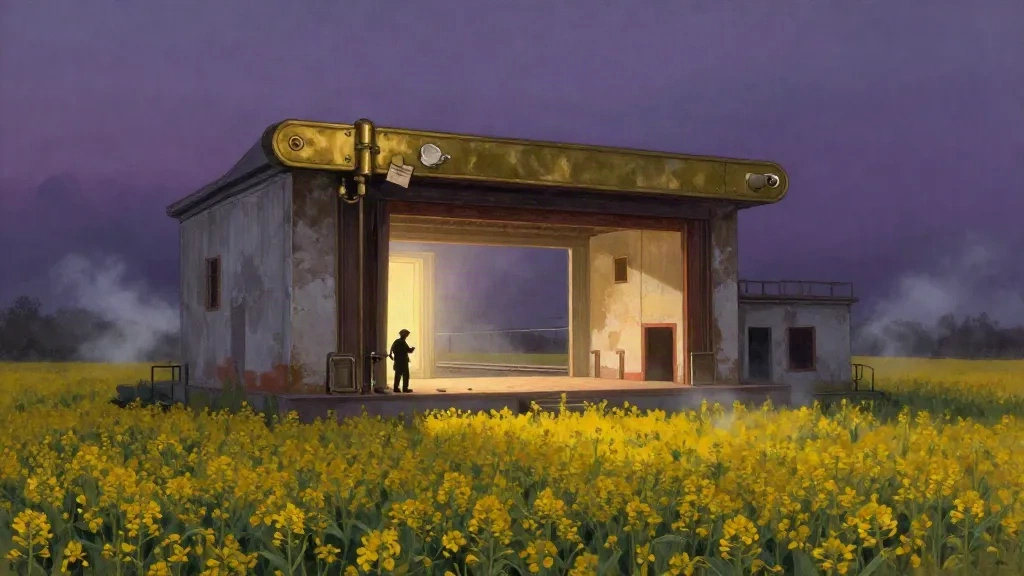
Behind her workshop, the Brass Hinge Theatre raised its velvet curtains each midnight. It performed only tomorrow’s discarded endings: a city sinking beneath a bell, a queen returning as her own plague, a river declaring every promise void. Seats sold well. Tragedy had a loyal public, especially when certainty waited in the lobby.
On the seventh night of Saffron Rain, Mara took a stage door in her teeth.
Beyond it lay a vestibule dressed in deep plum. A railway timetable floated against the far wall. Midnight departed, but every minute afterward had been crossed out in wet black ink. From beneath a tarpaulin came the patient ticking of a clock.
That was how she found the ending.
The Unbuilt Room
The set showed a kitchen with loose floorboards, a blue kettle, and a window facing fields. A woman in an apron entered carrying a train ticket. She placed it beside an empty teacup, kissed the child sleeping under the table, and left by the garden gate.
Then the scenery folded. A narrator’s voice declared that, at last, the woman understood the destination of all journeys, and the room collapsed inward.
“The ending is unfinished,” Mara said.
“It is not performed,” replied the house from somewhere under the boards. “There is a difference.”
Mara found an iron crowbar in the wings and pried up the stage. Beneath the kitchen lay the actual room: whole walls, a warm chimney, dust softening every edge. The child slept. The woman’s train ticket rested beside the teacup, though the kettle had never boiled.
Mara took the crowbar. The theatre’s hinges groaned behind her.
“The ending is tomorrow’s property,” the house said. “You cannot carry it into the present.”
“It is leaning over the railing,” Mara said. “And I know how to mend what hangs crooked.”
She pried apart the final hinge. A door appeared in the room’s west wall. Beyond it lay a platform under saffron lamps, a departing train, and the woman running toward it with blood on her sleeve.
There was still time to choose. Not rescue. Not prophecy. Choice.
What Closed the Matter
Mara began building the door. She shaped new hinges from her largest stock and carried them into the unbuilt room before dawn. The platform beyond the door advanced one minute whenever her hammer fell.
By the third night, the performance drew full houses. The Brass Hinge Theatre announced a special presentation: Mara Is Dead. In the finale, a bright detonation erased the stage. The recovered ending had been sold.
The theatre’s owner, Master Pell, found her in the engine loft beneath the velvet seats. He was a narrow man dressed in smoke grey, carrying a clean cup and no water.
“People require uncertainty,” Pell said. “Leave it untouched, and they purchase the theatre to feel certain they have escaped it. Let them see tomorrow intact, and attendance collapses.”
“You profit by closing the mystery.”
“I preserve the market.”
He offered her the theatre. She could keep every hinge, every workshop, every comfortable assumption. In return, the unbuilt kitchen would be struck from the stage after the final bell.
Mara took the empty cup from him and struck its rim against a hinge. The sound was small, ordinary, and entirely unsellable.
The Bell That Did Not Fall
At midnight, the audience watched the kitchen again. The child woke. The woman entered carrying the train ticket. She saw the platform through Mara’s door, looked at the sleeping child, then set the ticket beneath the teacup.
She picked up the child.
Pell cut the stage power. Saffron work lights vanished. Deep-plum scenery kept its colour beneath emergency smoke. Somewhere overhead, departing wheels began to slow.
Mara struck again. The theatre rose around her on thousands of hinges, every seat tilting toward the stage, the stage folding toward the workshop, the workshop opening onto the fields beyond the unbuilt window. For three suspended seconds, there was no correct inside.
The audience climbed through the scenery. Some carried their own unfinished choices. Others brought only questions, which was enough. Pell reached for the main lever, but the door had no hinge he could close.
By morning, the theatre stood beside a real kitchen in real fields. There was no timetable on its wall, only pale squares where somebody had once believed tomorrow fixed.
Mara left an empty teacup on the sill. Beside it lay a train ticket with no destination printed on it.
Some futures are not cut short. They are frightened of the ground they will have to meet.





