 Netwrck
Folk Horror.
The Last Undelivered Letter
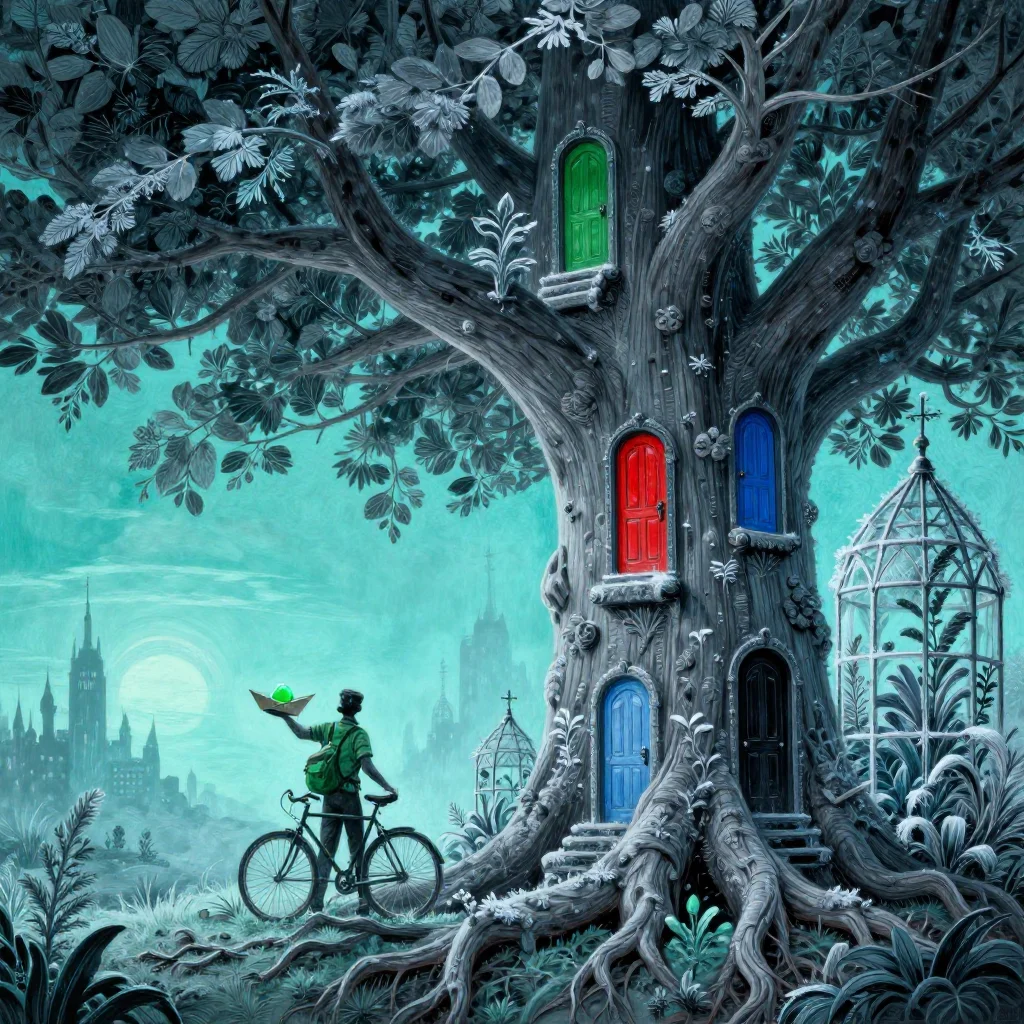
Mara’s bicycle had one impossible habit: it turned toward closed doors.
She noticed it on her third delivery to the botanical garden, where an iron-grey trunk rose through eleven glasshouses and bore doors instead of branches. Narrow green doors in the bark. Red doors sealed with frost. One tiny blue door at ground level, fitted with a brass knob polished by many patient hands.
Across the courtyard, the garden’s iron gate remained locked. Beyond it lay the town, the railway, and the black river. Yet when Mara rode past the gate, the bicycle pedalled itself three times and carried her through the blue door into a lane she had never seen.
That lane existed only for a few seconds. She delivered a parcel to an elderly woman, accepted a paper boat in return, and found herself back inside the garden with frost whitening the tyres.
Now the future had stopped sending letters.
Not slowly. Not occasionally. Every postbox in the city was empty, every pneumatic tube silent, every scheduled delivery cancelled. The government issued notices explaining that people had become too busy to write. Mara, who had spent nine years carrying words between strangers, did not believe them.
At the base of the door-bearing tree, she waited with the paper boat in one hand and the green stone the old woman had pressed into her palm.
The Land That Was Listening
The gardener found her there before dawn.
He was a narrow man in a coat sewn with seed envelopes. Frost silvered the grass around his boots. When Mara showed him the boat, he unfolded one corner of it and discovered tiny black writing beneath the crease.
“Instructions,” he said.
“From whom?”
He placed the boat on the soil. The paper swelled as if rain had fallen on it, though the sky remained clear. A line appeared in dark ink:
Bring the listener to the eastern glasshouse before the first door opens.
Mara asked where to find the listener. The gardener looked toward the roots.
“You brought one in your pocket.”
The green stone was warm now. When she set it against the trunk, the bark rippled like water struck by a stone.
One of the red doors opened.
Beyond it waited a winter road beneath a cyan sky. Frost whitened every fence. Iron birds hung from telegraph wires without moving. Far away, a city stood in silhouette, bright with windows, though no smoke rose from its chimneys.
Mara recognised the street. She had delivered letters there as a child.
Then the gardener told her about the treaty.
Two centuries earlier, the land had sued the first families for clearing its forest. In exchange for grain, medicine, and the right to enter the gardens, the settlers had signed away one thing they had believed belonged to them: the right to keep their thoughts private.
People had laughed when it was read aloud. Written thought was not spoken, surely. A letter sealed in an envelope remained an exception. A diary locked in a drawer was not confession.
But the land heard paper breathe.
Every private intention pressed into ink had been absorbed by the roots. Every unposted message remained there, legible, waiting.
“The treaty is why the doors exist,” the gardener said. “The tree grows where the law and the forest agree.”
Mara’s bicycle rang its bell inside the glasshouse.
What the Future Wanted
The bicycle had gone without her.
She found it beyond the red door, resting in the snow beneath the impossible dawn. Its front wheel pointed toward the distant city. The saddle held a fresh bundle of letters.
There were thousands.
Each envelope bore a date from the next day, the next year, decades she had not lived. Mara opened one with numb fingers.
“Mara, if you are reading this, you have finally asked why we stopped.”
The handwriting was hers.
She tore open another. Another. Another.
Across them appeared the same message in different hands, all written by people who had inherited the future’s silence. The city’s thoughts had become too heavy for its descendants. Every hope, apology, declaration of love, and last request remained trapped beneath the soil.
To send even one letter, the future had needed a courier. Someone whose bicycle could pass through sealed boundaries. Someone who would ask the question no one else had thought to ask.
Behind Mara, the garden doors began opening.
First one. Then ten. Then hundreds.
Red, green, blue, and iron-black rectangles appeared throughout the winter branches. Through each came a sound: conversations in empty houses, wheels turning on abandoned roads, waves breaking against a future shore.
The treaty made no sound, but Mara felt its attention settle over her like frost.
The land had permission to listen. It did not need permission to answer.
The Unsent Message
Mara placed the green stone on the bicycle’s handlebars. Its glow joined the soft cyan light bleeding over the horizon.
Then she put the paper boat into the nearest snow.
It did not sink. Its sides rose like fins, and it moved downstream, carrying every thought the future had trapped into the iron river.
The bells began.
Inside Mara’s bundle, thousands of envelopes struck one another at once. The sound was almost unbearable. Doors slammed in the distant city. Glasshouses cracked from root to roof.
The old treaty remained valid. The land had heard. The land had answered.
But nobody had asked whether the future wanted silence.
Mara gripped the handlebars and pedalled into the cyan dawn. Behind her, the doors folded inward like closing eyes. Ahead, the unwritten city waited.
She had come seeking a letter from tomorrow. She carried only one.
In its blank space, the green stone glowed: a small, patient light against the frost.





