 Netwrck
Speculative Fiction.
The Note in the Wood
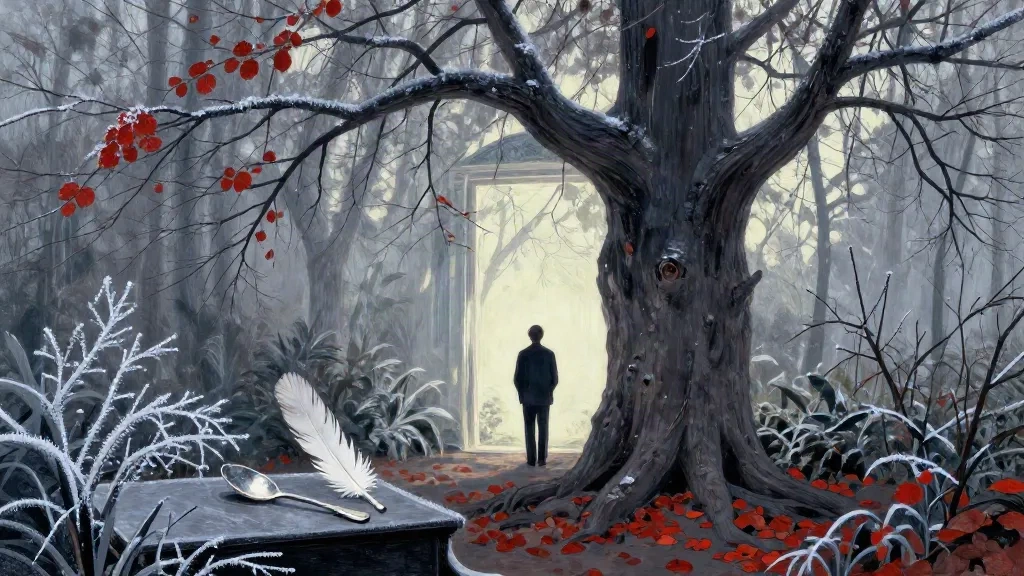
Every autumn, the tree at the center of the botanical garden produced doors.
They opened in the trunk without hinges, their edges thin as birch bark. Behind them lay rooms that had not existed before: a salt marsh under a violet moon, a railway platform occupied only by crows, a kitchen where an old woman argued with a kettle. Gardeners catalogued each one. Visitors paid to knock.
On the first day of the long winter, Mara Venn heard a note.
It came from the lowest door, painted rust red and furred with frost. A boy was telling his sister that their father would not return from the northern ridge. The child said it plainly, though his voice shook. Mara heard a clear sound above the strings of the garden’s empty pavilion, a note without a source.
She named it the truth-note.
By dusk she had heard seven.
Mara composed each one into short pieces for her instruments. A lie made no music. A polite evasion made only a thin, sour vibration. But a true confession opened a chord in the air, clear enough to tune.
Her desire was simple and, she told herself, practical: to build something that could survive the storyteller.
She meant a song.
A House Against Winter
She began with a melody recorded from the gardeners’ confessions. A glazier admitted that he had sold the garden’s best lamps to pay a debt. A botanist confessed that the white-feathered bird nesting in the eastern glasshouse was not a bird at all. A child said she had seen a silver spoon floating beneath the ice of the reflecting pool.
Each truth-note entered the song.
By the second winter, the season had become a generation. No one remembered spring. The canals froze beneath a rust-red sky, and the tree’s doors sealed shut by morning. People burned furniture in the public halls. They ate bulbs, bark, and seed stored in locked cabinets. The garden became a gray country of rationed breath.
Mara’s song was nearly complete.
She kept one white feather from the eastern glasshouse on her piano. Whenever the wind moved it, she heard the note she had never found: the sound of her mother saying goodbye.
She also kept a silver spoon, polished thin from constant handling. As a child, she had eaten from it during fever. Her mother had promised that whenever Mara was lost, the spoon would point toward home.
That winter, the spoon pointed north.
What the Tree Kept
On the coldest night, the tree opened a door.
No one had touched it. The wood breathed out warm air carrying the smell of wet soil. Beyond the threshold was summer, green grass moving under a white sky. A girl stood there with her back turned, holding a white feather and a silver spoon.
Mara crossed the threshold.
The season behind her collapsed. Frost raced across the garden, closing doors, freezing instruments mid-note. She had brought her unfinished song, but not enough of it. The girl turned. She had Mara’s face.
“You built it to remember us,” she said, “not to release us.”
The truth-note sounded inside Mara’s chest.
She understood then that the tree had not been growing escape routes. It had been growing witnesses. Every truth admitted through one winter remained in the wood, waiting for a voice large enough to carry it forward.
Mara had mistaken endurance for preservation. A song could not keep winter away. It could only make room inside it.
The Door She Carried
She sang beneath the white sky.
First came the rust-red note of the sealed doors. Then charcoal notes for the builders, gardeners, and children who had survived. The melody rose through the borrowed summer and struck the threshold.
The real garden answered.
One by one, the lost voices returned: the glazier’s confession, the botanist’s secret, the boy who had spoken for his sister. They did not erase the winter. They filled it.
Mara’s mother was last.
“I left because staying would have taught you to leave quietly,” the woman said.
The note was unbearable. Mara held it anyway.
When she returned, the spoon pointed toward the piano. The white feather lay beside it, untouched by wind. Outside, pale winter light entered the garden for the first time in a generation, falling through the open door onto the dark floor.
The song had not survived the storyteller.
It had survived her.





