 Netwrck
The Midnight Change
At midnight the river took its breath backward and ran uphill toward the hills.
Foam climbed the western bank and slid away from the sea, carrying leaves, corked floats, a drowned hen, and the black upright shape of a door that had no business sinking. Along both quays the lanterns came alight without being lit, one after another, the way a man walks a dark stair he has memorized. Under a violet dusk the water shone the color of a split shell. On the eastern side the people of Vey kept one hand on their shutters and watched the neighboring town of Orison appear across its former course.
Orison had burned forty years ago. Sava’s mother had been nine years old and had smelled it from here, a sweetness under the smoke that she never afterward managed to name in any other language. Yet each midnight the steep roofs returned, complete with narrow windows and lanterns moving behind the glass. Citizens still crossed the dry riverbed with bowls of milk and set them on the oldest stones. Nobody admitted knowing whom they fed. The town council called the bowls a courtesy. The children called them the tax.
Sava came down from the copper watchtower with a salt jar under one arm and a glass seed sewn inside her sleeve. She had crossed to the dead town twice: once as a child, carried on her father’s shoulders past the line of stakes, and once as a woman of nineteen, wading a winter flood toward her sister’s voice. Only the second crossing had returned her. On the return she had been eleven days gone and had left her boots, her wedding ring, and a great deal of her appetite behind in Orison, and she could not say, even now, which of the three she missed most.
She earned her living four streets up, above the dye yard, in a shop whose painted sign still read The Kettle and the Fretting because her grandmother had been too poor to repaint it and her mother had been too proud. Sava mended distances. Not cloth: distance. Torn friendships, ruined roads, the long silence between a living husband and his dead wife. Her customers brought her their quarrels wrapped in cloth, and by morning they could no longer remember why they had begun. The work cost nothing and paid everything, and that was the trouble with it. Sava had never mended a wound so willingly that someone stopped noticing it had been made.
“You want them to forget,” Toma said that week, the boy apprenticed to her since autumn, “but you never ask what they’d have to forget.” He was fifteen and quick with the needle and had already begun selling short hours of quiet in the market, three coppers for a quarrel between two fishwives. “Ask them. Then they choose.”
“Then they choose forgetting and forget that they chose,” said Sava. “Go home, Toma.”
The Agreement in Bone Dust
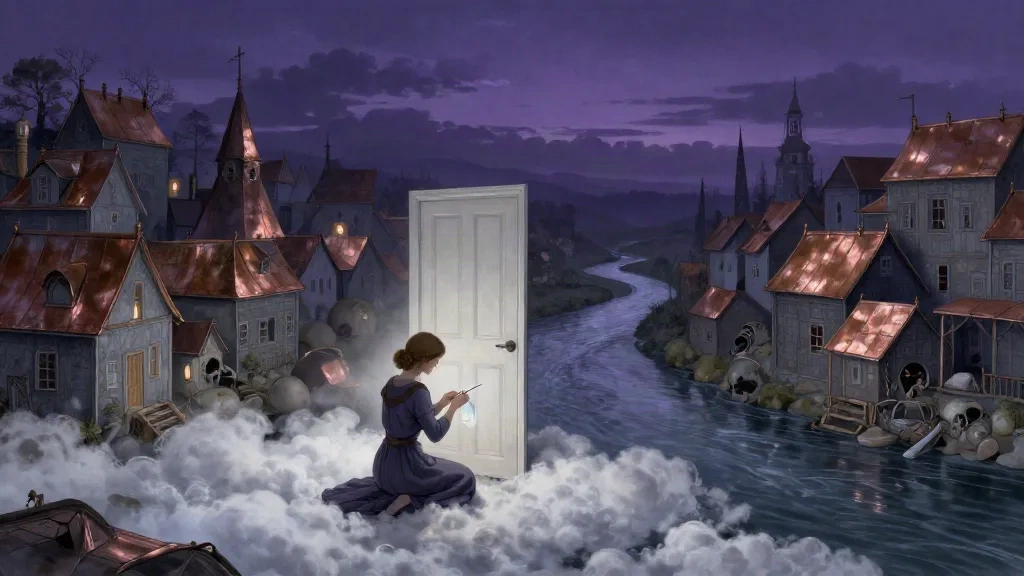
The door waited at the center of the exposed riverbed.
It was tall enough for four armed guards abreast and narrow enough for a seamstress alone. It had no hinges and no lock. Its frame was cut from cloud-white wood that had never been a tree, and its center was water, moving with the reversed current. Letters floated beneath the surface, pale as fish bones, and turned over and over without ever arriving at an edge.
A leather roll hung from one of the black studs in the frame, stiff with salt, sealed with wax the color of a bruise. Sava broke it with her thumbnail. Inside, the village agreement had been written in Chancery, the old tongue Orison had spoken before the fire, in a hand that had doubled every descending stroke to make forgery harder. It had been forbidden for four decades. Reading it aloud in Vey was a fine. Reading it well was a hanging. Reading it believing it was, technically, treason against nobody, and this was how Sava came to be kneeling in the mud at one in the morning with her hands flat on a door made of running water.
She could not read a word of it.
But when she pressed her fingertips to the leather, the words rose through her and arranged themselves in the taste of ash and cold water:
EACH BORDER REQUIRES TWO WITNESSES, ONE SPEAKING FOR THOSE WHO STAY, ONE SPEAKING FOR THOSE WHO GO. NEITHER MAY OPEN WITHOUT THE OTHER’S CONSENT.
A second sentence resolved on her tongue, slower, as if the door had learned it reluctantly.
THE DEAD MAY BE ASKED, BUT ONLY THE LIVING MAY AGREE.
She waited. The water in the frame guttered. Then a third clause came up through the salt in her fingertips, and this one had been cut deeper, the strokes fresh, the ink still wet after forty years.
THE WITNESS WHO SPEAKS FOR AN OTHERS MUST SPEAK AGAINST THEIR OWN INTEREST, OR THE STITCH HOLDS BUT THE DOOR DOES NOT.
Her throat tightened. A door that opened only by mutual consent was a fair principle, the kind of principle her mother had taught her to sew with in border towns along the Siphon: two colors, two threads, one knot. But a door with no living mayor to grant consent was a trap, and this door was worse than a trap. It was an audit.
Because Sava knew, everyone in Vey knew, what Vey’s interest was. The Siphon had been cut in the spring after the fire, when the old king’s engineers found that Orison’s spring ran under a ridge and could be led a mile and a half east into the orchards at Vey. Vey’s three mills, its dyed cloth, its copper watchtower, its forty years of never once going hungry: all of it stood on stolen groundwater. The orchards of Vey were an orchard of another town’s water, brought through a ditch that never entirely dried.
Consent, in other words, would have to cost Vey the one thing Vey had.
What the Dead Refused
First she tried asking the river.
She cast the salt jar into the water beneath the door and spoke for Vey: We will keep the crossing closed. We will not open the door. Go down. The stream loosened, whisking silver east, and the frame held. Across the bed the shutters of Orison slammed in a rising chatter, and beneath the drowned streets the bells began to ring, not loudly, the way a child rings a doorbell with a whole household inside.
Then Sava placed her palm against the center of the door. It was not glass, though it looked like a bead of frozen sky. The seed lay inside it, formed out of the color of a winter dawn, and when she pressed her thumb against it, the door spoke in her sister’s voice.
“You promised to come back for me.”
“I did.”
“You left the door open.”
“Ilma—”
“Not the door in Orison.” The voice was patient, which was worse than anger. “I mean the gate. In the March of the Fire, on the ninth, when the wind came over the hill. The gate stood open all day and the wardens drank at the trough and no one would let us in. I stood in the water up to here.”
Sava had been five. She remembered the ninth of March only as a smell of wet ash and a long afternoon. She had spent thirty years arranging that afternoon into a private drowning and had never once asked who had held the gate.
Across the bed, a woman in a copper mourning dress came down from the tallest house in Orison. Her face was Sava’s own face, younger and washed clean by flame, and she did not stop at the door, and she did not ask to come in. She stood eight feet from it, the way you stand from a stove you once burned your hand on.
“We are not asking to come home,” she said. “We are asking for the water.”
And Sava understood, with the clarity that only comes at three in the morning in a riverbed, how bad the arithmetic really was. The third clause demanded that Vey’s witness speak against interest. Vey’s interest was the Siphon. To speak against it, the town would have to consent to give back the spring, one measure at a time, forever, and the third well would fail by midwinter, and the northern orchard would go to cider instead of fruit, and somebody in this town, some particular person with a particular name, would end the year hungry because the dead were being polite.
The dead were not innocent either. Orison’s council had spent two winters arguing about the spring before the fire, and had gone to the king with a demand for a share, and the miller Hanno Vey had answered that demand with a lamp and a bucket of oil, and the same Hanno Vey’s grandson now sat on Vey’s council, and the same ditch carried the same water, and nobody had ever once had to confess to anything.
Sava drew the glass seed out of the door and held her needle above it. She could mend this distance. She could mend anything: two brothers who had not spoken since their father’s funeral, a road washed out, an entire town’s forty years of pretending. In her shop, women laid their wedding cloth under her scissors and by dawn could not remember why they had ever hated their husbands, and the husbands came back the next week cheerful and ruined and bought more cloth.
But the dead had never been mended. Only lulled.
“The town will lose its ancestor,” said the mayor from the Vey bank.
“Your ancestor drowned in our ditch,” said Sava.
“Your ancestor burned it.”
“Your ancestor’s grandfather held the gate.”
The mayor did not answer that, and in the silence Sava heard how badly she wanted to.
The Mayor’s Arithmetic
Pell Agrin came down the eastern bank in a coat with no buttons, because she had pulled the buttons off the night the water reversed, in the first year, and had never replaced them, and nobody could say whether that was penitence or theater. She was sixty-one and had been mayor for nineteen of them and had buried four people in a drought that Orison had never had to bury anyone in.
“Cut it,” she said. “Not a stitch. All of it. Take your needle to the frame and cut every thread, and the contract dies with the door, and Orison goes back under the river for good.”
“And the spring?”
“Stays where the king put it. The king is dead. The agreement is dead. A thing that cannot be read cannot be enforced, and a thing that cannot be enforced cannot be blamed. We stop the bowls. We stop the midnight bells. We let the river be a river and the dead be a story we tell the children in winter so they learn not to be cruel in March.”
It was, Sava thought, the best offer anyone had made her in ten years of being careful. It solved the water and solved the haunting and cost the town nothing it could name. It also meant, precisely and exactly, that Orison would be erased again — not by fire this time, but by the far quieter instrument of a clause that had been cut in deeper ink than the rest.
“That makes the dead a prisoner of forgetting,” Sava said. “Which is a cell. You have just built a nicer one.”
“I have built a dry one.”
“You have built one without a door that can be opened from the inside.”
Pell Agrin looked at the mud, and then at her own hands, ruined by forty years of pulling rope and stinging nettles and other people’s grief. “Then tell me what consent costs, Sava, since you are so fond of the price of things. Tell me what the clause wants from me.”
“It wants you to say a true thing that hurts Vey to say.”
“I have said several of those this week.”
“It wants you to say one you cannot take back with a reason.”
The mayor was quiet a long time. Above them both the midnight lanterns guttered, and across the bed the dead woman stood her eight feet from the door with her hands loose at her sides, waiting, in the manner of the very patient, for a number to be finished.
A Door That Could Refuse
Sava sat down in the mud beneath the frame and took out her good needle, and Toma came running down the bank with a lantern because somebody had told him there was going to be sewing, and she sent him back, and he went as far as the stones and sat there instead.
“I can mend the frame,” she said. “I can join Vey to Orison and north bank to south bank and hold the seam for as long as there is cloth. What I cannot do is sew your consent into one piece and call it a joining. That would make obedience look like agreement, and then the door would be a very beautiful thing that opens when it is opened.”
“The clause,” said Pell Agrin. “Against your own interest.”
“Against your own interest. Yours is the one it wants.”
So Sava did what she had done for ten years with other people’s grief: she asked, and she did not suggest. She went up and down the Vey bank in the two hours before dawn with her notebook and her blunt pencil, going door to door, asking each person the same question. What would Vey give up, and mean it, and go on living after?
They gave her the wrong things first. The baker gave up the festival. The miller gave up his grudge against the eastern bank, cheaply, and then added that he had given up the grudge twice already. A woman of sixty said she would give up the right to call herself a good woman, which brought a small uncomfortable silence into the room in which she lived. The old ferryman said he would give up knowing that he had been forgiven, and Sava wrote it down and crossed it out and told him why, and he nodded, because he was eighty and had been waiting forty years to be told.
The answer came from Ilsa Renn, who mended nets in the shed by the eastern quay and had lost a son to the drought of the ninth winter. “The third well,” she said. “One night a year, back into the bed, forever. And every seventh winter the rest goes with it. We lose the north orchard. We lose the good clay. My grandson’s grandchildren will not have the west field.”
“Yes,” said Sava.
“And you’ll sew the seam on that?”
“I’ll sew the seam on that.”
Ilsa Renn thought about it a long moment. “Then I say it to the door, and I say it where my son can hear me, which he can’t, and I say it anyway.”
Eleven voices in the end. Some small, some large; a net-mender, a boy of fifteen who gave up his certainty that the milk bowls were silly, a woman who gave up her right to be angry at the Hanno line, and Pell Agrin, who stood at the water’s edge in her buttonless coat and said the one sentence she could not unsay with a reason.
“Vey will return the third well to Orison’s bed on the winter solstice, one night a year, and every seventh year the whole flow, and the north orchard goes to cider, and the clay goes to river, and no one in this town is to say again that the water is ours. We give it because it is theirs, and we will not be thanked, and we will not be forgiven, because forgiveness is not what we are owed and is not what we are offering.”
Then Sava sat beneath the door and cut the seam.
The first stitch joined Vey to Orison, and the thread went in wet and came up clear, the way good thread does when the cloth is willing. The second joined the north bank to the south bank, and the reversed river leapt a foot in the air and settled. The third she left loose: a length of thread with no needle at the far end, hanging, so that anything on either side might take it and pull when it was ready to.
“If the dead will not cross,” she said, “they are not being kept out. They are declining. And if they come one night, the loose stitch is the one they will have to pull. I will not sew shut what must be reopenable, or I will have made a cage with excellent workmanship.”
She stitched the glass seed into the unfinished seam. It held the pale light of the dead town, and for a moment the whole frame was a lamp, and Orison showed through it in reverse, its people walking their drowned square, unhurried, going about the business of a Tuesday that had happened in another century.
At dawn the river began its return. Its foam withdrew toward the east, thinning around the door’s feet, and the door swung inward, as a door does when the house behind it is empty. It opened into mist on both sides: Vey’s road led to Orison’s square, and Orison’s lanes led to Vey’s market, and the connection was entirely without traffic. No spirit entered. No citizen vanished. The bells stopped. The dead woman raised one hand, palm out, the way you touch glass, and did not cross, and behind her other shadows stood up at their windows to watch her not cross, and that was the shape of their consent: they let it be a door instead of a rescue.
The Loose Stitch
Nothing in the town thanked Sava. The opposite happened, slowly and in the correct order.
First the water. On the first solstice the third well ran backward for one night, and Ilsa Renn stood in her shed and watched the bucket come up with mud in it, and said nothing to anybody for a week. By midsummer the north orchard had gone to cider. By the third winter the well had failed in earnest, and the town bought water from Hanno Vey’s grandson at four times the old price, and paid it, and hated Sava with a specificity that would have been impressive in a better cause.
Then the milk. The bowls stayed, but nobody pretended about them any more. Children carried them down at dusk and learned the names on the stones, all two hundred and eleven, and Ilsa Renn’s son’s name was the first one a child in Vey could recite. The council asked Sava whether this was necessary. She told them what the clause was, and one of the councilors, a young man, said that was very well but the dead did not get thirsty, and she said that the dead had gone without for forty years and the living could manage one evening of inconvenience, and the young man laughed at her and then, in the spring, put a stone of his own in the ground and did not tell anybody.
Then the shop. The third loose stitch had a price Sava had not itemized: to sew a frame that could refuse, she had to give up the only needle in Vey that mended more than cloth. Her power had never been hers; it had been the cloth’s, and she had been spending it. After the solstice she could still mend a torn hem, a split seam, a sleeve gone at the elbow, and she did it well, and slowly, and with thread.
Customers came at first and then stopped coming. The woman who had laid her wedding cloth under Sava’s scissors for eleven years and woken without a reason to hate her husband came instead to Toma, who could not do it, and wept in the shop, and Sava let her, and did not pretend it was a loss. The guild wrote to say that her right to open for mending had lapsed, since her certification was in the mending of distance and she had surrendered the instrument. She appealed. The appeal took two years and cost the house its front step, and the guild denied it in the fourth month of the eleventh winter, and Sava put the Kettle and the Fretting back on its sign and let it lie.
Toma stayed. He had become the town’s cutter, and Vey hated him for it, and the apprentices came to him with complaints and left with questions. He learned to sew the shape of a hole and to leave it, which is the harder stitch and the one nobody pays for.
On cloudy nights, the door remains where the river forgets itself. It opens only when two voices say yes — one for those who stay, one for those who go — and it closes the moment either voice, mortal or dead, is permitted to say no.
Once a year, through the loose stitch, Ilma speaks. She never asks for anything, because the dead got very tired of asking in their lifetime, which is how one arrives at a fire with a bucket. What she says is a fact, delivered the same way every year, in the flat voice of a woman reading a measurement:
The spring is not theirs.
And once a year the people of Vey stand in the square and hear it, and the ones who are very old remember hearing it before, in another March, from the other side of a gate that was open all day, and say nothing, and go home, and drink their water, and find it, every seventh winter, a little heavier than it should be.





