 Netwrck
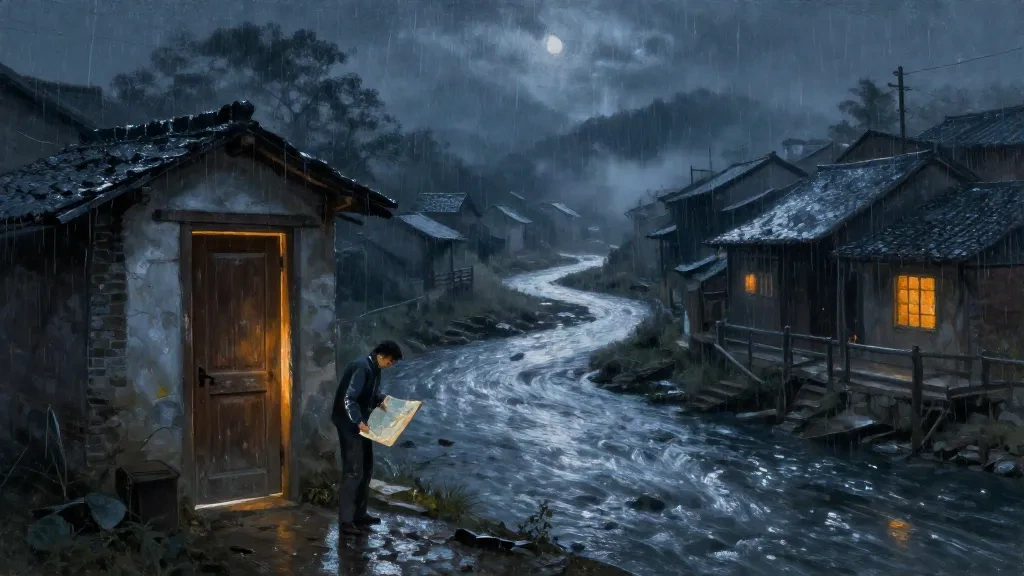
The Hour of Reversal
At midnight, without thunder and without rain, the Vey turned and flowed uphill.
Elian waited beside its silver-black water with her brass case of tools and the unfinished map folded under her arm. The map had come from the Ministry of Roads two months earlier, after the boundary dispute, printed in iron-grey ink: four streets, two bridges, a stone marker, and a single red line showing which parts of Bellweather legally belonged to the northern bank. It was accurate only when the river faced south. Every official in the valley carried a copy, and every official knew to hide it under the floorboards before midnight.
Her work was to translate the dreams of sleeping machines. Lock-keepers. Mill cams. Tram brakes. Weather towers. They murmured in voltages and rotating sequences, and she gave their sleeping shapes words, and the words went into record books that the Ministry graded, stamped, and paid her for.
She had learned early that a machine's dream was not a message. It was a pressure. The river gauge did not warn; it complained. It had complained every year of her life, and every year she had copied the complaint into her notebook in a clean, small hand, and the notebook had gone to the Ministry, and the Ministry had graded it unremarkable, and no one had ever asked what the gauge had been standing on.
That night the only machine awake in Bellweather was the gauge itself, a squat iron pillar bolted to an unmarked stone in the shallows. Its dream came down her earpiece as a procession of hinges turning underwater, patient, and then impatient, and then patient again.
One by one its pulses repeated the same phrase: At the sixth door, remember correctly.
Across the water, one window glowed amber. Everyone in Bellweather kept their lamps dark before reversal. Dark houses were how a town apologized to a river for what it had done. That window belonged to her mother.
Elian closed the notebook. She did not write the sentence down. Writing was how a thing got owned, and she was professionally very good at making other people's pain legible to men who would never have to carry it.
What the Family Remembered
She crossed by the upper bridge. The current pressed against the pillars, carrying leaves, silver rain, and a wooden door beneath her feet.
The door had no handle, no number, no hinges, no paint. It was simply there in the dry riverbed, upright and unharmed, while water climbed around it.
Her mother waited inside the amber room with an unlit lantern on the table.
It was not dead, Elian thought, and then, the way a thought arrives that you will pay for later, it was.
“You took the river gauge,” her mother said.
“It said the sixth door.”
Her father answered from the dark hall, without raising his voice, the way he had delivered every survey finding of his life. “There were five.”
Her brother followed from the stair. “There was one.”
Elian set her case down. She had spent eleven years asking machines what they meant, and the machines at least admitted when they were damaged. “Which one of you is telling the truth?”
Her mother touched the paper. “Your father promised to take us across before the river turned.”
“He promised to destroy the road,” her father said.
Her brother struck the table, hard, so the lantern jumped. “You promised to bury the proof.”
“That was your mother.”
“No.”
The chimney flashed amber. Somewhere beyond the walls, iron hinges turned over.
Elian thought, with the professional calm she had built specifically for moments like this, that her family had been damaged in three separate directions and had then been kept together, for thirty years, in the dark, by an agreement no one could repeat in the same order twice. The river carried each memory toward a different century. Her mother remembered the promise. Her father remembered the promise as an instruction. Her brother remembered only being left to hold one end of something while both adults let go.
None of them were lying. That was the trouble. The Vey had taken one true version each and filed them in different years.
“You are all describing the same night,” Elian said. “You are just describing it from different sides of the water.”
The Three Instruments
Her father was the Ministry surveyor who had drawn the red line. She knew his hand in the margin notes of her own childhood copy of the map: small, impatient, illegible at any scale. He had drawn the boundary, and he had told her for twenty years that a boundary was only a promise made visible, and that a promise made visible was stronger than a promise made out loud.
Her mother had kept the lantern. It had been on the crossing table, the night the family went over, and the wick had never been lit afterward, and every year her mother polished it and set it out and did not explain.
Her brother was a registry boy at the Ministry office in Bellweather, which meant he copied maps all day, and had been copying this one since he was fourteen, and had not once been asked to.
“All three of us did all three things,” Elian said.
Nobody contradicted her. Nobody agreed either.
The Bend in the Street
Her mother opened the amber window. Rain turned to needles in the light, and the room filled with the smell of wet slate and cold iron.
“The Ministry map erases the old crossing,” her mother said. “Every time the river reverses, it comes back. The line is the only thing that holds while the water walks.”
Elian laid her own copy on the table, weighted with her brass tools, and looked again at the street beneath the amber window. There was no sixth door on the paper. There was no sixth anything. But the street bent where no street should have bent, a shallow impossible angle, as if the cartographer's ruler had been asked to keep a secret and had only pretended to.
She drew it in. One line. Then another.
The gauge whispered in her ear, under the rain. A map is not where the world stays.
“Mother,” Elian said. “How many doors were in the riverbed?”
Her mother looked at the lit window for a long time. “Does it matter how many there were? Only how many of them the town can carry.”
Her father had gone. She heard his boots in the street below, unhurried, and then her brother's, faster, catching up, and then neither.
Elian heard the sixth door unlock before she saw either of them reach it. The sound was small and domestic, like a latch in a farmhouse kitchen, and it made her hands go to her tools before she could stop them.
The Sixth Door
She ran through Bellweather's sleeping streets with her map open to the rain, because she could not close it and could not leave it behind, and half a mile later she understood that this was the whole argument she was going to have with herself for the rest of her life.
The Vey swept over the old bridge and struck the houses with a sound like a book closing. A door passed beneath the water. Then another. Then a third, gone upstream with leaves turning on it like hands.
At the dry bed her father and her brother stood on opposite sides of the unmarked door, so that anyone who looked at them from the road would see a family divided by something they refused to name. The current streamed over their shoulders toward the hills.
“We did not come to open it,” her father said. “We came to prevent you.”
“From what?”
“From drawing what it contains.”
“Tell me what it contains.”
Her father had the look he had worn in her childhood, in front of a burned foundation and two men from the Ministry, when he had chosen the word verified and it had cost him a house. “A century the river took. Not the water. The year. Everything that happened on this bank between the last reversal and the next, while the water was walking. The people in it. Their claims. Their addresses.”
The rain went on. Somewhere behind her the amber light in her mother's window thinned.
“So the red line,” Elian said slowly, “is not a border.”
“It is a lid.”
“And you drew it.”
“I drew it because you were six,” her father said, “and I was the only man in the valley who could write a straight line and mean it.”
Her brother laughed, one short breath, no humor in it. “And I have copied it every year for sixteen years so that no one would look at it long enough to ask what it was for.”
Elian understood then, standing with the water climbing her boots, that the family's agreement had never been a secret. It was a job. Somebody had to remember correctly, and every century of the Vey had taken her family apart by handing all of them the same job and none of them the instructions. Her father had sealed. Her mother had kept the seal from being relit. Her brother had made the seal look ordinary. And she, the one who made sleeping things speak for a living, had spent eleven years translating a river that had been screaming the same word into her ear since she was nine years old.
“If I draw it,” she said, “the door opens.”
“If you draw it correctly, it opens once and stays open,” her father said. “If you draw it the way the Ministry draws, you have opened nothing and you have erased the only reason anyone still remembers there was a crossing.”
“And if I leave your line?”
Her brother answered, because it was his turn, and he had earned it. “Then in forty years a stranger comes with a Ministry seal and a clean sheet, and there is no one left in this town who can tell him what he is looking at. And he will write that it was never here.”
A Better Map
The amber window began to go out. Dawn was close, and with dawn the river would turn again, and the town would wake up to a wet silence in which nothing had been admitted.
Elian took out her knife. She had three choices, and she understood all of them, which is the only difference between judgment and panic.
She could erase the bending street, restore the Ministry's four roads, let the bell-shaped hill stay a mystery, and be the good translator again: unreadable, ungraded, employed. Her father would go on being right. Her brother would go on copying. Her mother would go on polishing a lantern she refused to explain. Some of that was peace. She had to admit that some of that was peace, and that was the worst of it.
She could draw the sixth door and leave the red line, which would be a lie with two halves that did not touch.
Or she could cut the line out.
She thought about the north bank. The red line was the only thing standing between the Halloway farms and a claim to the Bellweather side, and the boundary dispute two months ago had already put a Ministry assessor in the valley, and an assessor who found an unmade road under a hill would not be pleased, would be curious, and would be incurably honest. Cutting the line would not merely reveal a door. It would dissolve the legal ground of the town into a question.
“That ends the north bank,” her brother said, watching her. “You understand that's what you're doing. Not to us. To people who never heard of any of this.”
“Yes.”
“And your gauges.”
“Yes.” She thought of the record books, the stamps, the clean small hand. “Yes, I know. I'd like it on the map that the translator was the one who did it.”
Then she cut the red line away, all of it, in one long pull, because a boundary removed in pieces was still a boundary.
And she drew: the dry riverbed with its five doors, the upper bridge with no eastern end, the street that bent, the stair that had no room at the bottom, and the sixth door under the bell-shaped hill. She drew the red line's absence as well, a wide honest blank, because a map that lied about its own omission was only the Ministry map with better handwriting.
Where memory had failed she left space. Not many pages of it. Enough.
“You have made us visible,” her father said.“No,” Elian said. “Readable. There is a difference, and it is the only one I have.”
She gave the map to her brother, because he was the one who had been copying the lie for sixteen years and had the most practice knowing where the ink went.
Upstream, under the hill, the unmarked door opened once. Not wide. Far enough to see a room full of tables, and on every table maps turning toward different mornings, and at each table a person with her own face bent over a sheet, ruling a line.
Then the Vey reversed.
The Morning After
Water rushed downhill, lifting the wooden doors out of the bed. Five of them went, and floated, and struck each other in the current like men arguing in a queue. The sixth remained, upright, dry, its blank face pointing at the sky.
Elian left Bellweather at noon. The rain had stopped and the town smelled like a wet cellar. On the quay the assessor from the Ministry was already there, standing over her discarded Ministry copy with the red line on it, and he was reading, and his face did the thing she had seen it do once before, which was to stop moving entirely.
“This is not a survey,” he said.
“No,” she said. “It's a report of what was surveyed over. There's a difference. The difference is that the report was written by someone who was standing in the water.”
He would send it upward. It would take eleven months. The north bank claim would go into a room in the capital and come back as a question, and the question would be about a line that was no longer there, and there would be no version of the answer in which Bellweather came out clean. She had done that. She had done it on purpose, with her own hand, and she was going to be asked to justify it by people who would never be able to hear the reason.
Behind her mother's amber window something caught the light that was not a hand. A small steady flame, low, at table height, where a lantern had stood unlit for thirty-one years.
The brother came out with the new map rolled under his arm and the registry sack on his back, because he had resigned by breakfast and had gone straight to copying, the only skill he had ever been given, and now the only skill anyone in Bellweather would need: the patient reproduction of a thing nobody had invented.
He put his hand flat on the paper, feeling the ridges the knife had left in the paper, and said, “The gauge. What will it dream now?”
Elian had listened for it through the whole reversal. It was still awake. It was dreaming, patiently, the way a thing dreams when it no longer has to shout.
A map is not where the world stays, it said, but it is where the living say they live.
The north bank ran downhill for three days. On the fourth, without any ceremony, the water turned and went back up the valley past the bell-shaped hill, and in the dry bed the sixth door was still there, and a woman with a brass case of tools sat down on the silt in the rain, opened her notebook, and began, at last, to write down what it had been saying all her life.





