 Netwrck
Adventure.
The Empty Place
At the center of the Museum of Doors stood a kitchen scarred by smoke, its copper pans hanging above a black-cherry stove. Mara Kest came every winter to cook there. Each recipe gathered its missing eaters: grandmothersto arrive dust-ringed, dead sailors to criticize her salt, childhood friends to steal bread from the plates they no longer owned.
Her family legend concerned the final plate in that kitchen. Mara’s great-grandmother, Ada, had supposedly served an unnamed traveler a bowl of black-cherry soup during the drought year. The stranger had then opened a door in the dry riverbed beyond the museum and crossed toward a copper horizon, carrying away the courage to begin again.
Mara wanted to prove Ada had not invented the journey. She wanted one witness to step through that door and remember her name.
What the Recipes Remembered
She cooked Ada’s recipe exactly: black cherries preserved without sugar, pale barley, vinegar, a strip of cured onion. The first bowl summoned Ada herself.
The old woman appeared on the kitchen stool, younger than any photograph. Steam rose between them. Mara asked about the drought. Ada told her about rain in April, a cracked copper cup, three peaches ripening in winter. She denied the traveler and the door.
“A legend is only hunger wearing an ancestor’s coat,” she said.
Then she tasted the soup.
Recognition struck Mara before Ada looked up. The old woman began naming the beach where she had buried a yellow cup, the song her mother refused to sing, the dog that had guarded her against thunder. The second spoonful took the memory of Ada’s face.
Ada remained at the table, astonished and unafraid, but Mara saw a stranger.
The Umbrella at the Riverbed
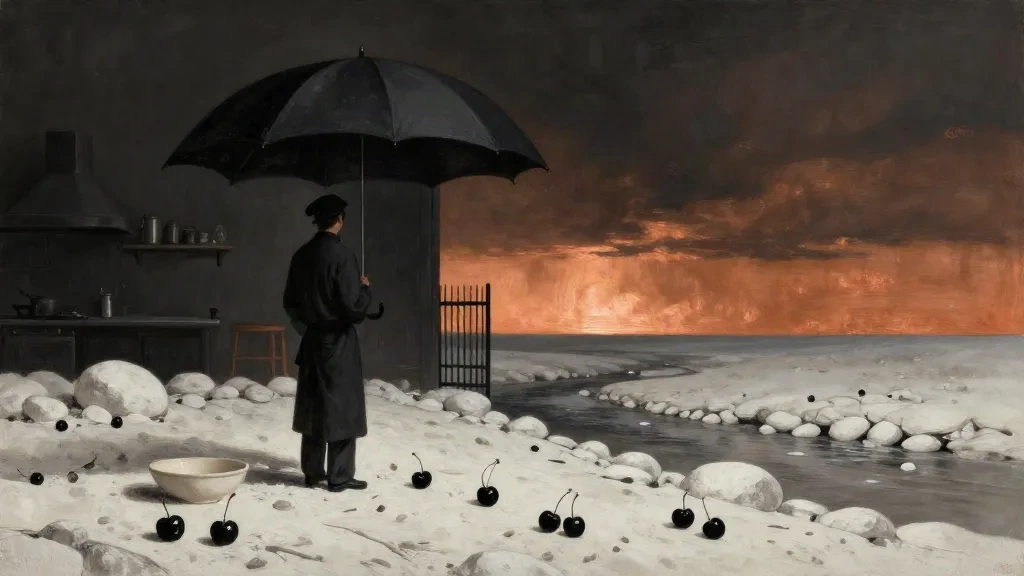
Beneath a black umbrella, Mara found the dry river among the museum exhibits. White stones formed its banks; copper dust filled the cracks. At its center waited a narrow black gate.
Three words appeared above its lintel: One Memory, Entered Once.
The museum keeper had warned her not to look back. A recipe could summon its eaters, but no table could call the same person back after they had forgotten. Courage, according to the gate’s warning, required surrendering the memory of why you had needed it.
Mara understood at once. She could remember the courage and lose Ada, or preserve Ada and remain outside forever.
The umbrella turned in a wind with no rain. In its curved black surface she saw herself serving soup to a gray-haired stranger beneath a copper sun. Before he lifted his head, Mara recognized the way he held his spoon.
Her father, missing for thirty-two years.
The Last Serving
She did not open the gate immediately. First Mara returned to the kitchen and cooked every recipe she knew: Ada’s barley soup, the bitter fish her father had praised, the plum tart her brother had carried into the desert. Around her appeared the family’s lost tablemates. They passed dishes, argued about salt, and accepted the food she had made from their remembered mouths.
At dawn, Mara placed one black cherry in a pale stone bowl.
Her father arrived with mud on his sleeves and the drought wind in his clothes. The gate had sent the first taste of the soup across the years, preserving the moment before memory could be taken. He looked at Mara as though she were a stranger who had remembered his name.
“You are Ada’s,” he said, surprising her. “She promised I would be the last one to eat.”
Together they walked to the dry river. The black umbrella shielded them from copper dust. Mara gave him the final spoonful, then pressed her hand against the gate.
Its cost took the taste of every dish Ada had cooked, the smell of her kitchen, and the exact shape of her face. Mara remembered having loved someone. She could no longer remember why.
The gate opened inward.
Beyond it, not darkness waited, but a broad copper horizon under a pale sky. Her father stepped through without fear. At the kitchen table behind her, Ada laughed at something none of them could remember, and strangers began passing bowls from hand to hand.
Mara shut the gate. The black umbrella lay across the dry stones, still open. She carried it home, though by morning she had forgotten why it mattered.
Years later, she returned to the museum and made black-cherry soup for a grieving child. He ate, laughed, and told her the legend of a woman who traded away every detail of her mother, but kept the courage to serve an empty chair.
Mara smiled as though hearing it for the first time.
Then she ladled another bowl.





