 Netwrck
Historical Fantasy.
The Guests of Absence
By November, the shadows of Brackenwell had learned to arrive before the trains. They slipped beneath the lamplight of the mineral hotel, pooled on frosted platforms, and climbed the shoulders of anyone foolish enough to wait in the last dark hour. The village called it an old fashion, but Nurse Elin Vale knew better. She had spent nine winters easing fevers, resetting bones, and silencing the coughs of children who sensed trouble in the chimneys. A house that suffered before its people did required a more delicate remedy.
Her first patient this season was the Marrow house. Its windows breathed mist even in a sealed room. Its pantry clock ran backward, and every cup upon the table filled with black water when touched. Elin brought lavender, salt, and a bottle of winter bronchitis mixture, but the family would not have needed the mixture. They needed the parlor restored.
When she asked what ailed the house, the daughter pointed toward the speaking tube beside the mantel. “Papa has decided to leave us,” she whispered.
“Then let him go,” Elin said, though the words felt like closing a door in a storm.
“That is what I cannot bear,” the daughter replied.
Elin understood. A departure could be trusted; a departure denied became an appetite. It sat at the table, filled the best chair, and asked to be loved until the roof gave way.
An Error in the Timetable
At the stationmaster’s office, Mr. Sorley had laid out a railway map in black chalk and tobacco brown ink. He was a narrow man with narrow spectacles and the calm of someone who believed civilization was chiefly a matter of properly spaced trains.
“Your patient, Nurse Vale,” he said. “The Marrow house. Its ending is scheduled incorrectly.”
“No house has a timetable.”
“Everything does. Birth is an arrival. Illness is a delay. Marriage is two tickets issued for one destination.” He tapped the map, where blue lines joined beneath the mountains. “Death is only a train leaving without the necessary revisions.”
Elin set a railway ticket on the desk. It was damp despite the stove, though no rain had fallen since midsummer.
“Master Edric Marrow intends to take the 8:10 tomorrow,” she said. “His daughter asks him to stay long enough to speak plainly with him.”
Sorley examined the ticket. “Then the train is wrong.”
“The train is not the illness.”
“Nurse.” His pencil stopped. “If a man says he will leave, people call it sorrow. If the timetable says he leaves, we call it fact. Someone must correct the disagreement.”
What the Red Scarf Remembered
That evening, Elin went to the Marrow house with Sorley’s station lantern and the red scarf she always carried. It had belonged to her brother, who had gone east during the war and never sent word. She never wore it. She used it to bind the sick: around a fevered wrist, above a bleeding cut, once around a door handle that had begun drawing blood from anyone who touched it.
The scarf tightened in her hands.
Its wool carried a remembered rhythm: three knocks, a pause, three more. Behind the speaking tube, the Marrow house was silent.
Elin opened the tube and heard wind moving through a railway carriage. Then Edric said, “If she asks whether I regret it, tell her I do. If she asks whether I am afraid, tell her I am.”
She felt the house inhale.
“If she asks whether I love her,” he continued, “tell her she will become cruel if I stay.”
Elin closed her eyes. The girl had been cruel because silence let a child imagine every cruelty. Edric had stayed because love had made him afraid of being needed.
Sorley struck a match beneath the paper ticket. A blue flame opened in its center.
“There,” he said. “An error.”
“No,” Elin answered. “A truth with a bad delivery.”
The Last Platform
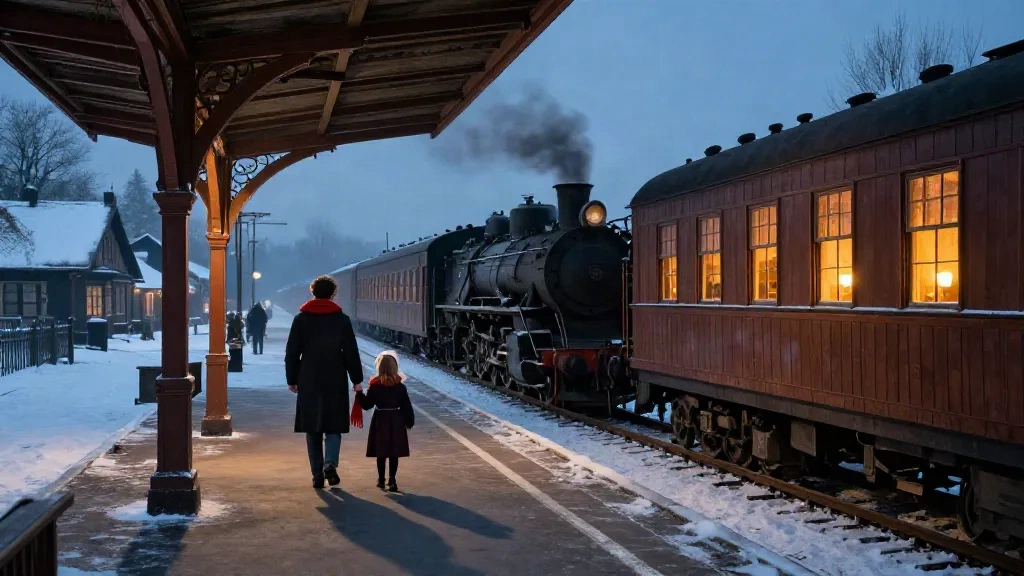
The 8:10 had not arrived. Beyond the station windows, however, its shadow lay across the rails, engine first, patient and black. The red scarf streamed toward it as though the wind had found an old allegiance.
Edric stood beside the ticket barrier with his daughter beside him. Neither spoke. The house had followed them: its windows glowed in the station glass, its chimney sent a thin plume through the roof, and its shadow sheltered the platform.
Sorley adjusted his spectacles. “If I hold the departure,” he said, “the ending waits.”
“An ending can wait,” Elin said. “A person cannot be held to it.”
She unwrapped the scarf and placed it over the daughter’s shoulders, leaving one end in Edric’s hand. The red wool joined them without force. The scarf carried warmth, not magic; permission, not command.
“Tell her plainly,” Elin said. “Not as a father leaving for work. Not as a weather that cannot be altered. As yourself.”
Edric looked at his daughter. “I have been afraid that you will need me more than I can give.”
She answered, “I already need you less. That does not mean I need you not at all.”
The station clock trembled. The shadow train released one white plume. Then Edric took the ticket from Sorley’s hand and tore it once down the middle.
The 8:10 arrived empty, its lamps reflected in the snow. The Marrow house exhaled. Every window in Brackenwell brightened, and for the first time that winter, the shadows had nothing to claim.
Sorley smiled mournfully at his timetable. “Then that is all we have changed.”
“No,” Elin said, gathering the red scarf. “We changed what a ending is for.”





