 Netwrck
Historical Fantasy.
The House With No One Inside
Every bridge in Bellwether carried a promise carved beneath its stones. The river witnessed them all, keeping the words in its slow brown memory. The oldest bridge promised safe passage. The newest promised a market on the far bank. None had yet learned to keep its mouth shut.
Mara Venn, the village nurse, knew the town by its ailments. Not people alone. Houses.
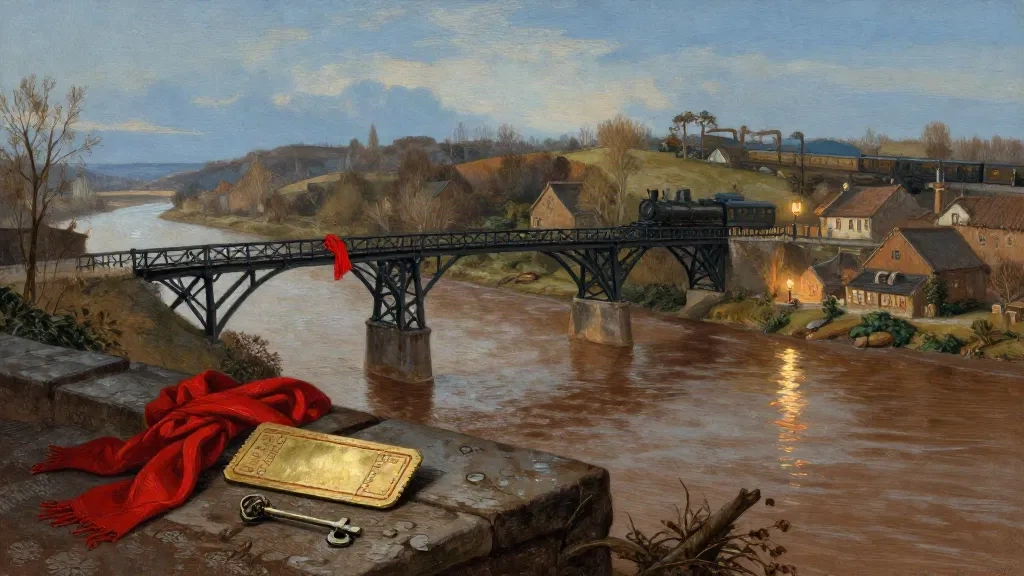
She entered the abandoned customs house with her black medicine bag and a red scarf wound twice around her throat. The scarf had belonged to her brother, Tomas, before he left for the northern line. In the kitchen, the hearth breathed cold smoke. In the upstairs bedroom, wallpaper peeled into long strips, revealing the same gray wall beneath.
“Homesick,” Mara said, setting down her lamp. “That’s all.”
The house answered with a floorboard that split beneath her heel.
At the station, the stationmaster arranged tickets beneath his brass clock. He was a lean man in tobacco-brown wool, forever checking the departure board as if numbers could be persuaded to change.
“Your brother’s train leaves at six,” he said.
“I know.”
“Then stop saying goodbye as though he were already dead.”
Mara placed the red scarf on his counter. A folded ticket lay beside it, dated tomorrow, with no destination written on the face.
“He asked me to meet him at the east bridge,” she said. “Before one of us leaves.”
“A promise?”
“An apology.”
The stationmaster smiled without warmth. “Apologies are not scheduled. I have retired the entire category.”
A River-Side Consultation
Mara returned to the customs house after dark. The windows had filled with reflected candlelight, though no candle burned inside. In the parlor, she found a woman seated beside a portrait.
Her face was thin and familiar. Not a ghost. Worse: a version of Mara’s mother as she had looked on the morning she walked down to the river and never returned.
“You cannot mend this by leaving,” the woman said. “The house has been waiting for an answer.”
“What answer?”
“Whether the promise was ever true.”
Mara looked at the portrait. Her mother wore the same red scarf. The same blue-gray light touched both faces.
“I was six,” Mara said. “I told Tomas our mother would come back when the river brought her.”
“Did it?”
“No.”
Outside, the river struck the pilings with a measured knock. Steel blue moonlight trembled across the water. The house groaned, and the portrait split from nose to chin.
On the table lay a brass key. Mara had never seen it before. It was warm as if recently carried.
“The east bridge,” the woman said. “Take the key. He is waiting where the promise begins.”
Mara took it. The house settled around her, its walls exhaling years of held breath.
The Stationmaster’s Error
At five-forty, the stationmaster began pacing.
He moved between the telegraph key, the timetable, and the locked departure gate. The train waited outside, its engine sending low tremors through the platform. He had pulled the conductor aside twice.
“A delayed carriage is still a carriage,” he said. “A missed connection is a disaster.”
“The bridge is closed,” the conductor replied. “The river is high.”
Mara heard him through the station wall. Her key fit the gate. Inside, the timetable blurred as names, times, and destinations slid into one another.
She forced it open.
“You think every ending is a mistake,” she said.
“I think endings are evidence of poor preparation.”
“And this?” She held up the blank ticket. “What does this prove?”
His face changed. “Where did you get that?”
“From the house.”
He reached for it. She withdrew her hand.
“Your brother’s ticket,” he said. “He returned it. Said the journey had been canceled.”
“By whom?”
He looked toward the dark windows. “By the stationmaster.”
At last, Mara understood. Tomas had meant to leave. Her mother had promised to return when the river witnessed their reunion. When she did not, Tomas had spent years believing every departure was another broken appointment. He had bought a ticket to test whether the town would come after him.
The stationmaster had cancelled it.
Outside, the whistle cried.
One Speaker Remaining
The train began to roll. Mara ran down the platform, the red scarf streaming behind her. At the east bridge, Tomas stood beneath the lantern, one foot on the first stone and one on the bank.
He looked older. The scar over his eyebrow had faded, but his hands were still braced against absence.
“You came,” he said.
“You asked me to.”
“I asked the river.”
The water struck the bridge piers. The carved promise shone beneath the surface: I will speak for those who cannot.
Mara held out the ticket. “I am sorry I made you wait.”
“I am sorry I left without hearing you.”
The train gathered speed behind them. The stationmaster ran out with the conductor at his heels, waving a revised timetable.
“The platform closes in thirty seconds,” he shouted. “This is a scheduling impossibility.”
Tomas looked at the rail. Mara understood the choice was not whether he boarded, but whether he would do so while silence stood between them.
They spoke together over the river: their mother’s promise, their childhood, the years each had mistaken for abandonment. No one finished the story perfectly. The river did not make it true for them.
When the whistle sounded again, Tomas tore the blank ticket in half. One piece he dropped into the water. The other he placed in Mara’s hand.
“Next train,” he said. “Stay with me.”
Mara turned toward the station. The red scarf caught the lantern light, bright as a spark between steel blue and tobacco brown. Behind her, the train carried away an empty seat.
By spring, the customs house had repaired itself. The stationmaster replaced the blank tickets with columns labeled Arrival and Return. Mara kept the key in her bag, though the door no longer needed opening.
And whenever the river rose, the bells rang once for every promise still spoken and twice for those waiting to be spoken again.





