 Netwrck
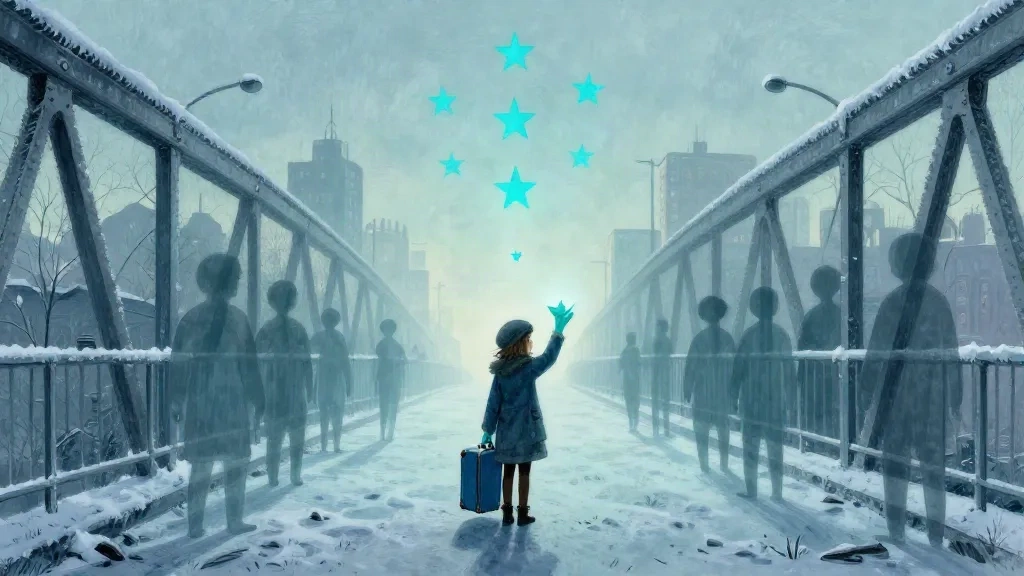
Folk horror. Told in Vell.
The Blue Suitcase
Every morning in Vell the shadows rose before the citizens did.
They came out from under fences and through unlocked doors and gathered at the frost-white market stalls while their owners were still asleep, and by the time the bakers lit their ovens the shadows were citizens too: quick black people with opinions and debts and small copper names pinned inside their coats. They argued about the price of eels. They courted. They stole one another's hats and did not admit it. To greet one another in the street the living said, Good shadow, keep close, and said it warmly, the way you say it to a dog you have raised.
Feeding them was easy. You exhaled into them. Cigarette smoke, tea steam, the sour breath of a bad morning: the shadows drank whatever you gave and grew fat on it, which is why Vell's people smoked too much and argued about it and were, on the whole, thin.
Mara was eleven and the city's child archivist. Her library lived inside a blue suitcase, its shelves packed with ledgers and pressed leaves and stoppered bottles of weather and the unfinished sentences of streets that had been paved over. She carried it wherever the citizens sent their shadows. She knew which shadow belonged to which liar, and which dog was being lied about, and exactly what had been written on the courthouse steps the night the river froze.
Her own shadow had been missing for three years.
Nobody in Vell would say the reason out loud, but the reason was in the suitcase, on the last page of the register for the year of her mother's death: a bell-ringer named Odal Vale had climbed the tower on a night of hard frost and had not come down, and the shadow of an eleven-year-old girl had torn itself off the flagstones and gone after her, and had not come back. Mara had grown a little each year without it. She cast nothing. In photographs she looked like a smudge with luggage.
On the morning the frost began at noon, she found a note tucked beneath the suitcase handle, folded four times, in the narrow upright hand of Aldren Vale, the Night Registrar, who was not her father and never said otherwise.
Bring the Seven Sisters back to the sky before my shadow dies.
Do not ask whose life is mine.
Mara knew Aldren. He served tea in the same crooked shop every evening and complained about the pigeons and let her sit on the flour chest without buying anything. He was not old. He was not ill. But his shadow had begun leaving the shop at midnight and coming back thinner each time, folded small, like a letter put away out of anger.
The Citizens Below
The first shadow parliament met beneath the iron railway arches where the light had never once reached. Mara stood in the queue with grown shadows while her boots squeaked on the frost, and the queue did not make room, because in Vell the shadows had been queueing at that arch since before the railway.
“You carry the records,” said a shadow with a crown-shaped head. “Then you know the law: nothing is taken out of the sky without a public hearing.”
“I know the contents better than the law.”
“That is why we are afraid of you and have not yet decided what to do about it.”
She set the suitcase on the ballast and opened it. Inside, between a jar of thunder and a child's lost tooth, lay a brass star-map. Seven circles had been cut clean out of it, each with a small number scratched beside it. She laid the map on the ground. The shadows leaned in and did not touch it; the dead do not touch brass.
“The Seven Sisters were taken in the year the river froze,” said the crowned one. “Hidden in the sleeping. One in the brewer Vess, who woke each morning for a week unable to remember his own name. One in the bell-ringer. One in a child who waited at the north window and never stopped waiting.”
“Why?”
“Because the sky was collecting a debt.”
Mara touched the empty circles with two fingers. Above the iron roofs a pale cyan line appeared in the sky, though it was barely nine in the morning and the sun had not earned it. The impossible dawn brightened. A bell began ringing somewhere under the streets, not in any tower.
At the same moment, on the courthouse steps, Aldren's shadow came out of the doors holding its own chest as though something had been struck out of it.
What the Ledger Said
She read him the truth afterward, in the cold, with the map on her knees and the shadows pretending not to listen.
“The debt is not Aldren's,” she said. “Vell borrowed its shadows. Every citizen's shadow is on loan from the sky, and the interest is payable in names. Eleven years ago Aldren stole the Seven Sisters to stop the interest being charged. The Sisters were the currency. He hid them in sleepers so the sky could not audit us.”
“And in exchange?”
“He paid with himself. Slowly. A memory a month, so the loan would keep rolling. He has forgotten the war, his sister, the year he was apprenticed, the sound of his mother's voice. He still knows what a ledger is. He has forgotten whose face goes with it.”
The crowned shadow made a sound like a dry cough. “Then the sky is owed nothing, and we are owed eleven years of quiet.”
“No,” Mara said. “The sky is owed the principal. Six hundred years of it. Aldren never stopped the collection. He only moved the names around.”
The Wool Glove
She found the first Sister inside a wool glove nailed to the bridge post above the frozen lock, blue-gray and stiff as a drowned cat's paw. It was empty except for a paper boat, and when she shook it, a small star fell into her palm and burned cold enough to ache behind the eyes.
“Do not put it in the river,” the star said, in the voice of a child reading aloud. “The river has already been paid.”
“Paid with what?”
“With everyone who ever walked across it. It counts them still. It counts them twice, so it will count them again.”
Then the city came apart at the seams. The brewer's shadow turned on him at the market and put both hands around his throat in the manner of a man who had forgiven nothing. The bell-ringer's shadow climbed the tower and would not come down and rang for three hours, and every dog in Vell answered. Citizens fled from their own silhouettes across the white streets, and the shadows, for the first time in living memory, did not follow.
Mara's suitcase grew heavier with every block she walked. The books inside began whispering names of places that no longer existed, and one of them whispered her mother's name, over and over, in a bell-ringer's voice, wrong in every particular.
The Ones She Carried Out
She went in order, because she was an archivist and order was the only weapon she had.
Number two was in the wool lining of a midwife's braid, and the midwife screamed when it came free, because the star had been keeping her young and she felt sixty years arrive at once. Number three was in the collar of a dog that had been dead in the arcade for a year, and Mara had to sit down afterward. Number four was in a tax collector's ledger, written in a hand like a bleeding signature. Number five was in the sleeping child at the north window, who woke, asked whether the sky had finished being angry, and went back to sleep on her feet.
Number six was in the bell at the top of the tower, and to get it Mara climbed past her mother's own ghost, which was waiting on the fourth landing with its mouth open, waiting to be told where to go.
The North Window
Aldren's shadow found her at the north window with its face turned into hers, wearing her features the way a man wears a borrowed coat, badly.
“The deadline is not my death,” it said. “It is the morning after my last memory. When I forget my name, the sky takes what it was owed, and it takes all of it at once, from everyone, and Vell wakes up shining.”
“Would that be so bad?”
“You cannot sleep. There is no place to put the day. You will be seen. You will be entirely seen, for ever, with nothing between you and the light. Call it mercy if you like. Everyone calls it mercy until they have not slept for a month.”
Mara unfolded the paper boat from the wool glove. It had been folded from a page torn out of her own library, and beneath the crease, in Aldren's hand, was a list of seven names, one for each Sister, one for each hiding place, signed and witnessed in the city's own fashion.
The first name on the list was hers.
She read it twice, and the frost outside ticked like a struck glass, and the cyan wound in the sky over the roofs narrowed to a seam.
“You said not to ask whose life is yours,” she said to the shape in the window.
“I said it because you would have asked,” Aldren said, from the doorway, in his own voice, which was going thin at the edges like his shadow. “Ask me now, if it helps. It will not help. I have paid for the answer four times and forgotten it every time, and I remember the paying better than the price.”
The Ledger of the Dead
The seventh Sister had hidden in the archive itself.
Mara unlocked the suitcase under the north window and lifted the oldest ledger from the bottom of the case, where it had been lying under the bottle of fog and a key to a house that no longer stood. It was warm. It was the color of a lamp seen through closed eyelids. She had carried that book since she was six. She had never once opened it, because it had no writing in it, and the archivist's rule is that a book without writing is a book that has not been asked the right question.
She asked.
“You,” the star said.
“I am not a star.”
“Every citizen is a shadow the city borrows from the sky. The seventh was hidden in the smallest shadow in Vell, and you kept it, and it kept you, and it is why you cast nothing and have not cast anything since you were eight years old.”
Under the window the frost was melting on the sill in a line, and beyond it Vell lay in its false cyan morning, and in the streets below the shadows were leaving their houses, going home without their owners, carrying pieces of the dark they had been born with.
Mara held the warm ledger in both hands and did the thing she was an archivist for. She turned to the final leaf, where the collected names of Vell were written in copper ink in the small firm letters of every person who had ever been given a name in this city. She read them the way a hearing is read: aloud, in order, with the date and the cause, from Ora the Faded, taken in the year of the small frost, to the newest entry, which was dated tomorrow.
The sky listened. That is the thing nobody tells you about a hearing: the sky listens, and it is not listening for mercy.
The principal came due in her mouth. Six hundred years of it. She felt it go out of her like breath, and what it took with it was the name she had been given, and after that the name she had given her mother, and after that the smell of the flour chest in Aldren's shop, and after that nothing at all, which was a mercy after the first three.
A Sky in Debt
The Six went into the paper boat. The Seventh went into her palm, and the wool glove tightened around her wrist by itself, iron fingers closing beneath her sleeve, and for a moment she was a child being held by something that was not alive and would not let go.
Outside, Vell abandoned its shadows. The city became a city of bodies casting light. Every street was flooded with soft cyan morning, every face naked in it, every person visible down to the fruit of the eye, and the first scream came from the fish market, because there is no such thing as a modest ghost.
Mara walked out onto the roof with the boat in both hands and let it go.
It rose through the impossible dawn, and the seven stars poured out of its folded pages one at a time, each of them finding its place among the constellations with the small click of a key in a lock that has been waiting. Then the sky exhaled. It was an enormous sound, and no one heard it but the animals, and the animals lay down.
When the light went out of the streets, every citizen in Vell had a shadow again. They stood about in the cold touching their own faces, astonished, unaccountable, themselves.
Except one.
Aldren Vale came out of the shop holding his empty teacup, and he looked at Mara with the polite blankness of a man meeting a stranger who knew his business.
“Do you remember my name?” he asked.
Mara opened the blue suitcase. One star burned under the lid, warm as a lamp through closed eyelids. It was not hers. It was the city's, and the city would have to find someone small enough to keep it.
“No,” she said.
“Then we are both safe,” he said, and smiled without offense, and went to bed.
The Morning After
There are three things Mara knows that she has never written down.
The first is that a public hearing can be held by anyone, if the person calling it owns the book the names are written in. She had held one, with seven stars in the sky and her own name gone out of her like a coin dropped into a well, and she had made one decision in it, and the decision was this: the debt was not Vell's. The debt was the sky's. Vell had been borrowing light for six hundred years and the sky had been calling in the interest on children, on the nameless, on whoever could not be traced and so could not object. Aldren's crime was that he had hidden the ledger.
So she had entered the true total on the last page, in copper ink, in the small firm letters, and she had made the debtor and the creditor the same party. The sky now owes Vell. It will go on owing for as long as there are shadows, which is to say for as long as there is a city that is afraid to sleep in a room with no corner in it. Aldren had tried to win by cheating. Mara won by accounting.
The second is the price, which nobody in Vell will discuss, because nobody remembers it in the same shape. The shadows came back, but the seventh place was empty and had to be filled, and it was filled the way any shadow is filled: by borrowing. Mara walks with a shadow now that is the right size and the wrong shape. It has her height and somebody else's walk. It stops in doorways. It waits for her at the ends of streets, half a beat late, the way a stranger waits who has mistaken you for someone they used to know. Her mother's shadow, they tell her, is the one that watches the north window. It is thinner than it was. It is getting thinner.
The third is the book. It sits on her flour chest in the corner of Aldren's shop, and it is the oldest ledger in the archive, and it is no longer empty. She has read the first page. Every entry in it is a name, and every name is dated, and the dates run forward.
The last entry is dated tomorrow. It is written in her hand. She has not written it yet.
She keeps the book anyway, the way her mother kept the bell rope, and every morning she wakes an hour ahead of her shadow and says, out loud, to the empty corner of the room, the only name she has left for it, which is the name of the person who made it, and which is not hers, and which she will not write down.





