 Netwrck
Folk Horror.
The Observatory at the Edge of Morning
Mara Vale had not left orbit because she loved the sky. She had left orbit because the ground had become a rumour.
From the observation deck of the old desert station, the stars sent their messages in narrow blue scratches across the instruments. The messages were not pictures. They were voices, stripped of their bodies and carried across the black by something patient enough to repeat them.
Most of the voices belonged to forgotten broadcasts: farmers calling over static, children reciting names, lovers leaving late messages on answering machines. Mara listened to them while the station’s solar wings cast frost across her gloves.
One voice was different.
It was hers.
Not the recorded voice from her old public appearances, polished for release and buried beneath official commentary. The raw voice. The one that had been used as background noise in reports about the evacuation, a fragment nobody had thought to preserve.
She wanted it back.
“Signal twelve,” she said to the empty room. “Play signal twelve.”
The receiver answered with a soft cyan glow.
Doors in the Dust
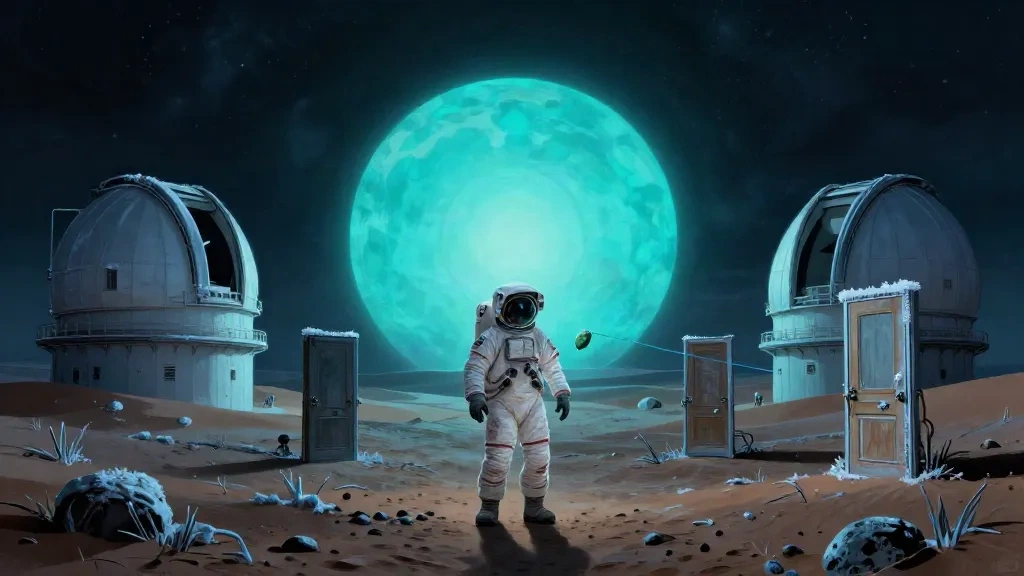
By nightfall, the storm had swallowed the mountains. Wind drove sand across the observatory roof in pale, whispering sheets. The air smelled of iron and cold glass. Every few minutes, a distant knock sounded beneath the floor.
Mara left the receiver playing and walked toward the maintenance corridor.
The first door was wrong.
It stood where the wall had been, its blue-painted surface beaded with melting frost. When she opened it, warm desert air rolled past her, carrying the smell of dust and distant rain. Beyond it was a town she knew from childhood, empty except for a single lit window.
Inside the window, a woman sat with her back to the glass.
Mara stepped back. The door vanished. The wall returned, smooth and iron-dark.
Another knock came from inside it.
She found the second door beside the telescope controls. It opened onto the inside of her childhood bedroom, though the walls were covered in frost and the green stone on her dresser shone with a light that made the whole room look underwater.
A blue thread ran from the doorframe to the bed.
When Mara touched it, the room filled with her mother’s voice.
“Mara, you are making noise again.”
The voice was distant, casual, and exactly right.
Mara closed her eyes. The recording continued, now carrying the sentence she had spoken years later: “Earth is a rumour. Stay where the stars can still hear you.”
She had never spoken those words.
The storm rearranged the corridor again. Three doors appeared, each opening onto a different hour of the same night.
The Voice Beneath the Static
Mara returned to the receiver and began transmitting toward the impossible dawn forming below the horizon. The light was not sunlight. It was soft cyan, spreading beneath the storm as if dawn had leaked through the earth.
“I know you are there,” she said. “Return the voice.”
The receiver answered with static, then with a voice beneath it.
Her own voice, younger and frightened, saying: “If they leave me out of the record, leave me in the signal.”
Mara’s hand tightened around the green stone. She had carried it since the station’s first winter, when she found it beneath the telescope platform. It had no known mineral composition. It was warm when she was afraid.
The cyan light strengthened. The stars disappeared.
On the monitor, Earth appeared as a pale outline made entirely of doors. They opened across oceans, deserts, cities, and the ruins of the old launch complex. Through each one came a different version of the same morning.
Her recovered voice was in all of them.
“Choose,” it said.
Mara understood then. The observatory was not receiving messages from distant stars. Something beneath the stars was making records, and history was one of its rooms. It kept every discarded sound in a place where the living could hear it.
The storm tore open the final door.
Beyond it stood Earth, untouched and silent.
The Last Door
Mara stood at the threshold. Behind her, the station trembled. Ahead, the world waited in the blue-white silence before dawn.
She placed the green stone in one hand and the blue thread in the other.
For years, she had refused to return because returning would have proved the ground was real. Now she wanted only one voice to prove she had existed before the rumours began.
The voice spoke through the open door.
“Mara Vale,” it said. “Astronaut. Test subject. Background noise.”
She could let the door close. She could keep the station, the orbit, the messages without bodies, and the perfect certainty that absence was not surrender.
Instead, she stepped through.
The door slammed behind her with the sound of a final star going out.
On the desert floor, dawn arrived without frost or shadow. The observatory stood where it had always stood, except that every window was open.
From each one came a voice.
And from the largest window, faint beneath the wind, came her own voice saying clearly, at last, the words history had tried to bury:
I was here. I was here before you decided I was only noise.
The blue thread lifted from her hand. The green stone split cleanly down the middle.
Between them, the impossible cyan dawn began to recede.





