 Netwrck
Folk Horror.
The clocks at Saint Orra
At Saint Orra, the clocks had been forbidden to agree since the winter the river froze with a woman’s name inside it. In the long nave, iron clocks leaned against one another, each keeping a different grief: the hour of a buried bell, the minute a fox crossed the snow, the second before a roof fell. Monks wound them at dawn and argued about noon until the candles burned low. Outside, the country had no reliable time. Dawn might arrive at three, or not at all.
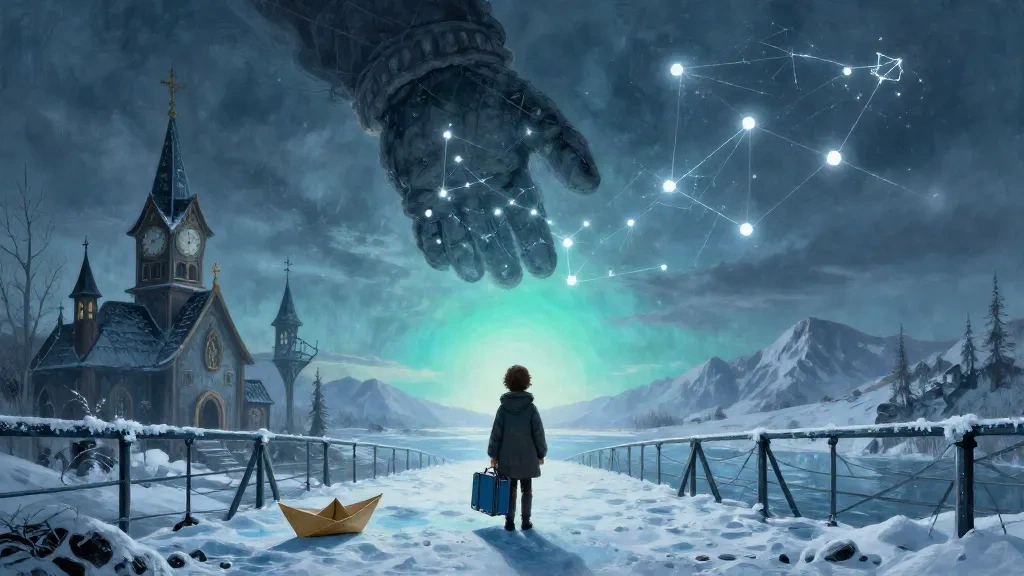
Thessa was eleven and the monastery’s youngest archivist. Her library lived in a blue suitcase with a cracked handle: ledgers, prayer scraps, a jar of black buttons, and the small brass stars she had been assigned to catalogue. Every constellation in the sky was believed to have been copied into the monastery once. Thessa had found the record proving otherwise. The winter called the Glove had been taken from the northern sky, its seven stars hidden inside a single bright shape.
Her work was to return it. Before she could begin, the prior summoned her to the warming room.
The deadline of the living
Mother Elian stood beside the stove, wearing one grey wool glove. She was not old enough to be dead, and not young enough to be mistaken for a ghost. Her bare hand rested on a paper boat pinned beneath a silver cup.
“You will leave before the third bell,” she said. “That is the deadline I inherited from myself.”
Thessa stared at her. “You are not dying.”
“No,” Elian replied. “That is the difficulty.”
The monastery had begun taking deadlines from the living. A promise spoken aloud could attach itself to a person and grow teeth. Elian had promised Thessa’s mother that the stars would be restored before the first frost. The promise had outlived the woman who made it, then found Elian, then began counting down through every room in the monastery.
Thessa took the paper boat from beneath the cup. It was folded from a prayer to Saint Orra, the patron of lost hours. The wool glove on Elian’s hand was embroidered with a thread of frost.
North by the iron road
Thessa packed the blue suitcase and left through the side gate. She followed the iron road north, where telegraph wires stood like frozen ribs. The clocks in the village windows showed impossible afternoons, all stopping at the same minute. At a bridge, a crow dropped a brass star into the snow. Thessa bent to retrieve it, but the star skated away over the ice.
Behind her, the monastery began ringing without hands. Each bell removed another hour from the sky. When Thessa looked back, the road had disappeared beneath white. A paper boat slid past her boot, empty and perfectly dry.
At the northern observatory, the Glove waited inside a cage of frozen glass. It was not a glove but a shape made from seven stars, stretched into fingers and thumb. The missing dawn hovered behind it, soft cyan light leaking through the cracks in the winter.
The keeper was a blind woman wrapped in iron filings.
“Return the constellation,” the woman said, “but do not return the dawn.”
Thessa opened the suitcase. The little brass stars trembled. “Why?”
“Because dawn has learned to follow whoever carries it.”
The sky owed back
Thessa understood then. The constellation had not been stolen for a collection. Someone had pulled it down so the impossible dawn would have a place to wait. The glove belonged to a traveller who crossed the frozen country carrying winter in its wool. Each year it had given one more star to the monastery, until the sky was almost empty.
She placed the seven brass stars on the frozen floor. The wool glove unwound itself, pale and enormous, and the paper boat in her pocket filled with weight. The stars rose through the glass and settled into their proper places. One by one, the northern lights returned.
But the dawn followed Thessa.
It entered the blue suitcase, turning its pages cyan. Elian’s voice came from the distant monastery: “The deadline has arrived.”
Thessa closed the case before the light could spill out. She understood that restoring the sky did not undo the promise. It only gave the promise a road.
At Saint Orra, Mother Elian waited in the nave. The clocks had stopped. Thessa set the paper boat on the altar, still carrying the weight of a borrowed hour.
Elian removed her wool glove. “The sky is whole,” Thessa said.
“Yes.”
“Then you are free.”
Elian looked at the child. “Not until you choose where the dawn goes.”
Outside, the impossible light pressed blue against the monastery doors. Thessa opened the suitcase. Cyan poured over the stone, over the stopped clocks, over Elian’s bare hand. The first true dawn entered the country and found every waiting shadow.
Thessa took up the wool glove. It was warm now, and inside it the small stars shone like distant windows.





