 Netwrck
Fairy-Tale Fiction.
The Last Performance
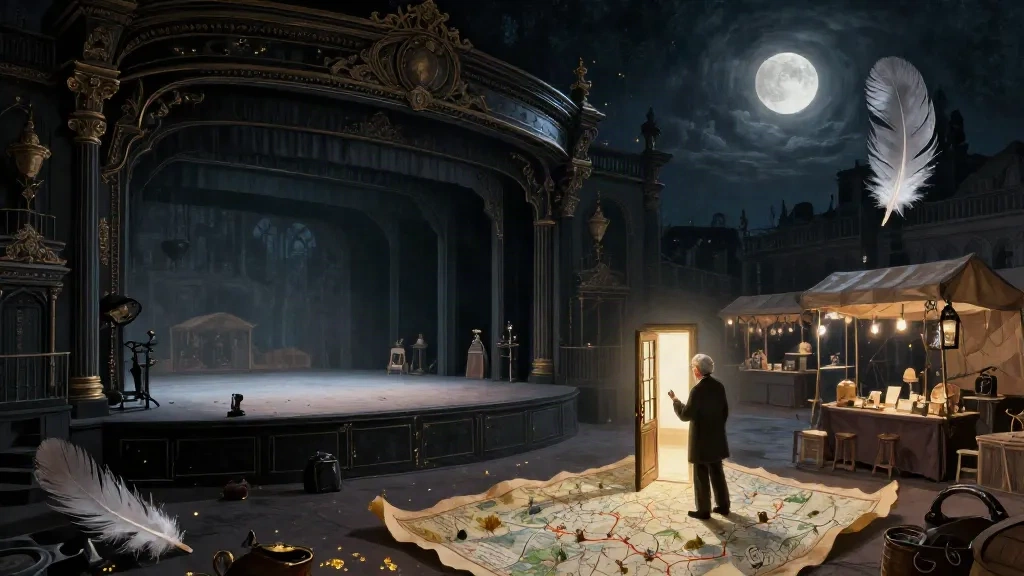
At the back of the theatre, where black lacquer walls swallowed sound, Mira Vale unfolded her oldest map.
It showed streets erased by flood, villages lowered into reservoirs, a railway swallowed by a quarry. In the margins, Mira had drawn doors. They opened onto rooms that no longer existed: the kitchen of a vanished island, the attic above a demolished theatre, the last infirmary of a town renamed twice.
Each door was an empty rectangle, neatly hinged.
“No arrivals tonight,” said the theatre from somewhere behind the stage.
Mira looked toward the wings. Cold moonlight lay across the floorboards, silver as a blade.
“There is always a lost thing looking for somewhere to rest.”
For thirty-two years, she had made maps of places abandoned by history. She had known the shape of every road leading nowhere and the exact hour a coastline vanished beneath the sea. Then her hands had stiffened, her eyes had clouded, and the theatre had given her a small job: painting scenery for endings discarded before they reached the stage.
On that night, the curtain rose without a wind.
Beyond it stood a market.
The Market of Expensive Truths
Stalls filled the black space, their lamps made from gold dust. On one table lay a silver watch ticking inside a glass bell. On another rested a red mitten, still warm.
Signs hung between them:
THE THING YOU REMEMBER MOST
THE THING YOU LOST FIRST
THE THING YOU TOLD YOURSELF WAS TRUE
Everything expensive was true. The market had no false jewels, no painted gems, no borrowed names. It sold only what remained after comfort had been peeled away.
Mira found a stall where a moth wing lay on black velvet. She reached for it, but the vendor raised one finger.
“That is not yours,” he said.
Across the aisle, a white feather trembled beneath a glass dome.
Mira’s fingers closed around the moth wing. A memory opened: a lamp, a summer window, a child crying because the moon had vanished behind clouds.
She had forgotten the child’s face. The market had not.
“You can buy back anything you misplaced,” the vendor whispered, “if you can afford the truth of losing it.”
Then he named his price.
The Door Under the Stage
Mira’s name.
She drew back. The moth wing snapped.
“You do not mean my name,” she said.
“No,” said the vendor. “I mean the place that made you forget your name.”
Below them, the theatre groaned. Somewhere beneath the boards, a bell struck once.
Mira looked at the white feather. It was not beautiful. It was only stubbornly clean.
“I am trying to make a place where lost things can rest,” she said.
“Then stop treating them like things you own.”
She reached for the feather. The glass broke. Moonlight poured out, carrying the scent of snow.
When Mira opened her map, the vanished places had changed. A road ran between them, thin as a needle. At its end stood a blank square.
She drew a door.
The market vanished.
Mira woke beneath the stage with dust in her mouth. Above her, the theatre whispered in a hundred forgotten voices.
A Room That Could Not Keep the Past
She painted for seven nights. No mountains, no seas, no grand cities. Only a room with a wide door, low chairs, and windows facing different seasons.
It was not a museum. Nothing behind glass. Nothing labelled.
On the first morning, a child arrived carrying the memory of a vanished moon. Mira gave her a brass bowl and asked her to place it wherever she liked.
On the second, an old man brought the name of a ship that had sunk before he was born. He did not speak it. He set it on the table and left.
On the third, the white feather arrived without a message. The moth wing followed, still trembling.
Mira placed them on the floor.
Then she opened the door.
Beyond it was not an ending.
It was a path.
And along the path, many lost things waited—not to be restored, returned, or remembered, but to become whatever they had not yet been.
Mira stood in the doorway. Behind her, the room was warm. Before her, the moonlight waited.
This time, she stepped through.





