 Netwrck
Mystery.
The Unremembered Garden
On the seventh floor of the Arreton Apartments, Mara Venn unlocked the service elevator with a brass key warm as a summer stone. She carried it on a blue cord beneath her coat, though no one in the building had seen her use it for anything but opening the courtyard door.
Everyone in Arreton remembered the future. They knew which elevator would break before the inspector arrived, which neighbor would leave before sunrise, and which rain would arrive three minutes after the sky turned clear. They remembered birthdays, arguments, farewells, and the precise shape of their own last days. They could not remember yesterday.
Mara was the municipal gardener. Her work was to plant stories in neglected courtyards: small trees of remembered kindness, ivy trained around lies, flowering bulbs fed with private grief. The city called it beautification. The tenants called it nonsense.
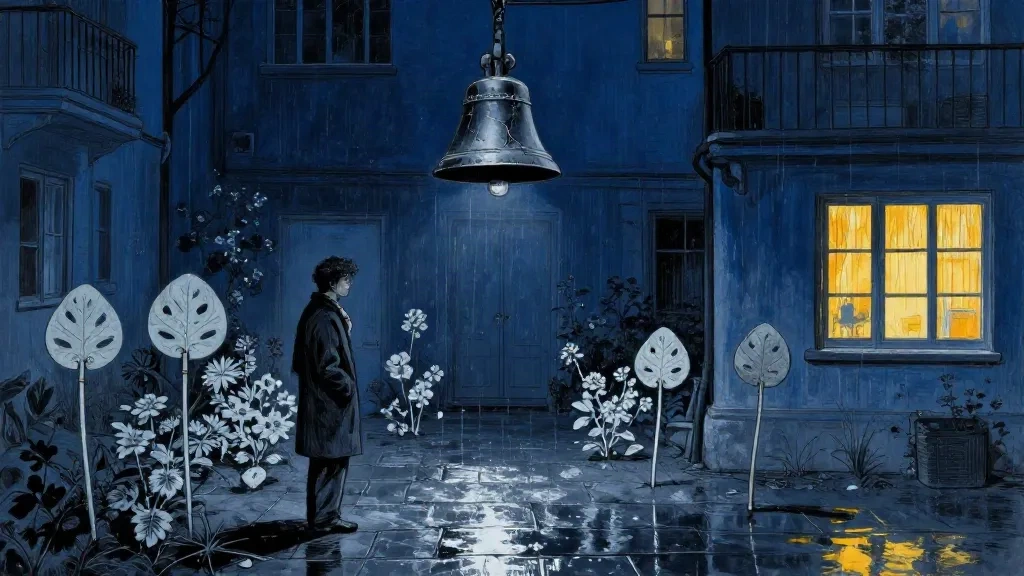
Her assigned courtyard lay between the eastern stairwell and a wall of sealed windows. Nothing grew there. A cracked bell hung in an iron frame above the empty beds, its split rim holding one bead of rain. The bell had not sounded since the building opened, and the residents said it rang only when the future demanded a witness.
Mara knelt beside the soil and found a tin box buried shallowly. Inside was a child’s drawing: a blue house beneath a silver sky, with one amber window. On the back, in an adult’s hand, were the words, “When nobody believes, bring us somewhere safe.”
A Machine Without a Miracle
The courtyard’s shelter stood in the basement, behind the boiler: a squat machine called the Consensus Engine. It converted collective belief into usable shelter for people displaced by storms, market closures, and sudden changes in the city.
Its gauge rested at zero.
The operator, Ilyan, tapped its copper face. “It works only when nobody believes in it.”
Mara frowned. “That is contradictory.”
“That is its design. One believer makes it doubt. Two make it perform. Three make it build something absurd and call it home.” He glanced toward the courtyard. “The engine has been waiting for a story no one can prove.”
Mara remembered the tin box, then remembered that she could not remember receiving it. She searched the apartment’s ledgers, finding a family named Pell: three children, a flood, a promise that someone would return with a key.
No Pell appeared in the building records. No family portrait occupied the hall. Yet Mara felt the story pressing against the blank side of her mind.
That evening, she planted the child’s drawing in the courtyard. The engine’s needle trembled.
By dawn, the soil had produced three pale stems. Each bore a leaf shaped like a key.
The Doubt of the Bell
Mara rang the cracked bell.
No sound emerged. The residents gathered anyway, drawn by the future they could not control. They stood in the rain-silver courtyard and watched the stems bend toward the sealed windows.
“The Pell family will arrive,” one woman said.
“They left,” another replied.
“They are here,” said a boy, pointing.
The amber window at the far end of the building lit.
Inside it stood a room: beds, a table, a dry floor, three children waiting beneath a blue coat. The Consensus Engine hummed, but its gauge remained empty.
Mara understood. The machine could not believe its own work. She had to make the family’s story uncertain enough to survive certainty.
She told the residents the drawing was stolen. She told them the key opened nothing. She told them the amber window was only a reflection.
One by one, they agreed.
The bell cracked all the way through.
The Shelter That Chose
The courtyard walls folded inward without collapsing. The courtyard became a corridor, then a kitchen, then a room with twelve beds. The Pell children stepped through the window carrying a wet coat and a brass key identical to Mara’s.
The engine’s needle swung hard to the right.
“Shelter is not a machine,” the eldest child said. “It is a story people keep changing so others can enter.”
Mara looked at the key in her hand. It had grown cold.
In the basement, the Consensus Engine shut down permanently. Its copper face remained warm, but no needle moved. Ilyan stared at it for a long time.
“Now we have to maintain it manually,” he said.
Mara carried the key into the new room and hung it beside the bell’s remains. Outside, rain silvered the windows. The single amber light did not vanish.
It waited, patiently, for another family no one believed would arrive.





