 Netwrck
Historical Fantasy.
The Memory of Rain
On the first morning of October, Mara Venn unlocked the courtyard of the Ninth House and found the future already there.
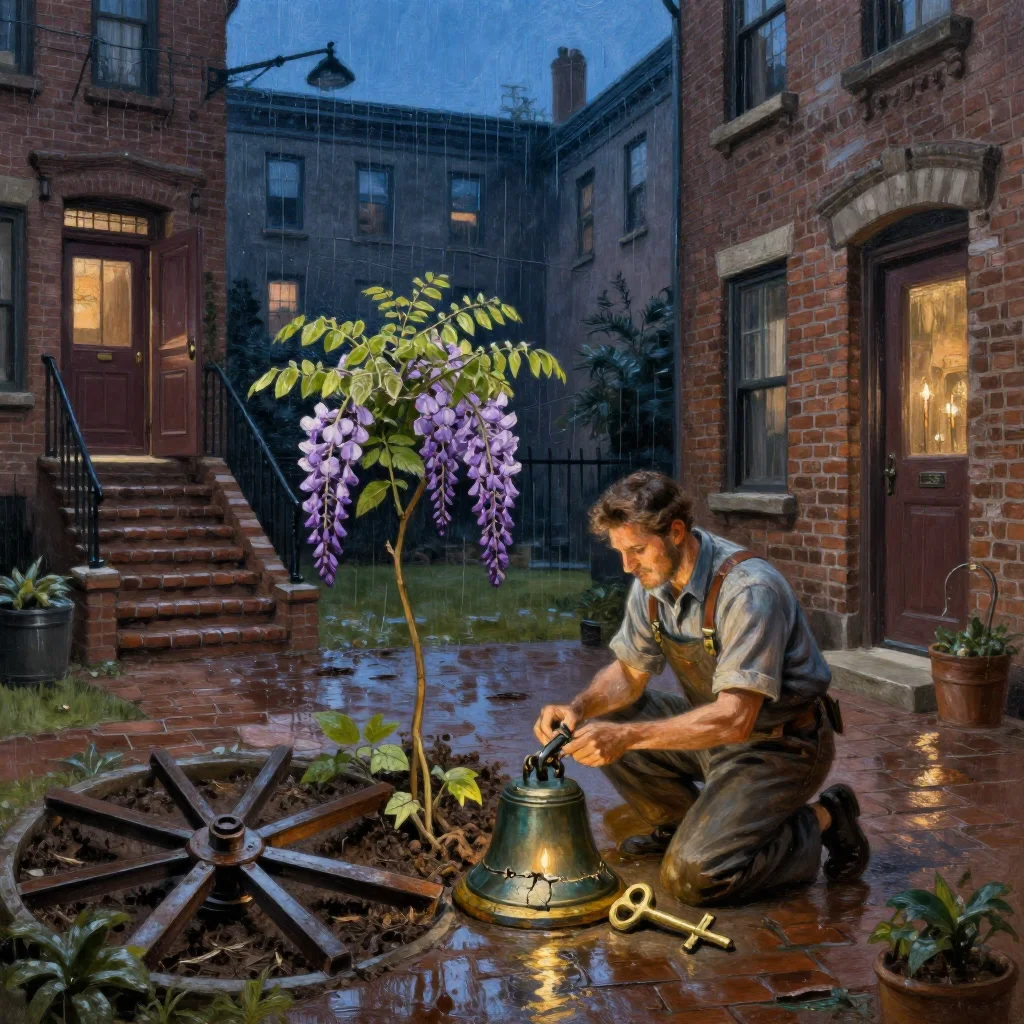
Rain hung in the air above the beds, each drop suspended like a bead of steel on a windowpane. It trembled when she stepped forward, then vanished into the soil without wetting her shoes. Around her rose the apartment building's inner walls, nine floors of soot-black brick, balconies patched with rust, and windows glowing in colors that did not belong to any lamp.
Everyone in the building remembered the future. They knew which elevator cable would fail on Thursday, which neighbor would leave before breakfast, which child would be born in November. They remembered the year the river froze and the year the bells stopped ringing. They could recite endings while still eating breakfast.
Mara was the municipal gardener. Her brass badge hung from a cord around her neck, stamped with a shovel crossed over a quill. Her work was to tend the neglected courtyards of the city and plant stories in them. Not seeds, exactly. A story required a beginning, a middle, and somewhere sheltered for its ending.
She knelt beside the dead wisteria and placed her palm against the frozen earth. The courtyard remembered her grandmother's kitchen, blue curtains, a kettle singing before rain. The memory rose through her fingers, warm and sour, smelling of tobacco and onions.
Her own family story had no ending. Her mother had disappeared when Mara was eleven, leaving behind a cracked bell and a brass key tied with blue thread. The neighbors said the mother had gone north. Others said she had gone into the future and waited there until Mara was old enough to follow.
Mara kept both objects in her coat. The bell never rang. The key opened nothing she had found.
A House for the Unremembered
The Ninth House sheltered people who had lost the habit of expecting anyone. A widow who knew every sunset but no visitor. A boy who worked in the kitchens and remembered the moment he would die, though not the date. A woman from the old rail line who could recite the names of strangers who had never arrived.
They slept in the courtyards when the rooms became too small for the future. They ate beneath the balconies. They spoke in fragments, afraid that a complete sentence would make the future notice them.
Mara had been commissioned to plant a story there. A proper story, she was told, with a gate, a hearth, and enough shelter for ten people. The city required gardens as civic infrastructure. A courtyard without a story was only a vacancy.
Her assignment gave her one family legend: the Bellmakers of Saint Orra, who had sheltered a line of fugitives beneath a railway arch during the winter of 1867. The legend ended when the last bell was cracked and the family vanished.
Mara disliked it. Shelter was not a grand word when you had lived without it. Still, she cleared the courtyard's central bed and began digging.
Under the soil they found a rusted machine.
It was a low iron box with a brass handle, a glass window, and seven spokes arranged around a needle. No one in the building had seen it before. The woman from the rail line said it had arrived before the building, while the widow claimed it would arrive tomorrow.
The boy touched the glass. “What does it do?”
“Nothing,” Mara said.
The machine opened.
A pale card rose from inside. It bore a picture of a courtyard, a bell, and a key. Beneath the picture were five words: BELIEVE IN AN EMPTY ROOM.
Every tenant gathered around it. The boy believed so fiercely that his knuckles went white. The widow declared the machine a municipal trick. The rail woman said it was a future with a hinge.
The glass went dark.
When they dispersed, the machine remained open. Every time someone expressed certainty, the needle fell. When nobody believed, the needle lifted.
The Empty Room
Mara discovered the rule by accident. She told the boy the card had been printed by the previous gardener. He laughed. The machine made a soft click, and a lamp lit inside the courtyard wall.
She told the widow she did not know what the machine was. The widow shrugged and said she had never trusted anything that arrived without an owner. Another lamp appeared beneath the stairs.
By sunset, the courtyard held three lamps, although no wires had been laid. The strangers watched them, suspicious and delighted.
Mara planted the legend in sections. She shaped the railway arch from broken bricks. She cut old names into flat stones. For the Bellmakers, she used red clay from a demolished house across the avenue. She made the cracked bell from the bell in her pocket, setting it into a wooden frame.
She left one gap in the wall.
The machine appeared at the gap every morning, its needle falling whenever someone praised the work and rising when they complained about the cold, the damp, the poor soil, the uselessness of a story about people none of them had known.
On the seventh morning, a man named Pell arrived with his daughter. He had the future of a train accident memorized and the memory of his wife's voice confused. He asked whether the courtyard could shelter them.
Mara said, “It is only a courtyard.”
“That is not a no,” Pell said.
That evening the city inspectors arrived. They carried maps of the courtyard and orders to fill it with gravel. The Ninth House had been scheduled for demolition for years, but the paperwork had finally remembered itself.
One by one, the tenants began believing in the shelter. They described its rooms aloud: a dry kitchen, a locked door, a view of trees. The machine's needle dropped every time. The lamps went out.
Then Pell's daughter walked to the gap and asked what the key opened.
Mara took the brass key from her coat. The cracked bell hung beside it.
“I don't know,” she said.
The child nodded, satisfied. The machine's needle sprang upright.
A Future Left Unfinished
The machine produced one final instruction: ONE TRUE THING, UNPROTECTED.
Mara understood.
Stories could shelter strangers only if they were not owned by the people inside them. She had tried to give the courtyard a legend with a safe ending. But a family story became a shelter when its ending remained open.
She planted the brass key in the wet earth, beside the cracked bell.
She told the truth: her mother had left the key for her. She did not know where. She had spent years pretending the absence was a mystery, when it was only an unanswered question.
The tenants added their truths. Pell said he was afraid of the train, not the accident. The widow said she remembered the future because she could not bear to remember the past. The boy said he wanted a home that did not already know when he would leave.
The machine began to turn. Its needle circled without stopping. The iron box gave out a smell of hot dust, then river water, then bread baking in a closed room. The soil split. A stairway rose from the courtyard, each step made of brick that had not existed before.
At the top stood a door painted tobacco brown. A keyhole shone in its center, reflecting candlelight from windows that were not yet there.
Mara climbed the stairs. Behind her, the residents waited without promising anything. They had stopped believing in the shelter. They were simply there.
The cracked bell sounded once.
She placed the brass key in the lock. The door opened onto a narrow room, empty except for a table, two chairs, and a window facing the street. Candlelight moved across the floor though no flame was visible.
Then she turned back.
Below, strangers were entering through the courtyard gate. The widow held the door. Pell carried a blanket. The rail woman had found a kettle.
Mara closed the door softly and left the key in it.
In the morning, the Ninth House had a new room. The inspectors found no violation in its construction. The machine was gone, but the courtyard remained, full of mud, lamps, and the unfinished sound of a bell.
Years later, children asked Mara where the room came from. She told them every family had carried one inside it. Then she gave them a spade and asked what story they would plant.





