 Netwrck
Surrealism.
The Bell Beneath the Courtyard
On the morning the sea returned the bell, Lio was planting a story in the courtyard behind number seventeen Ferrous Street.
He worked for the municipality, though his title said only groundskeeper. His tools included pruning shears, a trowel with a cracked wooden handle, and a tin of seeds that refused to remain seeds. Once opened, they became sentences. He buried them in neglected soil until roots surfaced as handwriting.
At number seventeen, he planted the story of the Maren family, who had lived there for three generations and left after a storm cracked the eastern wall. Their daughter, Inez, had hidden the brass key beneath the floorboards. Their father had carried the cracked bell up the roof and rung it whenever he needed the coast to return something valuable.
“A shelter for strangers,” Inez had said, handing Lio the key during her family's final week. “Not a museum. Not a monument. Somewhere they can arrive without explaining themselves.”
He planted that sentence in the courtyard. By noon, blue storm-light gathered beneath the windows. By evening, vines along the wall had arranged themselves into a door.
A Machine for Unbelieving
The machine stood beneath the door, hidden at first by rain-dark soil. It was a tall brass apparatus with ceramic rollers, copper wires, and a small glass window clouded from within.
A plate on its side read: RESTORES A LOST THING, PROVIDED NO ONE BELIEVES IT WILL.
Lio did not believe it would work. He put the brass key into its central lock. The machine coughed. Something inside struck the bell.
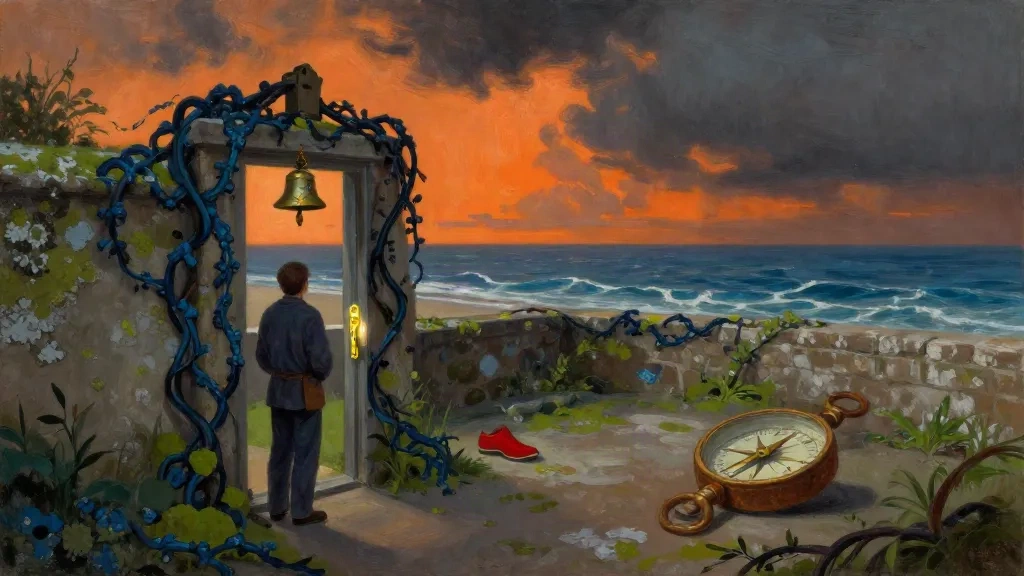
Every tide brought back one forgotten object. That morning it had brought the bell; the sea had left it on the seawall beside a dead lobster trap, still warm, its crack filled with orange salt. Lio carried it through the courtyard and hung it from the new door. Its sound was thin and imperfect, like a voice trying to remember its own name.
He wound the machine. The ceramic rollers turned. Inside, paper became fabric, fabric became boards, and boards folded themselves into a narrow bed. The family story grew over the walls, not as decoration but as shelter: a kitchen where anyone could boil water, a table where a stranger's silence would not be questioned, a room where the brass key opened not a private chamber but the outer door.
At dawn, three people arrived from the flooded road. Lio welcomed them. Then he said, “This cannot possibly hold.”
The Cost of Certainty
His doubt entered the walls.
The kitchen table folded flat. The bed narrowed until its bars pressed against the sleepers' shoulders. The courtyard door became a painted outline, and beyond it the tide climbed the street with the slow patience of a creditor.
“Believe in it,” one stranger said.
Lio shook his head. “If I believe, it will fail.”
“If you fail,” the woman said, “we fail.”
He considered the old bell. The Marens had rung it in storms, not to command the sea but to admit it was present. Their courage had never been certainty. It had been the willingness to act while the outcome remained impossible.
Lio stepped into the machine.
The rollers seized his coat. The glass window cleared, and inside he saw not his face but the whole courtyard as it might be: crowded with wet coats, mismatched boots, a kettle, a child drawing boats on salt-white tiles. In that possible future, the machine was rusted, silent, and useless. People still entered.
He understood its trick. It could not make shelter. It could only prevent him from mistaking shelter for his own power.
What the Tide Kept
He began again, planting doubt instead of confidence. May fail. May hold anyway. He scattered those words beside the walls, over the path, beneath the threshold. The courtyard accepted them.
The table opened. The bed widened. The door repaired itself with a sound like splintering wood remembering it had once been a tree.
At sunset, Lio hung the cracked bell where anyone could reach it. He left the brass key in the lock. The next tide brought a child's red shoe, a rusted compass, and a sealed envelope addressed to no one. Lio placed them in the communal room, where strangers began assigning them stories of their own.
That night, the machine restarted without him. No one touched it. Its rollers turned beneath the floor, restoring nothing, conserving everything.
Outside, the sea shone burnt orange under a moon of blue storm-light. Lio heard the bell and understood that the town had never forgotten its objects. It had forgotten how to receive them.
By dawn, the courtyard was full. Lio planted one final sentence in the soil: No one here owns the way back.
Then he opened the door and let the strangers in.





