 Netwrck
Magical Realism.
The Gardener of Empty Courts
On the third terrace of the comet monastery, where the chapel's stone leaned inward as though listening to something out past the shoulder of the world, Mara Venn pruned the last winter from a courtyard nobody used. The courtyard held three dead fountains, a bench with one arm, and soil so thin that every seed rose and died in the same night.
She carried a municipal gardener's silver trowel and a ledger of the monastery's neglected places. She was not a nun. Her title was municipal gardener, though the title had been struck in a city that no longer existed and carried no authority past the third terrace. She planted stories wherever the stone refused to hold a tree.
Her own family story had been a small one. A grandmother who left behind a brass key, a cracked handbell, and a sentence in a voice like a hinge being oiled: When the house forgets you, find the door that remains warm.
Mara had spent forty years trying to turn that sentence into a load-bearing thing. She wanted strangers sleeping beneath it. She wanted the story to become a shelter instead of a thing passed from one lonely mouth to another, where it thinned and lost its windows.
She had tried before. On Kessel Street there had been a courtyard like this one, with a cistern and a notice on a wall, and Mara had defended her garden out loud in front of the men who came to measure it. Belief as testimony, she had told them: if you say it is real, it will be real. The shelter had taken two years and eleven strangers and it had come down in a night of rain that the roof was not built for. She had kept the ledger since. In the column for what they said at dawn she had written, for Kessel Street, nothing, and under it, smaller, in pencil: they were defending me, not the roof.
The Ledger of Neglected Places
The ledger had four columns: place, what was planted, who sheltered there, what they said at dawn. Mara filled it in the hour before the comet trail came up, because the monastery's bells were rung at dawn by a boy who had never once been late and did not care to be a subject of record.
Third terrace, eastern court: nothing planted, nobody, nothing. Third terrace, western court: a bay tree, cut down in some prior's tenure for reasons nobody had recorded. Lower cistern walk: a fig, dead of wet, its root still under the flagstones. The last page held the entry she had made that morning in a hand steadier than her pulse: Third terrace, great court — nothing — nothing — nothing.
Prioress Solvei found her at the wall, the way Solvei found everyone, without hurry and without appearing to have moved. She was eighty-one and had governed the monastery through two famines, a schism, and a year when the roof came off the refectory. She did not believe in the cistern machine. She had, however, kept the great court empty for nineteen years, which is a different kind of faith and a harder one.
The rule is not that the court must be empty. The rule is that we cannot fill it and feed what comes.
“Your order writes a great many things down,” Mara said.
My order writes down what it can pay for. The road below this city is bad and getting worse. If a door opens up here that glows, we will be asked why we have nothing to give, and I will have to say: we have water, a roof, and no bread, and the roof is worse than useless to a family with children. Open a door long enough and the starving learn to call it a door.
“So you kept it empty.”
I kept it boring. A courtyard with dead fountains and a bench of one arm is not a destination. I have been boring at that court for nineteen years, Mara, and it is the most expensive work I have done.
Mara looked at her. “You could have filled it. Anything at all.”
I could have. It would have lasted two summers. Then it would have been ours to defend, and we would have defended it with the refectory roof, and the refectory roof is a story we are still paying for. Go on, then. Plant. But understand that the thing you are making is not for the people who arrive. It is for us, who must refuse them.
Mara understood, or thought she did, that this was not an argument against her. It was an inventory.
The Machine in the Cistern
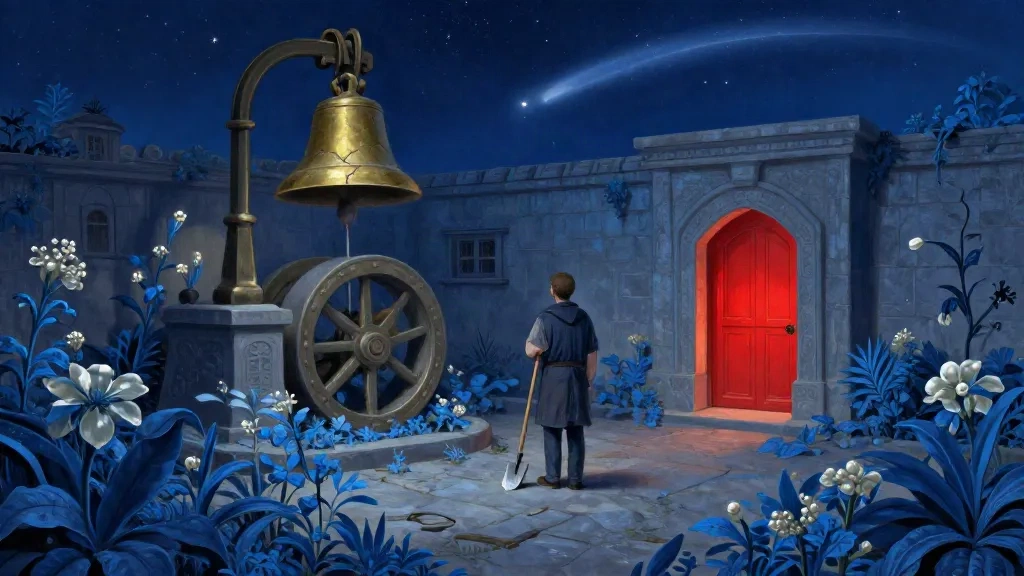
At the bottom of the court, beneath a slab scored with a red door, she found the monastery's old bell machine. It was a brass contraption the size of a small wine press: a wheel, a narrow keyway, a cracked bell hung above it on a bracket gone green. A lamp under the wheel blinked when she touched the rim, and the cistern above her head smelled of cold iron and something sweeter underneath, like fruit kept past its season.
The machine did not ring. It waited.
On the wall, a notice in the prior's hand, three lines deep and then nothing:
Charity is produced by confidence. Feed the mechanism one true conviction.
Mara sat on the slab with her hand on the keyway and read it eleven times. She had read worse advice and obeyed it. She thought about Kessel Street and the sound a roof makes when it has been lied to for two years.
The brass key went in without force. The wheel turned a quarter, stopped, and took her weight. The cracked bell gave one exhausted note, so low it pushed her back against the slab. Every lamp in the court went dark at once, including the ones in the stairwell, and the comet trail, which had been a slow white seam across the sky, went on burning as if nothing had happened to anyone but her.
From the cistern came a voice like a man speaking through water, and it did not sound like a question the way the notices had promised.
What do you believe this place will become?
Mara looked at the dead fountains, the thin soil, the red door scored into the stone.
“A shelter,” she said.
The bell cracked further. Somewhere above her a tile went into the gutter and lay there.
Who believes you?
She had prepared for herself. She had her whole life prepared for herself, the way a woman stands in a doorway she has repainted twice. Instead the machine gave her what it had always been giving the other courtyards in the ledger: it gave her the names.
The lost courier from Dimm who had slept in her grandmother's house and left his good coat folded. The child with the fever, who woke at four and asked whether the stars were wet. The woman with no shoes and no explanation who had eaten standing up, the way people do when they expect to be asked to leave. None of them had believed in anything Mara said. They had believed in bread, in a dry blanket, in an unlocked door and someone awake behind it. They had believed in a place, which is the same as believing in the person who keeps it, and is therefore much heavier.
She put her palm flat on the wheel and felt it warm under her hand, and she understood that the machine was not refusing her because she had lied. It was refusing her because she had brought a weight she could not carry and had called it a foundation.
That is not a fuel. That is a load. A miracle cannot hold a load.
“Then what holds it?”
The cistern said nothing. Machines of that kind never argued past the correct answer, and she had wasted her one question, which was a thing she would think about for years, in bad weather, in other courtyards.
What the Strangers Refused
She broke the basin of the largest fountain into planting beds, working by the light of her own lamp because the court's lamps stayed dead. Into the first bed she put the story of a boy who repaired the moon by working alone for eleven years. Into the second, the story of a woman who carried winter in her sleeves and lost it at a river ford. Into the third, a story without an ending, because strangers would need room to add their own, and a finished story is a story that turns people out.
The stories took root as blue leaves, pale bulbs, and flowers the color of old pearls. They produced no walls, no roof, no doors. Only shade, and a smell at dusk like rain on hot stone, which was the smell of the road below the monastery, and which stopped people on it, which was exactly the trouble.
They came up the comet path after the second bell, in ones and twos and then not in ones and twos. A quarryman named Hessa, whose coat had been mended so often it had become a kind of fabric of its own. A woman with a ledger of her own, who counted and disliked what she counted. A boy of nine who was supposed to be with his uncle and was not. Some were merely tired. Some had been turned away from every other door, and those had a way of standing that Mara recognized from her grandmother's doorstep, the way a person stands who has rehearsed being told no.
They saw the garden and thought it beautiful, and then became suspicious, because beauty at this hour with no owner is a question.
“It cannot shelter us,” Hessa said.
“The bell is cracked,” the woman said. She had said it kindly, the way one says a fact about a relative.
“This is only a story,” the boy whispered, and the pearl flowers closed as if someone had put a hand over them.
Mara felt it go. Not in the flowers; in the ground, under her boots, a subtle giving, the sound a rope makes when a knot is untied. Each denial loosened something, and the loosening was not punishment. It was measurement. The garden was counting how much of the structure was the garden's and how much was the crowd's opinion of the garden, and the answer was coming in fast.
She did not defend the miracle. She had defended one once and it cost eleven people a roof.
“What do you need,” she said, to Hessa, to the woman, to the boy. Not the court. The court was hers and the machine's and, she understood now, nobody's. “A dry place. Water. A door that closes from the inside. Someone awake tonight.”
The Night of the Digging
The Woman Who Named the Defect
The woman with the ledger was named Osrede, and she had a masonon's eye. She walked the third terrace twice before she sat down, and when she spoke it was not to Mara.
“Your roof pitch is wrong,” she said to Hessa. “It will throw water to the wall and pool it at the foot, and the foot is where the cistern is, and you will be standing on a wet floor in a hard frost in a year, which is a year away, which is a year most of us are alive for.”
“Then I will not build it that way,” Hessa said.
“You will build it so,” Osrede said, “because you are tired and it is faster.”
“Then you build it.”
“Someone will,” Osrede said. “It will not be you or her, that is how it gets built. That is the only interesting part and nobody will believe a word of it.”
They began before they had agreed to. That was the fact Mara wrote down later, in the column for who sheltered there, and underlined: they began before anyone said they would. A pilgrim named Ansel, who had spent his life in a foundry that made nothing but bell metal, was the first to touch the cracked bell, and he did so the way a man touches a bruise he has been told is his own.
What They Did Without Believing
They dug the cistern bed out and set the stones into lime. The lime was hot and smelled like a man shouting. The children carried water. Two brothers argued about the door for an hour and then hung it on the hinge backward and left it that way, and it stayed backward for nine years. Hessa sang badly. The nine-year-old boy counted the stones aloud under his breath and lost his place every eleven minutes and started over from the beginning, and this was not, Mara thought, the worst accounting she had ever heard.
The cracked bell's pieces went into the roof beams. Ansel fitted them the way he would have fitted a cracked casting, with copper, not solder, and he would not let anyone touch the joins.
“A repair should look like a repair,” he said, when Mara asked. “Otherwise people will say it was never broken, and then they will come and stand in the middle of it.”
They built low. That was the argument of the night, and it was the argument of the following four years: low walls, a slate roof taken from the refectory's dead weight, a door painted red because Hessa had red earth in his coat and no other pigment, and the paint would need doing again every year by somebody who stayed. No sign. No road up. No name over the door.
“A name is a summons,” Osrede said. “A name means it exists. If it exists, the abbott of the district will write to us, and he will come, and then it will be a hospice with a policy.”
Mara did not speak that night. She walked the perimeter with the lantern and watched the pearl flowers open, one at a time, in the order the strangers had come in, and she understood that she was a woman standing outside her own miracle, which was the price of having a miracle at all, and the price was exactly this: you had to be willing to stand outside it and say nothing, and if you said anything at all, the whole thing came down in the rain it was never built for.
What the Bell Cost
At dawn the machine spoke for the last time, and its voice had lost the water in it.
What do you believe now?
Mara looked at eleven strangers asleep under a roof held together with copper, at Osrede's ledger on her knee, at the red door warm under her palm, and she gave it the only true thing she had.
“Nothing,” she said. “I know what is here.”
The key turned without her. The wheel moved a full circle, and the cracked bell rang, and it was not the note the machine wanted. It was imperfect. It came out of the bell with a grain in it, a small hitch on the downstroke, and it traveled outward through the monastery, over the terraces, down the bad road, into the city below, and it was heard in courtyards that had been dead for a hundred years.
And the cost came due at once, because costs always come due at once.
The story-garden went wild. Every bed she had ever made in eleven courtyards broke out at the same hour, blue leaves the length of a forearm, pearl bulbs splitting their beds, roots going sideways into the flagstones with a sound like a boot in gravel. The cistern wall on the third terrace came down on its north face. Four hundred years of winter water came into the court and stood there, brown and full, up to the first step, and it stayed for nine days, and the shelter they had built in one night was half a foot under water for the whole of them, and everything they had cut from the refectory roof got heavier by a pound an inch.
They rebuilt. They rebuilt twice, because the second time it froze and the mortar cracked, and the third time they built it lower, which is the version that exists now.
Mara's hearing never came entirely back. For a year the bell's note sat in her teeth, so that in the evenings she could not hear the comet trail arrive, which she had listened to every night of her life, and she did not know until a child asked her why she was shouting at the sky.
And Prioress Solvei, who walked out onto the flooded terrace in boots nobody had worn that season, stood in the water and looked at a roof held together with copper, and said, “Well. It is the most expensive boring I ever did, and I have to live here.”
She was not angry. That was the part Mara never got over. She was not even triumphant. She went back inside and had the refectory's old beam reconciled in the accounts, in a hand that was steady to the last entry.
The Door That Remained Warm
It was not a miracle that anyone could point to and be believed. It was a slate roof over nine people's worth of floor and no more, in a monastery that could not feed eleven, built by people who had all been careful not to say the word.
That was the whole mechanism, and the machine had not hidden it: nine, and no more, and the ninth person was to be an empty space, kept for whoever had been turned away. Nobody who worked on it ever agreed on this aloud. Two people afterward said they had thought nine was a different number, and one of them was Mara, and she had thought it was ten.
It filled too, of course. A place like that fills. It filled the way a door fills, not the way a fair fills: slowly, and with people who had been cold, and with an argument at the threshold about whether a boy of nine who was supposed to be with his uncle counted as family, which he did, and which settled the matter.
It did not become a hospice. That was Prioress Solvei's last victory and her most expensive: the abbott of the district wrote twice, and the brother who answered both letters was a young deacon named Tolm, who had watched Ansel fit copper into a cracked bell and had written it all down, plainly, in a fair hand, for the order's book.
“It is not a miracle, father,” Tolm wrote, and it was true, and it was also the single most useful thing anyone did for that court in fifty years. “It is a courtyard with a good roof. The miracle is a word people use when they cannot think what to do next.”
But by the time he wrote it, others had begun writing it the other way, and there were coins in the almsbox that had not come from the order, and people on the road below who had heard the note and could point at the terrace and say there, and the emptiness that made the machine possible began, in the ordinary way, to fill with wanting.
Mara stayed. She was municipal gardener, and the city that had issued the badge did not need her, so she stayed and kept the ledger and planted in whatever courtyard went thin. Some of them held. Most of them didn't. She wrote that down too, in the last column, in pencil, without complaint: what they said at dawn.
At sunset, in the year the roof was being done for the third time, a child came up the comet path and stood with his back to the red door where the new paint was still tacky under his hand, and asked why it was painted so brightly, since it did not need to be, since anyone could see it from the road, since that was the whole trouble with it.
Mara gave him the brass key. It was a small thing to give and it was not small to give, and the child took it in both hands the way you take a coin from a stranger, and looked at her for a long time before he went down the steps.
“So,” she said, “even when the house forgets you, you will know where to begin.”
The boy looked toward the dark. Behind him, the next stranger was already walking up the comet path, carrying a bag with no name and a need with no owner, and neither of them was going to make a miracle of it, and neither of them was going to manage without one.





