 Netwrck
Surrealism.
The Courtyard of Small Doors
Mara arrived at the comet monastery with a municipal gardener's ledger, six packets of seed, and the firm belief that neglected courtyards were merely stories waiting for weather.
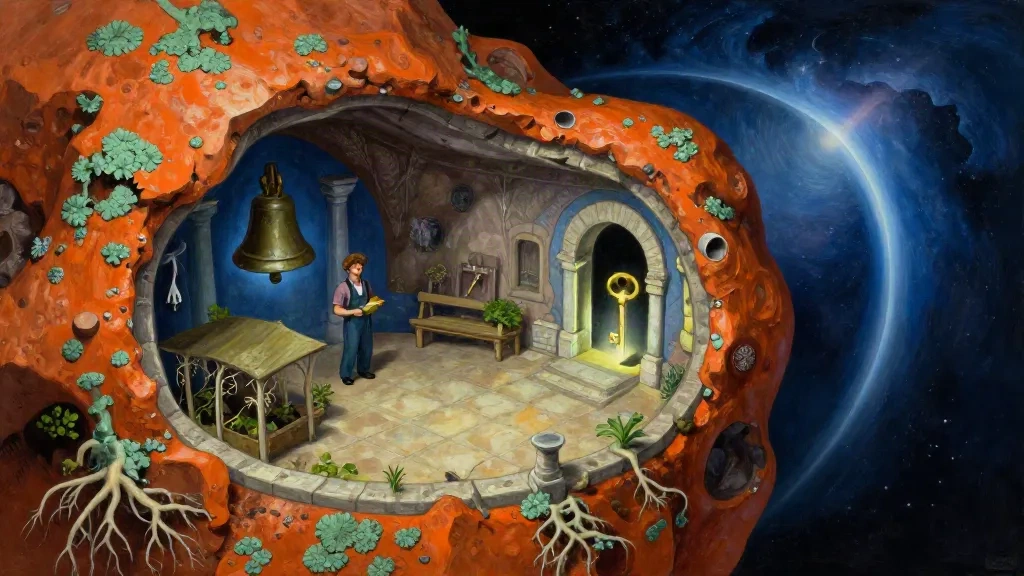
The monastery had been carved into the comet's tail, its walls layered with blue stone and orange mineral. At night, the surrounding sky moved in a blue storm-light, and the chapel bells answered one another across the void. Mara was assigned the smallest courtyard, where thistles had lifted the paving stones and rainwater collected in silver bowls.
She planted her first story in a cracked clay pot: her grandmother had hidden bread beneath a railway bench during the winter of the red moon. The words rose as pale roots, crossed the pot's rim, and became a narrow shelter for beetles.
By autumn, Mara had planted forty stories. A dead locksmith remembered in the shape of a gate. A drowned village surfaced as a row of blue doors. Her own family story waited in her pocket, folded into a square of paper.
The Machine in the Wall
The shelter began when the old bell cracked.
Its sound was not loud. It gave one exhausted note, like a spoon dropped into an empty well. The monks sealed it beneath the eastern wall, though no one could explain why. In the same chamber they found a brass key fixed into the stone, its teeth pointing toward the courtyard.
Beside the key stood a machine of copper rods, leather bellows, and glass eyes. Its brass plate bore a sentence: A SHELTER IS ACCEPTED ONLY BY THOSE WHO DO NOT EXPECT IT.
Mara's family story had been passed down in fragments. Her mother escaped a burning town carrying a child believed to be her brother. Her father built a house around the child, then repaired it every year, although it had never burned. The final fragment said only: when the house is finished, no one is left inside.
Mara wanted to plant that story in the neglected courtyard. She wanted its doors to open for strangers, not relatives. She wanted a place where the lost could sleep without proving they belonged.
She set the cracked bell beneath the machine and turned the brass key.
The Cost of Doubt
The machine did nothing.
Mara fed it her family's story. It measured the paper, burned a neat line through it, and returned ash. The monks watched from the arcade. One whispered that faith was a poor fuel. Another said the machine was a punishment for sentiment.
That night Mara returned with the paper restored. She had copied every word from memory, except the last. The machine accepted the new copy and still refused to move.
She tried believing deliberately. She stood before the machine with her eyes open, declaring that it would build the shelter. Nothing happened. She told the monks they must believe. The monks looked away.
When Mara stopped watching, the machine clicked.
The copper rods unfolded. The bellows breathed. Through the courtyard's cracked paving, roots lifted a low chamber into view. Its walls were made of compact memories: the smell of bread, a red moon, a gate repaired in rain, a child's hand without a name.
But every time Mara looked directly at it, the chamber sank.
She began tending it without supervision. She swept the courtyard, repaired the hinges, and told strangers what the shelter was for. The more she explained, the more carefully they avoided it.
At last she stopped explaining. She left the brass key on the threshold and told no one what it opened.
What the Strangers Found
Before dawn, the machine had built the roof. By sunrise, the cracked bell sounded a second time, clear and low.
Strangers arrived from the comet's other settlements: a courier missing both shadows, a child carrying a sealed jar of winter, an old woman who claimed the monastery had been her garden. They entered without knocking because no one had told them the shelter was there.
Inside, the family story became larger than its telling. It held the town's burning without flames, the father's repairs, the empty house, and Mara's own certainty that shelter required permission.
She planted the final fragment in the courtyard. It was not the sentence she had inherited. It was the sentence she had chosen: a door remains open until it has been used.
That night, the comet turned blue. The machine stopped. In the wall, the cracked bell split cleanly in two, and the brass key fell warm into Mara's hand.
She did not carry it back to the monastery. She carried it into the dark between stars, where no one believed in doors, and opened the door anyway.





