 Netwrck
Mystery.
The Unused Garden
Mara Venn arrived at the monastery with a spade, a city seal, and a seed catalogue she had never been permitted to use. The comet’s tail cut through the night beyond the narrow windows, a river of blue fire that made the monastery’s ink-black stone look wet. Rain silvered the terraces, and far below, one warm amber window shone in the abandoned wing.
She was the municipal gardener of Bellweather, a title that meant keeping weeds out of courtyards no one visited. The monastery had been entrusted to her for one season: repair the drains, prune the windbreak yews, make the cloister presentable for an inspection that never came.
Her real work waited in a neglected courtyard behind the chapel. Her mother had left her a brass key, narrow as a finger, wrapped in a scrap of black cloth.
“The story is here,” her mother had said, pressing the key into Mara’s palm. “Turn it toward someone who has nowhere to go.”
That was all. No explanation, no map, no forgiveness.
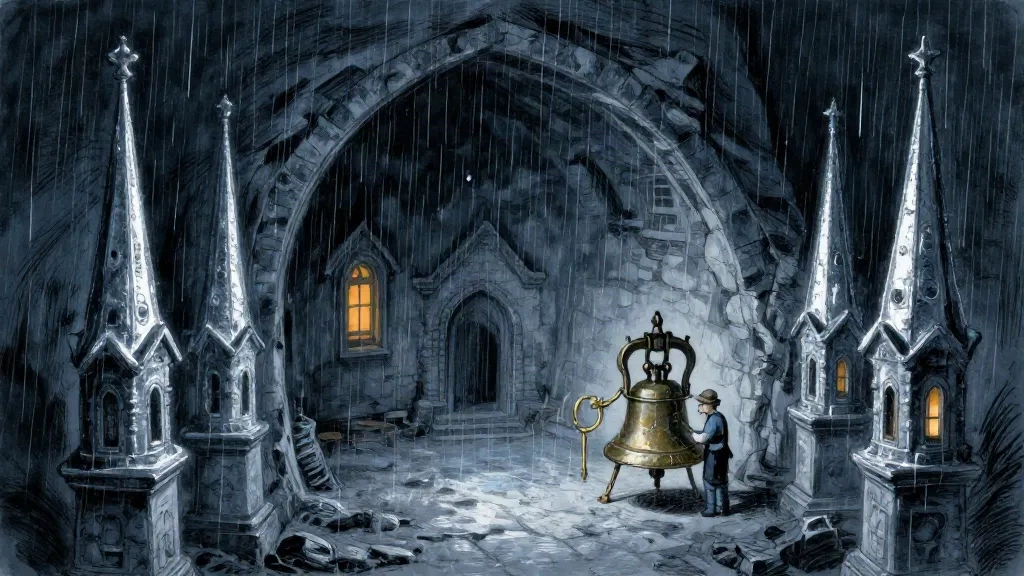
Mara opened the courtyard wall and found nothing but cracked paving, dead lavender, and a bell suspended beneath an arch without a roof. Its bronze was split from lip to shoulder. A single silver crack ran through the note it should have made.
At the center of the courtyard stood a machine shaped like a lantern without glass. Seven iron arms surrounded an empty cradle. A brass plate bore the words: THE HOUSE THAT LISTENS.
She turned the key. The lock resisted, then gave with a sound like a swallowed bell.
Nothing happened.
The Machine’s Condition
At dawn, Sister Anja found Mara kneeling beside the machine. The monk had served the monastery for forty years and kept its records in a hand like a bundle of wires.
“It is an old civic instrument,” Anja said. “It creates a shelter from a story told sincerely.”
Mara looked through the cracked arch. Beyond the comet’s vast darkness, the amber window remained visible.
“Then why is it empty?”
“Because belief is a kind of pressure.” Anja touched the machine with one careful finger. “Feed it a true memory, and it needs no faith. Offer it a hope, and it will collapse. Feed it a lie, and it will make a prison.”
Mara remembered her mother’s last winter: the smell of burnt onions, the blue bowl, the argument they had never finished. The story had been passed through their family as a warning. When the bell cracks, leave before the house learns your name.
She spoke it aloud. The machine’s arms lifted.
Threads of rain silver appeared between them, weaving a roof over the dead lavender. Mara felt warmth gather beneath the broken bell. A bed took shape against the wall, followed by a table, a basin, a hook for a stranger’s coat.
Then the courtyard door opened.
A boy stood there with a travel pack and a ticket in his hand. “Are you taking applications?” he asked.
Mara’s confidence flickered.
The machine shuddered. The roof dissolved.
Doubt Has a Weight
She tried again. Every time the boy appeared, Mara pictured the shelter failing under his weight, the city inspectors discovering an unlicensed refuge, her mother’s story becoming another warning passed to frightened children.
The machine produced only a heap of black leaves.
For three days Mara ignored the courtyard. She cleared drains, sharpened tools, and slept in the chapel cellar. Each night the amber window across the comet flickered once.
On the fourth morning she found the brass key in her apron pocket. She had not put it there.
Beside it lay a note in her mother’s handwriting: Do not build it for the person who arrives. Build it for the person who does not.
Mara returned to the machine and placed the cracked bell beneath its seven arms. She spoke not of the shelter, but of the winter her family had survived. She described the boy’s hunger without naming him. She gave the machine no image of rescue, only the truth that a stranger had once been fed at their table.
Then she refused to believe the machine would work.
She left the courtyard gate open and walked down the comet monastery’s stairs.
Behind her, the bell gave a single green-gold note. The amber window across the void went dark.
The Door Left Open
At the bottom of the stairs, the boy waited with the ticket crushed in his fist.
“I thought you had changed your mind,” he said.
“No,” Mara said. “I was afraid that belief would make it false.”
She gave him the brass key.
“The courtyard is yours,” she told him. “Not because I know it will hold. Because the door is open.”
He climbed toward the chapel, carrying only the key and the last of his daylight. Mara listened without following.
Above them, the machine began to work in silence. The cracked bell repaired itself one silver inch at a time, not ringing out, but holding the note.
By morning, three more strangers had found the path: a woman with a sealed letter, an old man carrying a seed tin, a child who would not say where she slept. None saw a miracle. They saw only an open gate, a dry courtyard, and a machine making room without asking them to believe.
Mara planted the first yew in the shelter’s edge.
The comet turned beneath them, carrying the monastery onward through the dark. And in the courtyard, the warm amber window burned steadily—not as a promise, but as a light left on for whoever arrived next.





