 Netwrck
Weird Fiction.
The Seller With Empty Hands
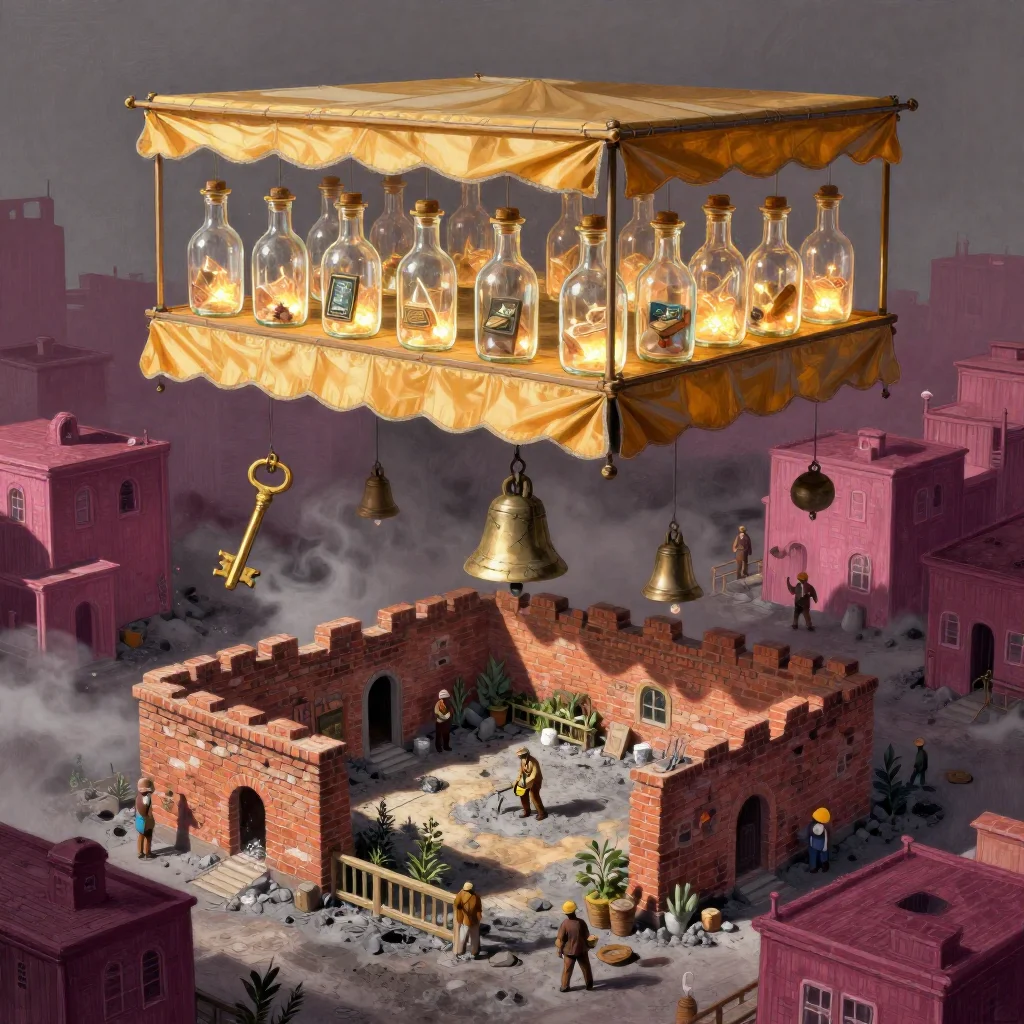
The floating market hung above the chimneys in smoke-grey air, its stalls lashed together from doors, boats, and library ladders. At midday the saffron awnings burned like small fallen suns. Below them, people sold memories in glass stoppers: a blue first, a silver quarrel, the green weight of a mother’s grief.
Mara Venn descended with an empty purse and a municipal gardener’s brass badge. The badge granted her access to vacant courtyards, where she planted neglected stories so they might root in weeds and clay. A story about a boy who befriended crows could brighten a prison yard. A story about sisters who kept one orange between them could prevent a feud for a generation.
Her own story weighed nothing.
It was the last thing her grandmother had retained: the account of a house on Venn Street that had sheltered every lost person in the district. No landlord had collected rent. No family had owned the roof. At dawn the house had folded itself into a courtyard and vanished.
Now the city’s official gazette described that night as a structural error, corrected without loss. Mara had inherited the certainty her grandmother had kept, which was the shape of a front door with no wall around it.
At the final stall, an unlabelled bottle wobbled in the display. A brass key rested against its cork.
The seller was a narrow man in plum sleeves. “Belonged to a house,” he said. “It will not open one.”
When Mara touched the key, the market went silent. Inside the bottle, a courtyard flickered: cracked flagstones, empty gutters, a bell hanging without a tower.
“How much?” she asked.
“Nothing. Nobody believes anything you sell.”
He gave her the key. Across the market, merchants began stacking memories before sunset. A woman’s laughter bloomed and collapsed. Names slid from labels. The whole floating bazaar turned toward the thinning sun.
A Garden Measured in Doubt
Mara found an abandoned courtyard behind the public baths. The soil was compacted with ash. She loosened it with an iron fork and planted her grandmother’s story at the center.
Nothing rose.
Across from the courtyard stood the district workhouse, crowded with people who had lost homes, employment, or the right to remain in the city. Mara looked at the locked gates. Her story had promised shelter, and expectation had killed it.
She told the superintendent, “A house cannot be planted here.”
He said, “Buildings require plans, permits, materials, drainage, and at least three months of construction.”
She handed him the brass key. “It will lock itself at dawn.”
“Keys do not decide when they lock.”
“This one does.”
Every person she approached closed the possibility with greater precision. The plasterers laughed. The plumbers called it condemned. One hungry boy tried the key on a drain cover and said the house was too small to be worth believing.
The market’s seller had spoken true: the machine of the story worked only when nobody believed in it. Its paradox was also its engine. Doubt loosened the ground.
So Mara told lies tailored to each trade.
She concealed the plans. She misstated the depth. She assured masons that no load-bearing walls would ever exist. By nightfall they arrived with salvaged stone, offended by the conditions but unable to refuse a challenge.
They built a roof without walls. Plumbers laid pipes toward nothing. Carpenters joined floorboards into a sheltered hollow beneath a sagging saffron canopy.
The Bell Beneath the Floor
Near midnight, the courtyard cracked.
A deep fissure opened where Mara had planted the story. Smoke-grey air leaked upward, carrying the scent of rain on warm paving. One by one, people removed from the city’s registers climbed out of the fissure carrying beds, chessboards, cages, and bundled possessions.
They were the lost inhabitants of the old Venn Street house.
The roof had never vanished. It had folded through time whenever someone declared it gone.
From the deepest opening came a cracked bell. The market seller had planted it there, Mara realized. He had separated the one piece of the house that could not remember itself. The bell rang only in the company of disbelievers, and now every mason, official, and stranger gathered there to witness the impossible.
The sound passed through the courtyard walls without shattering them. Masonry lifted. Timber flowed like dark water. Roof tiles climbed the air and locked into place overhead.
The house unfolded around its own absence.
Doors appeared. Brick walls rose from the ash. Stairs bent upward into rooms that smelled of frying onions, wet wool, and peppermint. Inside, each newcomer received a key that opened one wall at a time.
Only the final wall remained blank.
Mara climbed the roof and hung the cracked bell above the street. Its note did not proclaim completion. It made the blank wall shake.
From inside came her grandmother’s voice.
“A shelter is not somewhere you are kept,” it said. “It is somewhere you may leave.”
Mara understood the missing piece. Shelter had required no faith because it had been built to be doubted, questioned, changed, and shared. Sacred places demanded belief. Her family’s refuge survived only through use.
She rang the bell.
The blank wall became an open passage. Strangers entered carrying chairs. Children ran through with bread. Someone began sweeping. Someone else began arguing about whose turn it was to cook.
By dawn, the city’s surveyors found a courtyard with no name, occupied by hundreds of people, and no evidence that it should ever have been built.
Keys Returned
The market seller arrived at noon beneath a deep plum umbrella.
Mara held out the brass key. “What did it cost?”
“You still believe it can shelter strangers?” he asked.
“No,” Mara said. “I believe they can build it into something safer than I imagined.”
He refused the key. It had opened the house’s last wall, and he wanted no part of a place where so many disbelievers ate breakfast.
Mara hung it above the courtyard bell. Below, the former inmates of Venn Street carried tables into the afternoon. They argued over maps. They planted onions in the narrow beds. Children marked the doorframes with their heights, knowing they would outgrow them.
Smoke-grey air passed through the open windows. Far overhead, the memory market dissolved into saffron light, every unlabeled bottle returning to a forgotten life.
At evening, a woman carrying a glass stopper asked whether the courtyard always rejected miracles.
Mara pointed to the blank wall.
“It has room for one more tomorrow,” she said.





